

How to Tell When Your High-Impact Sports Bra Is Worn Out
Last Updated: October 31, 2026
Quick Summary
A sports bra worn out usually shows up as a band that feels loose at rest, straps that keep slipping, or more bounce during running and HIIT, even when the fabric still looks intact. Check the band and straps during normal wear and run a support test before deciding to replace it.
- A band that feels loose when you are standing still is the clearest warning sign.
- Straps that keep sliding off or need constant re-tightening mean the elastic has lost recovery.
- More bounce during running, jumping or HIIT means the bra is no longer controlling movement.
- Run the five-step at-home support test every three months and whenever training intensity changes.
- Two or more fails in the support test means the bra should be replaced.
Table of Contents
- Why a Worn-Out High-Impact Sports Bra Matters More Than You Think
- Stretched Band and Elastic: The Clearest Warning Sign
- Loose, Slipping or Stretched Shoulder Straps
- Cups That Have Lost Their Shape and Pads That Crinkle
- Fabric Thinning, Fraying, Holes and Exposed Elastic
- Reduced Support and More Bounce During Your Workouts
- A Repeatable At-Home Support Test for High-Impact Training
- When to Replace a Sports Bra, and How Long One Lasts
- Telling Wear Apart From a Fit Problem
- How Should a Sports Bra Fit, and Your Next Step With GrantB
- Frequently Asked Questions
Why a Worn-Out High-Impact Sports Bra Matters More Than You Think
GrantB Sportswear sees one question come up again and again: how do you know when a high-impact bra has stopped doing its job? A sports bra that has lost its support does more than feel uncomfortable. It changes how your body moves through a run, a HIIT session or a heavy lift. Spotting the signs early protects both your comfort and your training.
Research from the University of Portsmouth article on sports-bra fit and performance suggests that breast movement is directly linked to how well a bra holds you. The study notes that a higher neckline is associated with reduced breast bounce, with about 1% less bounce for each 1 cm increase in neckline height. Fit and support clearly matter, which is why wear is worth checking for.
Wear sneaks up on you. A sports bra worn out often still looks fine on the hanger, but the elastic has given up. This guide walks through the clearest warning signs, a simple at-home test and how to tell wear apart from a fit problem.
Stretched Band and Elastic: The Clearest Warning Sign
The most reliable sign that a sports bra is worn out is the band. A band that feels loose when you are standing still is a red flag. TLF Apparel's guide on replacing a sports bra describes a loose band at rest, and straps that need constant re-tightening, as clear signs a bra is worn out.
Check the band during a normal day, not only when you are trying the bra on. If it rides up your back or slides under your ribs mid-movement, the elastic is no longer holding its shape. Once the band stretches, the rest of the bra has to work harder to do the same job.
The article points to several warning signs; the table below sums up the clearest ones and what each one means.
| Warning sign | What it means | Action |
|---|---|---|
| Band feels loose at rest | Elastic has lost recovery | Replace the bra |
| Straps keep slipping or need re-tightening | Strap elastic is spent | Replace the bra |
| Cups misshapen, pads crinkle | Support structure is breaking down | Replace the bra |
| Thinning fabric, holes, exposed elastic | Fabric is compromised | Replace the bra |
| More bounce during running or HIIT | Movement is no longer controlled | Re-test or replace |
Loose, Slipping or Stretched Shoulder Straps
Straps tell you a lot about wear. If they keep sliding off your shoulders or stop adjusting properly, the elastic in them has likely lost its recovery. Fleet Feet's guide on when to replace a sports bra lists straps that slide, fall off the shoulders or no longer adjust properly as signs that a bra may be worn out.
Try this quick check: tighten the straps to a comfortable setting, then do ten squats. If the straps have loosened and you need to re-adjust them repeatedly, the support structure is breaking down.
Cups That Have Lost Their Shape and Pads That Crinkle
Cups do much of the work in a high-impact bra. When they lose their shape, they stop holding the breast in a stable position. Look for cups that appear misshapen, sag or no longer sit smoothly against the body. To understand why gym clothes lose shape over time, the reasons are mostly down to repeated stretching and washing.
Removable pads can also show wear. A pad that crinkles, bunches or feels lumpy after washing is no longer lying flat, which affects how evenly the cup supports you.
Fabric Thinning, Fraying, Holes and Exposed Elastic
Visible damage is the easiest sign to spot. Thin patches, fraying edges, small holes and exposed elastic all mean the fabric has been compromised. Once elastic is showing, the bra will not recover its shape, and it is time to replace it.
Pilling and dull, greyed fabric can also signal breakdown, even before holes appear. Fabric that has lost its smooth finish usually means the fibres are no longer doing their job.
Reduced Support and More Bounce During Your Workouts
The most important sign for high-impact training is a change in how much you move. If you notice more bounce during running, jumping or HIIT than you used to, the bra is probably no longer controlling movement as it should.
This is the sign people often miss, because the bra still looks and feels acceptable. Pay attention to whether your sessions feel different. Discomfort, bounce or a sense of the bra shifting are all worth taking seriously. For more on matching support to your training, see how to choose sports bra support.
A Repeatable At-Home Support Test for High-Impact Training
Most guides tell you to 'jump around and see how it feels'. That is not a test, it is a guess. High-impact sport demands a repeatable check with clear pass/fail criteria, because the whole point of a high-impact bra is controlling bounce under load, not looking intact on a hanger.
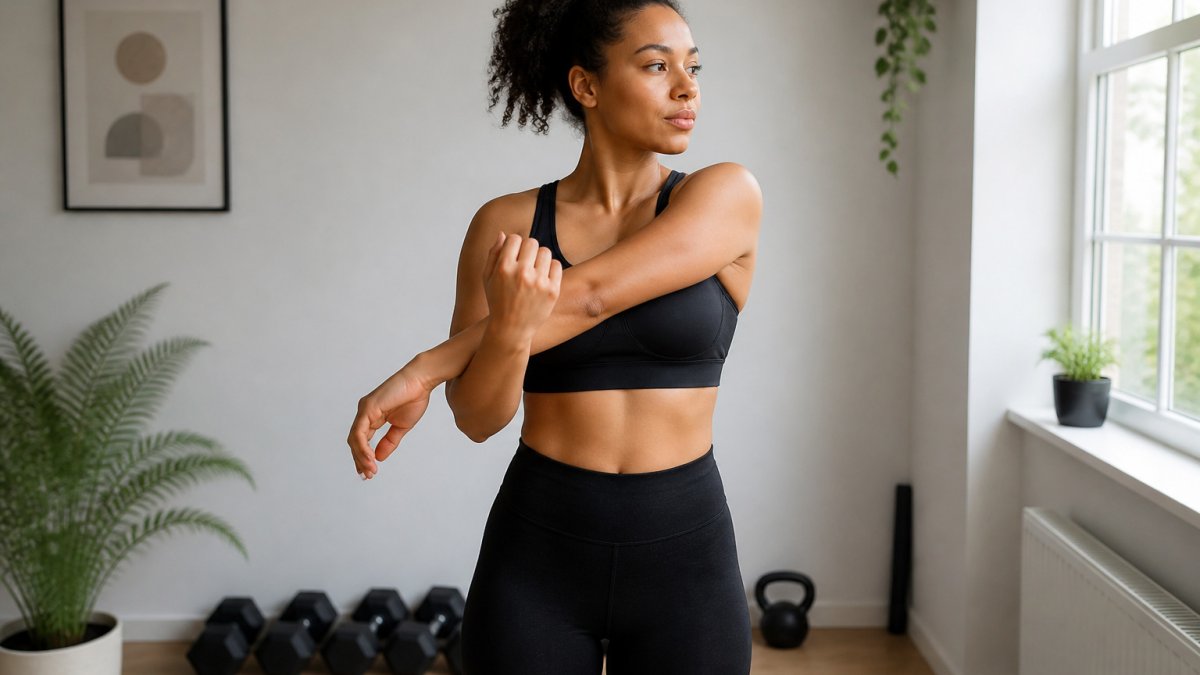
Run this five-minute protocol every three months, and again whenever your training volume or intensity changes. Do it in front of a mirror, wearing the bra as you would for a session.
Step 1, Set the baseline. Put the bra on and adjust the band and straps to your normal training fit. Note where the band sits on your ribcage and where the straps rest on your shoulders. This is your reference point.
Step 2, Band stability check. Stand tall, then raise both arms overhead and lower them ten times. Then do ten bodyweight squats. The band should stay level and flat against your ribcage. If it rides up towards your shoulder blades or slides down under your ribs, the elastic has lost recovery, a fail.
Step 3, Strap retention check. With the straps at your normal setting, do ten shoulder rolls and ten arm circles. If either strap slips off the shoulder or needs re-tightening mid-set, the strap elastic is spent, a fail.
Step 4, Bounce control check. Perform 30 seconds of jumping jacks, then 10 squat jumps, then 30 seconds of running on the spot. Watch the mirror and focus on the cups, not your face. The cups should stay in place and the breast should move with the bra, not independently inside it. Visible independent movement, cup gapping, or a sensation of the bra 'lagging' behind your body is a fail.
Step 5, Recovery check. Stop and stand still for 30 seconds. A healthy bra returns to its original shape and position. A worn bra stays stretched, bunched or twisted, a fail.
Why this matters more for high-impact training: running and jumping generate far greater breast displacement than walking or cycling, so a bra that passes a gentle check can still fail under impact. The bounce-control step is the one most people skip, and it is the one that actually predicts whether the bra will protect you during a run or a HIIT class. If you are unsure whether the issue is wear or fit, repeat the test with a bra you know is new and compare the results side by side.
When to Replace a Sports Bra, and How Long One Lasts
There is no single expiry date, and any guide that gives you one is guessing. What you can do is estimate when a sports bra worn out is due for replacement from how the bra is used, then confirm with the checks above. The variables that matter most are training frequency, activity intensity, rotation and washing.
Build a use-based estimate. Think in terms of high-impact sessions per week and how many bras you rotate. Rotating between two or three bras can help each one spend more time recovering between wears. Treat any timing as a rough guide, not a rule, your own checks decide.
Intensity matters as much as frequency. A bra used for steady running wears differently from one used for plyometrics, boxing or heavy lifting, where the band and straps are loaded repeatedly. If your training has become more intense, expect the bra to age faster and re-test more often.
Washing is the silent accelerator. Heat and agitation break down elastane. Washing on a cool, gentle cycle, using a mesh laundry bag, and air drying flat or line drying will slow elastic fatigue. Hot washes, fabric softener and tumble drying all speed it up. A bra that is washed after every session will age faster than one worn for two lighter sessions between washes, so match your care routine to your wear rate.
Use a rotation log. A simple note on your phone, purchase date, sessions per week, wash frequency, turns 'it depends' into a real estimate. When the log suggests you are approaching the range above, run the at-home support test rather than replacing on a calendar date.
Signs it is time, regardless of age: the band rides up during movement, straps need constant re-tightening, cups gap or the pads bunch, bounce has increased during running or jumping, or the fabric has thinned or exposed elastic. Any one of these is enough. For guidance on matching a replacement to your training, see how to choose sports bra support.
Telling Wear Apart From a Fit Problem
Not every uncomfortable bra is worn out. A bra that never fitted well will feel wrong from the first wear. Wear is different: a bra that once fitted well starts to feel looser, rides up or loses support over time.
A useful test is to compare with a bra you know still fits. If the old bra felt the same as new when you first bought it, the problem is likely fit. If it has changed gradually, wear is more likely the cause.
How Should a Sports Bra Fit, and Your Next Step With GrantB
A high-impact bra should feel snug around the band without digging in, sit flat against the body and keep the cups in place through movement. The straps should support without pulling.
If your current high-impact bra has failed the checks above, the GrantB Core Sports Bra is designed for high-impact support, with engineered underwire, adjustable straps and removable pads. You can buy a high support sports bra directly from GrantB. It is priced at £29.99. You can also read more about choosing supportive workout gear before you buy, or explore the GrantB Core Sports Bra to see how it fits your training.

Frequently Asked Questions
How do you know when a sports bra is worn out?
The clearest signs are a band that rides up or feels loose when you are at rest, straps that slip or need constant re-tightening, and cups that have lost their shape. Visible fabric wear often comes later than these functional signs, so do not wait for holes or fraying before you judge. If the bra no longer holds you steady during a jump or a set of burpees, treat that as the strongest sign it has reached the end of its useful life.
How often should you replace a sports bra?
There is no fixed date that applies to everyone, because lifespan depends on how often you train, how hard your sessions are, and how you wash the bra. A high-impact bra worn several times a week will lose support sooner than one used for light workouts. Rather than counting months, replace it when the band, straps or cups stop performing, and check it against the signs in this guide every few months.
Why does my sports bra feel less supportive than it used to?
Repeated stretching and washing gradually weaken the elastic and the structure that holds the cups in place, so support drops even when the fabric looks fine. Heat from the dryer and frequent high-intensity sessions speed this up. If you notice more bounce during running or jumping and the bra feels looser than when it was new, the support fibres have probably fatigued and the bra needs replacing.
Does washing affect a sports bra's support?
Yes. Hot water, tumble drying and harsh detergents break down elastane over time, which reduces stretch and recovery. Washing on a cool, gentle cycle, rinsing out sweat promptly and air drying flat will help a GrantB Core Sports Bra keep its shape for longer. Care cannot reverse damage that is already done, but it slows the process down.
