

Why Do Gym Clothes Lose Shape? Causes & Fixes
Table of Contents
- The Real Reasons Gym Clothes Lose Shape
- How to Wash Gym Clothes to Keep Shape
- How to Prevent Leggings From Stretching Out
- Are Recycled Polyester Leggings Durable?
- The Rotation Schedule That Doubles Activewear Lifespan
- Compression Garment Care: What Changes
- Spotting Fabric Failure Before It Ruins Your Fit
- Conclusion: Choosing Gymwear Built to Hold Its Shape
- Frequently Asked Questions
Last Updated: September 27, 2026
The Real Reasons Gym Clothes Lose Shape
Gym clothes lose shape because the elastane fibres woven into the fabric gradually break down, and once those fibres stop snapping back, the garment sags permanently. At GrantB Sportswear, we see this constantly: customers tell us their expensive leggings felt sculpting for three months, then went slack. The causes stack up, from heat damage during washing to the simple physics of repeated stretching.
Understanding why do gym clothes lose shape comes down to two things: what the fabric is made of, and what you put it through. Most people blame the garment. Usually, the care routine is the bigger culprit.
How Elastane Gives Fabric Its Memory
Elastane, also called spandex, is the fibre that gives activewear its stretch and recovery. It works like a tiny coiled spring: stretch it, and it pulls back to its original length.
Fabric memory is the term for that ability to return to shape. A quality legging with a high elastane content, such as the 22% elastane blend in GrantB Sportswear's Sculpt Leggings, holds its shape far longer than a budget pair with 5% elastane stretched across a thin knit.

Here's the distinction most guides skip: stretch and recovery are not the same thing. A fabric can stretch beautifully and recover poorly. Recovery is what keeps your leggings from bagging at the knees after a long session.
Heat, Sweat and the Slow Breakdown of Fibres
Heat is the single most destructive force for synthetic blends. Elastane is sensitive to thermal degradation, and warm water, hot tumble drying, and even a hot car boot all accelerate polymer breakdown.
Sweat matters too. Body oils and salts sit in the fabric, and over time they weaken the elastane bonds that hold the shape. A common mistake is leaving damp gym kit in a bag for hours after training. That trapped moisture and warmth is a slow attack on fibre recovery.
Textile Institute guidance on fibre care and laundering notes that synthetic fibres respond poorly to sustained heat exposure, which is why care labels on activewear almost always specify a cold wash.
How to Wash Gym Clothes to Keep Shape
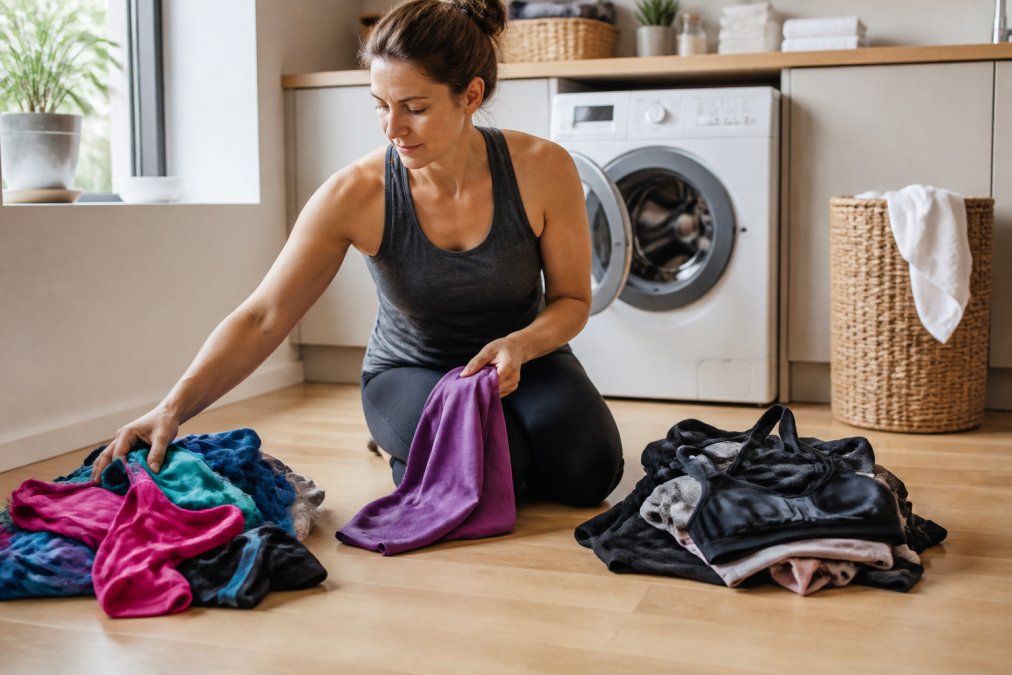
To keep gym clothes in shape, wash them cold, inside out, on a gentle cycle with a small amount of detergent, then air dry them flat or on a line. That routine protects elasticity far better than any fabric softener or "restoring" product on the market.
Most people wash activewear exactly like their jeans. That's the fastest route to baggy leggings.
Machine Settings That Protect Elasticity
Set the machine to a cold wash cycle at 30°C or below, use a low spin speed, and skip the fabric softener entirely. High spin speeds stretch the fabric mechanically, and softener coats the fibres so they lose their moisture-wicking ability.
A mesh laundry bag is a small investment that pays off. It stops leggings tangling with zips and hooks, which cause the micro-tears that eventually become visible pilling.
Detergent Residue and Why Less Is More
Detergent residue is a hidden cause of sagging. Excess soap left in the fibres attracts oils and dirt, stiffens the fabric, and interferes with how elastane moves. Use roughly half the detergent you'd use for a normal load, and choose a liquid formula over powder.
If your kit smells musty even after washing, that's residue talking. Run a second rinse cycle with no detergent and see the difference.
How to Prevent Leggings From Stretching Out
Preventing leggings from stretching out means rotating them, air drying them, and never yanking them on by the waistband. Small habits, repeated consistently, add months to a garment's working life.
A few practical rules we've picked up working with activewear:
- Step into leggings rather than pulling them up by the waistband
- Air dry flat, away from direct radiators and sunlight
- Never store damp kit in a gym bag for more than a couple of hours
- Wash after every one or two wears, not every five
Compression fit garments need extra care here. The tighter the fabric sits, the more tensile stress it's under, and the faster it fatigues if you're rough with it.
Are Recycled Polyester Leggings Durable?
Yes, recycled polyester leggings are durable, and in many cases they match the performance of virgin polyester. The recycled content refers to where the polyester came from, not a downgrade in quality. What matters far more for shape retention is the elastane percentage and the knit construction.
That said, recycled polyester does shed microplastics during washing, and those fibres are part of the same fatigue story. Every shed fibre is a fibre no longer holding your leggings in shape. WRAP's guidance on textile durability and circular fashion highlights that extending a garment's active life is one of the most effective ways to reduce its environmental impact.
The Rotation Schedule That Doubles Activewear Lifespan
A rotation schedule means owning three to four sets of gymwear and cycling through them, so no single garment takes the full load of your training week. It's the single most effective habit for extending lifespan, and almost nobody does it.
The reason it works is fibre rest. Elastane recovers by returning its coiled polymer chains to a relaxed state, and that return is not instant. After a hard session, the fibres are still under residual strain. Give the garment 24 to 48 hours off the body and out of the wash drum, and the chains settle back toward their original configuration. Wear the same pair two days running, or wash and re-wear it within hours, and the chains never fully relax. Over months, that partial recovery compounds into permanent deformation, the baggy knee, the sagging seat, the waistband that no longer grips.
A useful way to think about it: every garment has a finite number of full stretch-and-recover cycles before recovery degrades. Rotation doesn't reduce the number of cycles, it spaces them out so each one completes properly.
Working Out Your Rotation Size
Start with your weekly training frequency, then add a buffer for laundry turnaround. If you train five times a week and do one wash load of activewear, you need enough sets to cover the gap between washes without re-wearing damp or unwashed kit.
| Rotation Size | Wears per Garment Weekly | Typical Wash Frequency | Expected Lifespan |
|---|---|---|---|
| 2 sets | 2-3 wears | Every 2-3 days | 3-6 months |
| 3 sets | 1-2 wears | Weekly | 6-12 months |
| 4+ sets | 1 wear | Weekly or less | 12-18 months |
Those lifespan figures assume cold washing, air drying, and no tumble drying. Skip any of those and the top row becomes the realistic outcome regardless of how many sets you own.
Building the Rotation Around Real Life
A rotation only works if it survives contact with your actual week. A few patterns that hold up:
- Tag by function, not by colour. Keep one set for high-sweat sessions (HIIT, spin, running) and one for low-sweat sessions (yoga, mobility, weights). The high-sweat set gets washed more often, so it needs a longer rest window before its next wear.
- Hang, don't fold, between wears. Airing a garment on a hanger for a few hours after a light session lets moisture leave the fibres and gives the elastane a head start on recovery. Folding it straight into a drawer traps residual dampness.
- Never re-wear compression pieces. Compression garments sit under higher tensile stress than loose-fit kit, so they need the full rest window every time. Treat a compression set as a one-wear, one-wash item.
- Rotate the wash, not just the wear. If all four sets go into the machine on the same day, they all come out of the drum at the same point in their fatigue curve. Staggering washes spreads the mechanical stress of the cycle across the week.
What Rotation Won't Fix
Rotation slows the decline; it doesn't reverse it. If a garment has already developed shiny patches, a rolled waistband, or visible thinning, no amount of rest will bring the elastane back. Those are signs that the polymer chains have broken, not just relaxed. Rotation is a prevention habit, and it works best started on a new garment rather than a tired one.
Compression Garment Care: What Changes
Compression garments need cooler washing, lower spin speeds, and shorter wear cycles than standard activewear. The tighter the fit, the higher the tensile stress, and the faster the fibres fatigue.
A common mistake with compression kit is treating it like everyday leggings. It isn't. Compression fabric is engineered to hold a specific tension, and once that tension goes, the garment stops doing its job. Wash it after every wear, never wring it out, and lay it flat to dry.
If you're coming from standard activewear, expect compression pieces to feel stiffer for the first few wears. That's normal, and it's a sign the fabric still has its memory intact.
Spotting Fabric Failure Before It Ruins Your Fit
Fabric failure shows up visually before it shows up in fit. Learning to read the early signs saves you from discovering the problem mid-squat, and, more usefully, tells you whether a garment is worth saving or already past the point of no return.
The key distinction most guides skip is between surface damage and structural damage. Surface damage sits on the face of the fabric and can often be managed. Structural damage runs through the knit itself, and once it starts, the garment's days are numbered.
Pilling vs Fibre Snap: How to Tell Them Apart
Pilling is the small, fuzzy bobbles that form where fabric rubs against fabric, typically the inner thigh, under the arms, or along a waistband edge. Pilling happens when short fibres work their way loose from the yarn and tangle into little balls. It's a cosmetic problem. The yarn structure underneath is usually intact, and the garment still stretches and recovers normally. You can remove pills with a fabric shaver or a fine comb, and the garment keeps working.
Fibre snap is different. It's the actual breakage of individual filaments within the yarn, and it shows up as:
- Shiny, flattened patches on the seat, knees, or elbows, where the elastane has lost its crimp and the surface has gone smooth and reflective
- A faint, chalky haze across high-stretch zones, where broken fibre ends have lifted out of the knit
- Thinning opacity, hold the fabric up to a window and look for areas where light passes through more easily than the surrounding fabric
- A slight roughness or grab when you run a fingernail across the surface, where broken ends catch
Fibre snap doesn't reverse. No wash routine, no fabric softener, and no "restoring" spray rebuilds a broken polymer chain. Once you can see it, the garment has entered its final phase.
Reading the Early Warning Signs
Before the visible damage appears, the fabric gives you behavioural clues:
- A waistband that rolls or slips during movement, meaning the elastane's recovery has dropped below the tension needed to hold position
- Bagging at the knees or seat that persists for more than a few minutes after you stop moving, a healthy garment springs back within seconds
- Colour fading in high-stretch zones only, while the rest of the garment holds its colour, indicating localised polymer breakdown rather than general dye loss
- A change in how the fabric feels when you pull it on, a garment that used to snap into place but now slides on easily has lost its recovery
Repair, Retire, or Repurpose
Use the diagnosis to decide what to do:
- Pilling only, no shine, no thinning: repair. De-pill the surface, continue wearing, and check the care routine, pilling usually points to abrasion from washing with zips or hooks, or from a bag strap rubbing the same spot.
- Shine or thinning in one zone, rest of garment fine: retire from training. The garment may still work for low-stretch use, lounging, gardening, layering, but don't trust it under load.
- Shine plus thinning plus a rolled waistband: replace. The structural failure is widespread, and the next squat or sprint is when it becomes visible to everyone else.
When to Check
A quick inspection every few washes catches the transition from surface to structural damage before it's obvious in the mirror. Hold the garment up to a window, run your hand across the high-stretch zones, and check the waistband for roll. Thirty seconds of inspection tells you more about a garment's remaining life than the price tag ever did.
Conclusion: Choosing Gymwear Built to Hold Its Shape
The frustrating part of sagging leggings is that it's preventable, and it starts before the first wash. Choose fabric with a meaningful elastane content, wash cold, dry flat, and rotate your kit so no single piece carries the whole week.
GrantB Sportswear builds gymwear around exactly this problem. Our Sculpt Leggings use a 78% nylon, 22% elastane blend with four-way stretch and a supportive high waistband designed to stay in place, while our Sculpt Set pairs that fabric with a supportive sports bra for coordinated training. Free delivery is included, and orders over £100 get £10 off.

Get started with GrantB Sportswear and train in gymwear designed to hold its shape from your first rep to your final set.
Frequently Asked Questions
How long should gym clothes actually last before they lose shape?
Most activewear holds its fit for 50 to 100 washes, depending on fabric quality and care. Garments with a higher elastane content and dense knit construction tend to last longer. Washing in cold water, air drying and rotating between several pieces all extend that window. Once you notice sagging at the knees or waistband, the elastane has degraded and the shape rarely comes back.
Does heat damage the elasticity in gym clothes?
Yes. Elastane begins to degrade at temperatures above 60°C, and tumble drying accelerates the process. The polymer chains that give fabric its stretch and recovery break down faster with repeated heat exposure. A cold wash cycle at 30°C or lower, followed by air drying, keeps elasticity intact far longer than hot washing and tumble drying.
Can you restore the shape of stretched-out gym clothes?
In most cases, no. Once elastane fibres have suffered permanent tensile stress, the fabric memory is gone and the garment will not snap back. A warm soak can offer a temporary improvement, but it does not reverse polymer breakdown. Prevention through proper washing, air drying and a rotation schedule is far more effective than trying to fix stretched fabric.
Are recycled polyester leggings durable enough for heavy training?
Recycled polyester can match the durability of virgin polyester when the fabric is well constructed and blended with elastane for stretch. The key factors are knit density, elastane percentage and how you care for the garment. Look for a tight, opaque knit with at least 20% elastane, and always air dry to protect the fibre structure during intense training.