

How to Repair Small Holes in Athletic Wear Without Ruining Stretch
Table of Contents
- Why Small Holes in Athletic Wear Get Worse If You Ignore Them
- Assessing the Hole Size, Fabric Type and Tension Before You Repair
- Tools and Materials You Need to Repair Athletic Wear at Home
- The Best Thread for Stretchy Athletic Fabric
- Step-by-Step: Hand-Sewing a Small Hole in Stretch Fabric
- How to Fix Holes in Leggings Without Sewing
- Are Recycled Polyester Leggings Durable Enough to Repair?
- Testing Your Repair: Wash, Stretch and Workout Durability Checks
- Preventing Future Holes and Caring for Repaired Activewear
- When to Repair and When to Retire Your Gymwear
- Frequently Asked Questions
Last Updated: November 4, 2026
Why Small Holes in Athletic Wear Get Worse If You Ignore Them
A small hole in stretch fabric rarely stays small. According to Cinderella Sew's repair tutorial, most simple garment holes can be closed in under five minutes, yet a hole left alone for a few washes can double in size. The reason is tension. Every squat, stride and overhead press pulls at the weak point until the fibres around it give way too.
Stretch fabric is under constant load, so damage can spread quickly.
Below, we'll show you how to repair small holes in athletic wear so the fix holds through real training.
Watch out: ignoring a hole in a high-tension area like the inner thigh can turn a five-minute repair into a replacement purchase.
Assessing the Hole Size, Fabric Type and Tension Before You Repair
Before you thread a needle, check three things: how big the hole is, what the fabric is made of, and how much tension runs through that spot. A pinhead snag needs a different fix than a one-centimetre tear near a seam.
Use this quick guide:
- Under 3mm: fabric glue or a tiny stitch
- 3-10mm: hand-sewing with stretch thread
- Over 10mm or frayed edges: patch or professional repair
- Near a seam: reinforce the seam, not just the hole
If you're unsure whether your leggings have true four-way stretch, our guide on how to tell if leggings have true four-way stretch explains what to look for before you pick a method.
Fabric-Specific Compatibility: Nylon/Spandex, Polyester and Compression Blends
Most guides treat all athletic wear as the same. It isn't. The fibre mix decides which repair will hold and which will fail after a few washes.
Nylon/spandex blends. Nylon gives strength and a smooth hand; spandex gives stretch. Wooly nylon thread is a suitable choice for these fabrics, and a ballpoint needle helps prevent skipped stitches.
Polyester/spandex blends. Polyester is more heat-sensitive than nylon. Heat-activated patches work, but keep the iron at the lowest setting that bonds the adhesive and always use a pressing cloth. Too much heat glazes the surface and stiffens the stretch zone. Wooly nylon thread remains the safest sewing choice.
High-compression blends. These fabrics are under higher baseline tension, so any repair must move with the garment. A ladder stitch with wooly nylon and a small backing patch can help.
Cotton or cotton-rich activewear. Little stretch, so standard polyester thread and a simple running stitch work fine. No special needle is needed.
Match the repair to the fabric blend, not just to the hole size. Our guide on technical fabric versus cotton activewear explains how these fabrics differ so you can pick the right repair approach.
High-Tension Areas: Inner Thighs, Seat and Knee
Some spots fail more than others. The inner thighs rub, the seat stretches, and the knees bend thousands of times per session. Repairs here need extra reinforcement.
If your gym clothes are losing shape in these zones, our article on why gym clothes lose shape explains the causes and fixes. A hole in a high-tension area is a warning sign, not just a cosmetic problem.
Tools and Materials You Need to Repair Athletic Wear at Home
You don't need a sewing machine. A small kit covers almost every repair:
- Wooly nylon thread (for stretch fabrics)
- Ballpoint or stretch needles
- Small sharp scissors
- Fabric glue for stretch fabrics
- Heat-activated adhesive patches
- Pins and a thimble
- A scrap of backing material
Buy wooly nylon thread in a shade close to your garment, or use transparent thread for a near-invisible finish.
The Best Thread for Stretchy Athletic Fabric
The best thread for stretchy athletic fabric is wooly nylon, a textured thread that stretches with the garment instead of snapping. According to Repair What You Wear's mending guidance, wooly nylon is the go-to choice for stretch fabrics because it survives heavy-duty workouts.
Standard polyester thread has almost no give. On spandex or a compression blend, it can cut into the fibres and widen the hole. Wooly nylon stretches, so the repair moves with you.
A few rules of thumb:
- Match thread colour where you can
- Use transparent thread for odd colours
- Pick a ballpoint needle for knits
- Size 75/11 works for most activewear
Step-by-Step: Hand-Sewing a Small Hole in Stretch Fabric
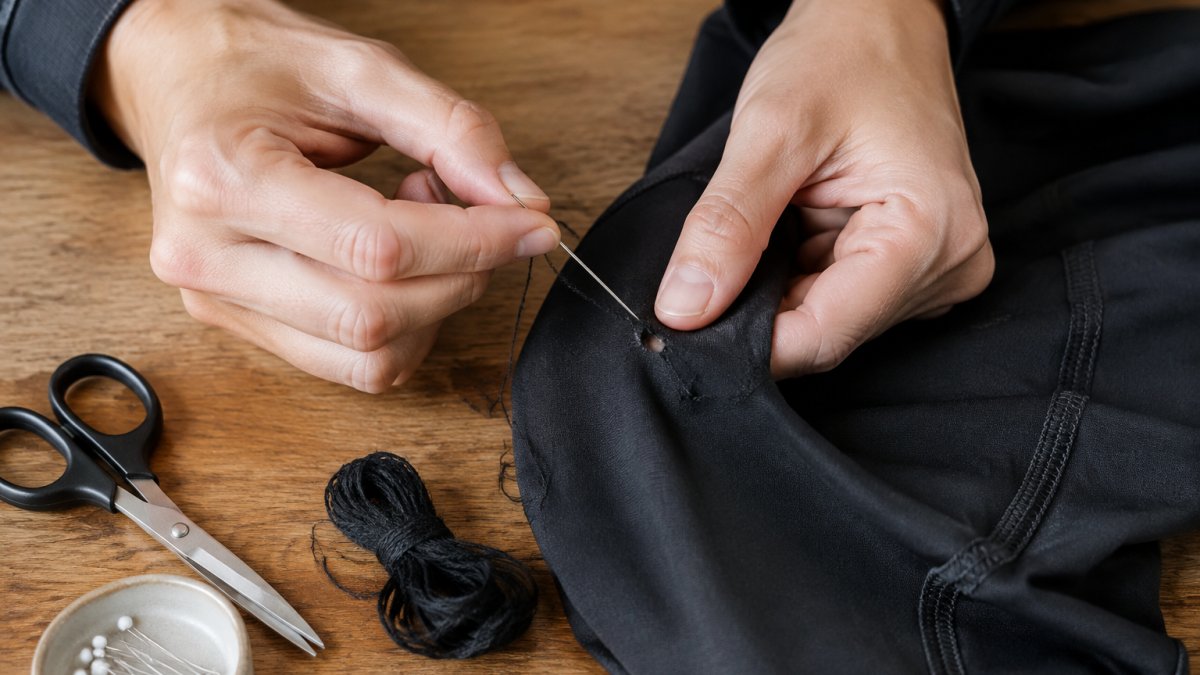
Here's how to repair small holes in athletic wear by hand in about five minutes. Work on a flat, well-lit surface and turn the garment inside out.
- Trim loose fibres. Snip any frayed threads so the edges sit flat.
- Add backing. Slide a small scrap of matching fabric behind the hole.
- Thread the needle. Use wooly nylon and knot the end.
- Anchor the stitch. Start just outside the hole and take small stitches.
- Close the hole. Work around the edge, pulling gently as you go.
- Finish and knot. Tie off inside the garment, not on the surface.
- Press lightly. A cool iron sets the repair without melting fibres.
The Invisible Stitch and Ladder Stitch for Neat Closures
The invisible stitch hides the repair inside the fabric. The ladder stitch works across an opening, pulling edges together without visible thread.
For a ladder stitch, work small horizontal stitches across the gap, then pull gently. The edges close like a ladder being folded. This method keeps elasticity and looks clean on dark leggings.
Reinforcing Seams Versus Repairing Fabric Tears
A split seam is not the same as a torn fabric panel. Seams come apart along the stitch line; fabric tears happen mid-panel.
- Split seam: re-stitch along the original line with a stretch stitch
- Fabric tear: add backing, then close with small stitches
- Frayed tear: use a patch for extra support
Fix seams first. A seam left open lets the fabric around it stretch and tear.
How to Fix Holes in Leggings Without Sewing
If you want to know how to fix holes in leggings without sewing, fabric glue and heat-activated patches are your two best options. Both work well on small holes in stretch fabric and take seconds to apply.
Fabric Glue and Heat-Activated Adhesive Patches
Fabric glue for stretch fabrics creates a flexible bond. Apply a thin layer, press the edges together, and let it cure fully before washing.
Heat-activated adhesive patches bond to the fabric when pressed with a warm iron. According to FabPatch's no-sew repair guide, rub-on stretch patches for activewear can be applied in about 60 seconds. Use fusing paper between the iron and the patch to protect the fabric.
Watch out: too much heat can melt synthetic fibres. Always test on an inside seam first.
Are Recycled Polyester Leggings Durable Enough to Repair?
Yes. Recycled polyester leggings can be repaired when the surrounding fabric is still sound.
Repairing them is no different from repairing any synthetic blend. Use wooly nylon thread, avoid high heat, and reinforce high-tension spots. The clothing and footwear repair market report values the global repair sector at USD 3.81 billion in 2026, which shows repair is now a mainstream habit rather than a niche one.
One caveat: check the care label before applying heat. Some recycled blends are more heat-sensitive than standard polyester.
Testing Your Repair: Wash, Stretch and Workout Durability Checks
A repair isn't finished until it survives repeated washing and real training load. Most guides stop at "give it a tug." That tells you almost nothing about whether the fix will hold after 50 wash cycles or a session of deep squats.
Test in four stages, in this order:
| Check | How to Test | Pass Sign | Fail Sign |
|---|---|---|---|
| Stretch | Pull gently in all directions | No puckering or snapping | Thread snaps or fabric puckers |
| Wash | Cold wash, inside out, mesh bag | Stitch holds, no fraying | Knot loosens or edges fray |
| Friction | Rub the repair 20 times with a dry cloth | No lifting or thinning | Patch edge lifts or thread wears |
| Workout | One full session in the garment | No reopening or rubbing | Repair reopens or irritates skin |
If the repair fails the stretch test, the thread is too stiff. Switch to wooly nylon. If it fails after washing, the knot came loose; re-stitch and tie off inside. If it fails the friction test, the patch adhesive is too weak for a high-tension zone and needs stitching reinforcement.
The 50-Wash Durability Check
A repair that survives one wash is not proven. Testing across repeated wash cycles gives a better indication of durability. You don't need to run all 50 at once. Wash the garment normally, inside out and cold, and inspect the repair every 10 cycles.
What to look for at each 10-cycle check:
- Cycles 1-10: knot security and edge fraying
- Cycles 11-30: thread wear and patch lifting
- Cycles 31-50: fabric thinning around the repair and loss of stretch
If the repair is still flat and the surrounding fabric hasn't thinned by cycle 50, it is holding. If the thread has worn through or the patch edge has lifted, the original method was too weak for that fabric and tension zone.
High-Tension Stress Test: Squat, Lunge and Run
Static stretch tests miss the real load. High-tension areas like the inner thigh, seat and knee need a dynamic check. After the repair has cured or been stitched, wear the garment for one session that includes:
- 10 deep squats
- 10 walking lunges per leg
- A 10-minute jog or brisk walk
Watch the repair during and after. If it puckers, pulls or reopens, the method is wrong for that zone. A ladder stitch with wooly nylon and a backing patch is the most reliable fix for high-tension holes; fabric glue alone often fails this test.
Preventing Future Holes and Caring for Repaired Activewear
Prevention comes down to washing and storage. Turn garments inside out, use a mesh laundry bag, and wash cold. Skip the tumble dryer, which breaks down elasticity over time.
For proper washing guidance, follow our guide on how to wash gym leggings so your repair and the surrounding fabric stay intact. For longer-term care, our tips on how to wash activewear for longevity help every piece last.
A few habits that help:
- Wash after every wear to stop sweat damage
- Avoid fabric softener on technical fabrics
- Air dry flat, away from direct heat
- Rotate your gymwear to reduce wear
Small changes add months to a garment's life.
When to Repair and When to Retire Your Gymwear
Repair when the fabric still has stretch and the hole is small. Retire when the fabric has gone thin, the elasticity has failed, or holes keep returning in the same spot.
Signs it's time to retire:
- Fabric feels thin or see-through
- Elasticity has gone slack
- Multiple holes in high-tension areas
- Seams keep splitting after repair
For pieces beyond repair, upcycling is an option. Old leggings can be turned into cleaning cloths or patches for other garments.
GrantB Sportswear offers premium gymwear designed to sculpt, support and move with you. Free UK delivery is available, and there is £10 off orders over £100.
Frequently Asked Questions
Can you fix a hole in leggings without sewing?
Yes. Heat-activated adhesive patches can work on small holes in synthetic fabrics. Clean and dry the area first, then press the patch firmly over the hole, covering at least 1cm beyond the edges.
What is the best thread to use for repairing stretchy athletic fabric?
Wooly nylon thread is the best choice for stretchy athletic fabric. It stretches with the garment, which matters on stretch and compression fabrics. Use a ballpoint or stretch needle and a small stitch so the repair moves with the fabric.
How do you prevent holes from forming in gym leggings?
Wash leggings inside out on a cool, gentle cycle and avoid the tumble dryer where possible. Use a mesh laundry bag to stop zips and hooks snagging the fabric. Rotate your leggings between sessions so the elastic recovers, and check the inner thigh and seat seams regularly for thinning. Catching a small snag early stops it becoming a hole that needs a patch.
Are recycled polyester leggings durable enough to be worth repairing?
Recycled polyester leggings are durable enough to repair when the fabric around the hole is still sound. If the fabric feels thin or see-through around the hole, a patch will not hold for long.
Your gymwear takes a beating, but a small hole doesn't have to mean the end of a favourite piece. With wooly nylon thread, a stretch patch or a little fabric glue, you can keep training in gear you trust. GrantB Sportswear makes premium gymwear designed to sculpt and support through every rep, so repairs are worth the effort. Get started with GrantB Sportswear and train with confidence from your first rep to your final set.
