

Is High Impact Support Worth It for Yoga?
Table of Contents
- Is High Impact Support Worth It for Yoga? The Honest Answer
- High-Impact vs Medium-Support Sports Bra: What the Labels Really Mean
- How Yoga Styles Change Your Support Needs
- The Best Sports Bra for Yoga: Matching Support to Your Practice
- Sports Bra for Yoga Inversions: Coverage That Stays Put
- Sports Bra Support for Hot Yoga: Breathability and Moisture Management
- Fit, Band Stability, and the Tests That Reveal the Truth
- Trade-Offs: When High-Impact Support Works Against You
- Frequently Asked Questions
Last Updated: October 12, 2026
Is High Impact Support Worth It for Yoga? The Honest Answer
Yes, high impact support is worth it for yoga, but not for every style or every body. For dynamic flows, inversions, and anyone with a fuller bust, a high-support bra keeps breast movement controlled and lets you hold a pose without adjusting. For slow, restorative classes, that same level of support can feel like overkill.
At GrantB Sportswear, we design gymwear around exactly this question: how much support does a body actually need for the movement it is doing? Yoga sits in an awkward middle ground. It is low-impact on the joints but often high-impact on the chest, because poses like downward-facing dog, lunges, and inversions ask the bust to move against gravity while you hold still.
That contradiction is why so many women get their bra choice wrong. They buy for the class name, not the movement.
Below, we break down what support labels really mean, how each yoga style changes your needs, and the fit tests that tell you whether a bra will stay put. The short version: high impact support is worth it for yoga when your practice involves flow, heat, or inversions, and unnecessary when it does not.
High-Impact vs Medium-Support Sports Bra: What the Labels Really Mean
The difference between a high-impact and a medium-support sports bra comes down to how much breast movement the bra is built to limit, not how tight it feels on the hanger. Support level describes engineering, not fabric thickness.

A high-impact bra is designed to control breast movement during running, jumping, and intense workouts. It usually combines firm underband tension with structured cups or compression panels.
A medium-support bra handles moderate movement: cycling, weights, Pilates, and gentler yoga. It feels lighter and allows more natural chest movement.
A low-impact bra suits walking, stretching, and restorative classes. It prioritises comfort over control.
Here is how the three levels compare on the things that actually matter in a studio:
| Support Level | Movement Controlled | Typical Construction | Best For |
|---|---|---|---|
| Low | Minimal | Single-layer stretch fabric | Restorative yoga, walking |
| Medium | Moderate | Light compression, soft band | Pilates, slow flow, weights |
| High | Strong | Compression, encapsulation, or both | Vinyasa, hot yoga, inversions, running |
Compression, Encapsulation, and Combination Construction
Compression support presses the breasts against the chest wall to limit movement. It is simple, lightweight, and effective for smaller busts, but it can flatten the chest and cause skin-on-skin pressure during long holds.
Encapsulation support gives each breast its own shaped cup, like a daily bra. It controls movement from every direction and suits fuller busts, but adds structure and weight.
Combination construction uses both: compression fabric plus defined cups. This is the approach we use in the GrantB Core Sports Bra, which pairs an engineered underwire with adjustable straps so the chest stays secure through both gym sessions and yoga flows. At £29.99, it is the piece we would point a first-time high-support buyer toward.
The term to remember is bounce control: the bra's ability to reduce vertical and side-to-side breast movement. Compression and encapsulation are simply two routes to the same outcome.
How Yoga Styles Change Your Support Needs
Your yoga style decides your support level more than your cup size does. A slow yin class and a fast vinyasa class can look identical on a timetable and demand completely different bras.
Below is a direct verdict for each common style, with the reasoning that drives it. Treat the support level as a starting point, then adjust for bust size and personal sensitivity.
Restorative and yin: Long, passive holds, mostly seated or lying down, often supported by bolsters and blankets. Chest movement is minimal, so low to medium support is enough.
Hatha and slow flow: Standing poses, gentle lunges, some forward folds, and long holds in warrior and triangle. Medium support usually covers it.
Vinyasa and power yoga: Continuous movement, repeated downward-facing dog, plank-to-cobra transitions, chaturanga, and arm balances. The chest is moving against gravity dozens of times per class, and a medium-support bra will let you feel that movement by the second sun salutation. High support with a lightweight build is the sensible pick.
Hot yoga and heated flow: Same movement as vinyasa, plus heat and heavy sweating. Support matters, but so does breathability. A bra that traps sweat will slide against damp skin, the band loses grip, and seams start to rub.
Ashtanga and inversion-heavy practice: Headstands, handstands, forearm stands, and shoulder stands put the bust under direct gravitational load. High support with firm band stability is the sensible pick, plus adjustable straps you can shorten for inversions and lengthen for seated work.
Aerial, acro, and dynamic partner work: Not strictly yoga, but often taught in the same studios. These add sudden loading, hanging, and being supported by another person, so treat them like a high-impact activity and choose combination construction with a firm underband.
Prenatal and postnatal practice: Movement is usually gentle, but chest sensitivity and changing bust size are common. High support with wide straps, soft seams, and encapsulation cups tends to be more comfortable than pure compression, which can feel flattening and uncomfortable on tender tissue.
The pattern is simple. The more your chest moves while your hands or feet stay planted, the more support you want. The more you lie still, the less you need.
The Trade-Offs Nobody Puts on the Label
High-impact support is not free, and in yoga the costs show up in three places.
Breathing. Yoga depends on deep, unrestricted breath into the ribcage. A bra with a very firm band and rigid cups can limit how far your ribs expand, which works against the whole point of the practice. If you notice yourself breathing shallowly in a high-support bra, the band is probably too tight or the front panel too stiff.
Spinal movement. Forward folds, twists, and backbends ask the torso to move freely. A stiff bra with heavy structure can bunch, dig, or restrict the mid-back, and the sensation is most obvious in seated twists and camel pose.
Heat and shoulder mobility. More construction means more fabric, and more fabric means more trapped sweat in a heated room. Very high necklines and thick racer backs can also limit how far your shoulders rotate, which matters in poses like eagle, cow-face, and any bind behind the back.
None of this makes high impact support a bad choice. It makes it a choice with conditions. The practical rule is to pick the lowest support level that still controls movement for your body and your practice, then rely on fit and construction rather than the impact label alone.
The honest answer to whether high impact support is worth it for yoga is that it depends on three variables: your bust size, your practice intensity, and how much you invert. Get those right and support becomes invisible. Get them wrong and you will spend the whole class adjusting.
The Best Sports Bra for Yoga: Matching Support to Your Practice
The best sports bra for yoga is the one that matches your support level to your practice intensity, then fits well enough that you forget you are wearing it. Support level and fit are separate problems, and most people only solve one of them.
Use this decision guide:
- Smaller bust, slow classes: Medium support with a soft band. Compression construction is enough.
- Smaller bust, vinyasa or hot yoga: High support, lightweight build. Look for moisture-wicking fabric and removable cups.
- Fuller bust, slow classes: Medium to high support with encapsulation cups. Skip pure compression, which flattens without controlling movement.
- Fuller bust, dynamic or inversion-heavy practice: High support with combination construction, a firm underband, and adjustable straps.
- Sensitive chest or post-natal: High support, wide straps, no hard seams across the bust.
If you want one bra that covers most of that list, the GrantB Sculpt Set pairs a supportive bra with moisture-wicking leggings for £59.99. The bra handles high-impact activity while the leggings offer a flattering fit with functional pockets, which makes it the easiest single purchase for someone building a studio-to-street wardrobe.

For warmer classes, the GrantB Core Shorts Set at £49.99 swaps leggings for high-waisted shorts, giving you coverage and comfort while you sweat.

What most guides miss is that yoga does not reward maximum support. It rewards the right support. A bra that is too restrictive limits the deep breathing and spinal movement the practice depends on.
Sports Bra for Yoga Inversions: Coverage That Stays Put
A sports bra for yoga inversions needs two things above all: full coverage and a band that does not migrate. When you are upside down, gravity pulls fabric, cups, and straps in directions they were never tested for.
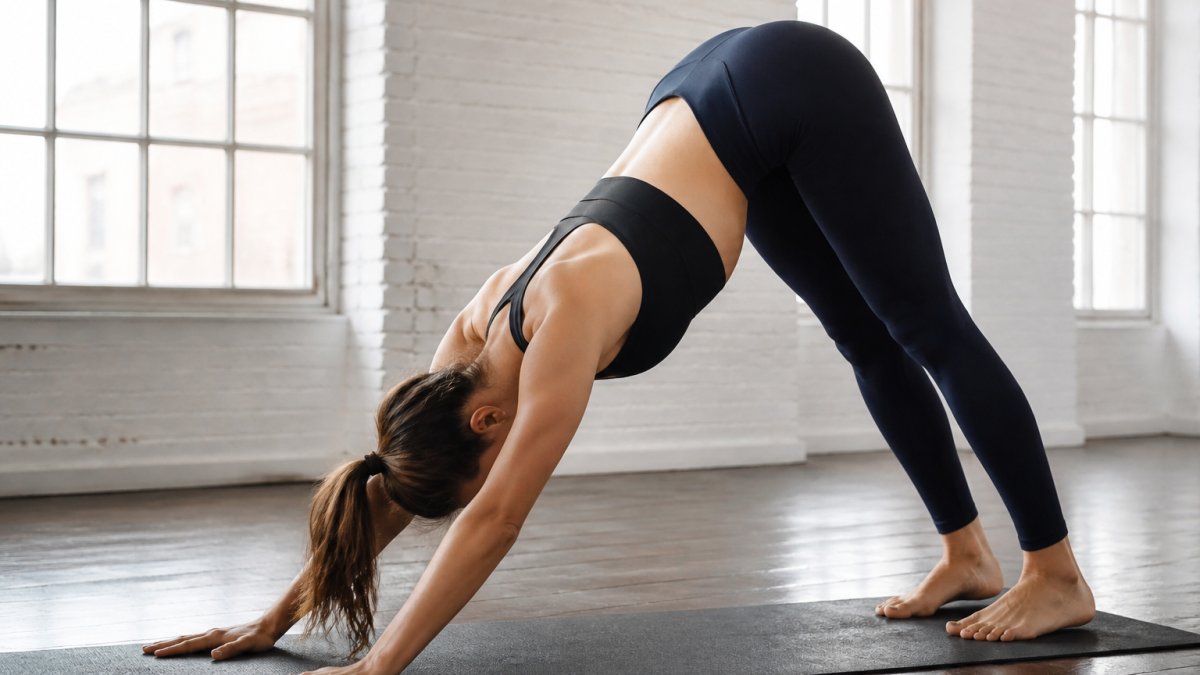
The failure mode is predictable. A bra with a loose underband rides up towards the neck in downward-facing dog. Removable cups shift and crease. Thin straps slide off the shoulder in a shoulder stand. None of these are comfort problems. They are coverage problems, and they pull your attention out of the pose.
Three construction details prevent it:
- A firm, wide underband that anchors to the ribcage rather than the bust
- Adjustable straps you can shorten for inversions and lengthen for seated work
- Moulded or removable cups that hold their shape when the chest is compressed
Coverage during inversions is also about necklines. A high neckline stays put when you fold forward. A deep scoop does not.
Sports Bra Support for Hot Yoga: Breathability and Moisture Management
Hot yoga punishes poor fabric choices faster than any other style. In a heated room, sweat changes how a bra behaves: bands lose grip, seams start to rub, and heavy fabric holds moisture against the skin.
Breathability and moisture management matter as much as support level here. Look for sweat-wicking fabric that moves moisture away from the skin, double-layer construction in the front panel for coverage without bulk, and four-way stretch so the bra moves with you rather than against you.
GrantB Sportswear builds its pieces from a 78% nylon, 22% elastane blend. The nylon gives a smooth, durable finish while the elastane provides the stretch that lets the fabric adapt to every movement. It is lightweight, moisture-wicking, and quick-drying, which is exactly the profile a hot yoga class demands.
Elasticity is the quiet factor. A bra with good stretch recovers its shape after every wear and wash. A bra with poor elasticity sags at the band within weeks, and a sagging band is a support failure.
For hot classes specifically, we would pair a high-support bra with breathable bottoms. The GrantB Sculpt Leggings at £34.99 use the same fabric blend, with a high waistband designed to stay in place through movement. If you prefer a layered look for the walk to and from the studio, the GrantB Performance Set at £69.99 adds a breathable jacket over high-waisted leggings. Note that the sports bra is not included in that set.
Fit, Band Stability, and the Tests That Reveal the Truth
Band stability is the single best predictor of whether a sports bra will work in yoga. Cups get the attention, but the underband carries the load. A bra with a perfect cup and a loose band will ride up in every downward-facing dog; a bra with a firm band and simple cups will often stay put through a full flow.
A well-fitted band sits snug and level all the way around, parallel to the floor. It should not ride up at the back, dig in at the ribs, or leave deep red marks after twenty minutes. If you can slide two fingers under the band at the side, it is too loose. If you can barely slide one, it is too tight. The band should do roughly 70 to 80 per cent of the support work, with straps and cups handling the rest.
The Pre-Purchase Tests
Run these before you commit to a bra, ideally in the changing room or at home with the tags still on.
- The band test: Raise both arms overhead. If the band lifts away from your ribcage, it will ride up in every inversion. A band that stays put under raised arms is a band that will stay put in downward-facing dog.
- The strap test: Shorten the adjustable straps, then roll your shoulders forward and back. Straps that slip are straps that will distract you mid-flow. Straps that dig in hard across the trapezius will be painful by the end of a long hold.
- The bounce test: Jump in place for ten seconds. Any vertical breast movement you can feel means the bra is not controlling bounce. For yoga, you are looking for control without a locked-down, board-like feel.
- The fold test: Fold forward into downward-facing dog and hold five breaths. Check for cup creasing, gaping necklines, and band lift. This is the single most useful test for yoga specifically, because it reproduces the pose that exposes most fit failures.
- The breath test: Place your hands on your lower ribs and take five slow, deep breaths. If you cannot feel your ribs expand, the band is too tight or the front panel too rigid. Yoga depends on breath, so a bra that restricts it is the wrong bra regardless of how supportive it feels.
- The twist test: Sit cross-legged and twist to each side, then reach one arm behind your back as if binding. The bra should move with your torso without bunching or pulling the band out of level.
- The inversion test: If you can, come into a shoulder stand or a supported headstand against a wall. Check that the neckline stays flat, the cups hold their shape, and nothing slides towards your chin.
Sizing and Adjustment Details That Matter
Most fit problems come from the band, not the cup. If you are between band sizes, size down in the band and up in the cup, because a band that is too loose cannot be fixed by tightening the straps. Straps should be adjusted so they sit flat without digging, and re-checked after the first wash, since elastane relaxes slightly with wear.
Look for a band with multiple hook positions if you can find one. A three-row hook-and-eye closure gives you roughly a couple of centimetres of adjustment as the bra ages, which extends its useful life. Bras with a single fixed band have no margin once the elastane starts to relax.
Cup construction matters too. Removable cups should sit flat against the chest wall without creasing when you fold forward. Moulded cups should hold their shape after a wash and not collapse in the middle. If the cups crease in the fold test, they will crease in class.
Comfort and freedom of movement are the payoff. When the band is stable and the straps are set, your range of motion in twists, lunges, and backbends stops being something you think about. That is the real test of a yoga bra: you forget it is there.
Trade-Offs: When High-Impact Support Works Against You
High impact support is not free. Every bit of control it adds comes with a trade-off, and in yoga those trade-offs show up quickly.
The first is breathing. Yoga depends on deep, unrestricted breath into the ribcage. A bra with a very firm band and rigid cups can limit how far your ribs expand, which works against the whole point of the practice.
The second is spinal movement. Forward folds, twists, and backbends ask the torso to move freely. A stiff bra with heavy structure can bunch, dig, or restrict the mid-back.
The third is heat. More construction means more fabric, and more fabric means more trapped sweat in a hot room.
None of this makes high impact support a bad choice. It makes it a choice with conditions. Here is how to weigh it:
| Situation | High Impact Support | Better Alternative |
|---|---|---|
| Restorative or yin class | Unnecessary pressure | Medium or low support |
| Vinyasa or power flow | Worth it | High support, lightweight build |
| Hot yoga | Worth it if breathable | High support, sweat-wicking fabric |
| Inversion-heavy practice | Worth it | High support, firm band, adjustable straps |
| Larger bust, any style | Usually worth it | High support with encapsulation |
| Smaller bust, slow classes | Overkill | Medium support, compression |
The honest answer to whether high impact support is worth it for yoga is that it depends on three variables: your bust size, your practice intensity, and how much you invert. Get those right and support becomes invisible. Get them wrong and you will spend the whole class adjusting.
That is the standard we build to at GrantB Sportswear. Support should be felt as confidence, not as restriction.
Choosing yoga gear gets complicated fast when every label promises something different. The simpler route is to buy from a range built around movement, not marketing. GrantB Sportswear designs premium gymwear that sculpts, supports, and moves with you, from the first rep to the final set. Our sports bras use a 78% nylon, 22% elastane blend with moisture-wicking, quick-drying performance, plus free delivery and £10 off orders over £100. Get started with GrantB Sportswear and train through every flow with support you never have to think about.
Frequently Asked Questions
Is a high-impact sports bra too restrictive for yoga?
It depends on the construction. A high impact support bra with four-way stretch and adjustable straps moves with you through lunges and twists rather than fighting them. Restriction usually comes from a rigid band or non-stretch cup, not from the support level itself. Try the bra through a full sun salutation before class. If your ribcage can expand on deep breaths and your shoulders rotate freely, the support level is not the problem.
Do you need a high-impact sports bra for hot yoga?
Not always, but sports bra support for hot yoga has to balance two things: bounce control and breathability. Heat raises your heart rate and sweat output, so moisture-wicking fabric and a lightweight construction matter more than maximum compression. A high-support bra in a sweat-wicking fabric works well for faster flows. For slower heated classes, a medium-support bra with removable cups often feels cooler while still managing breast movement.
What should you look for in a sports bra for yoga inversions?
A sports bra for yoga inversions needs full coverage that does not shift when you are upside down. Look for a wide underband that sits flat against the ribcage, adjustable straps you can shorten for a secure fit, and a neckline that stays close to the chest in downward-facing dog. Removable pads help maintain shape and coverage. Test it with three slow forward folds before committing to a class.
Can a medium-support sports bra provide enough support for yoga?
For slower styles such as hatha, yin, and restorative yoga, medium-impact support is usually enough. Breast movement in these classes is minimal, and the lighter construction gives you more freedom of movement and breathability. If you are in a vinyasa or power flow with jumping transitions, or if you have a larger bust, a high-support bra with adjustable straps and a structured underband keeps everything stable without needing to readjust mid-class.