

How to Choose Sculpting Gym Leggings: 2026 Fit Guide
Table of Contents
- Start With Compression Level, Not the Label
- How to Measure for Gym Leggings (Do This Before You Buy)
- Squat Proof Gym Leggings: How to Test Opacity Before You Commit
- Fabric Technology: What Sweat-Wicking and Four-Way Stretch Actually Mean
- The Best High Compression Leggings Fit Different Body Types
- Waistband Stability, Gussets and Seams: The Construction Details That Decide Comfort
- Sizing: Should You Size Up or Down in Sculpting Gym Leggings?
- Make Them Last: Post-Wash Care for Compression and Shape Retention
- Sustainable Fabric Sourcing and Sensory-Friendly Options
- Frequently Asked Questions
Last Updated: September 13, 2026
Start With Compression Level, Not the Label
Most shoppers pick sculpting gym leggings by colour, cut or price, then wonder why they feel wrong three squats into a session. The label tells you almost nothing. Compression level does. Sculpting gym leggings work by applying graduated pressure across the legs and waist, and that pressure has to match both your body and your training.

Compression is the amount of consistent pressure a fabric applies to your muscles and soft tissue during movement. Too little and the legging slides, rolls and offers no support. Too much and you fight the garment every time you hinge at the hip.
GrantB Sportswear builds its sculpt range around this principle: support that moves with you rather than squeezing you into a shape. Below, we break down the measurements, fabric tests and construction details that separate leggings you'll wear for years from ones that end up at the back of the drawer.
How to Measure for Gym Leggings (Do This Before You Buy)
Measuring for gym leggings takes five minutes and prevents most returns. You need three numbers: waist, hip and inseam. Take them over thin clothing or bare skin, keep the tape snug but not tight, and write everything down before you open a size chart.
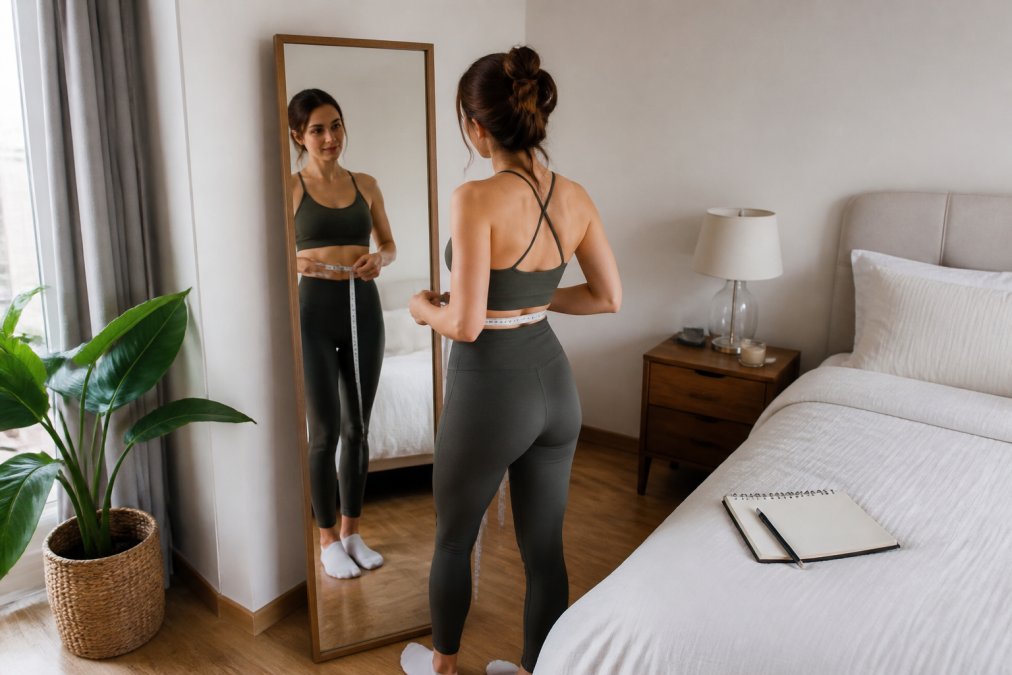
Waist, Hip and Inseam: The Three Numbers That Matter
Waist is measured at the narrowest point of your torso, usually just above the navel. Hip is the fullest part of your seat, taken with feet together. Inseam runs from the crotch seam to the hem of a pair of leggings that already fit you well.
High-waisted designs sit at or above the natural waist, so add two to three centimetres to your true waist measurement when comparing against size charts (the NHS). If you fall between sizes, most brands recommend sizing up for compression leggings because the fabric has less give.
Squat Proof Gym Leggings: How to Test Opacity Before You Commit
Squat proof gym leggings pass a simple opacity test: bend, squat and stretch in front of a mirror under bright light, and check that no skin or underwear shows through the fabric. You can run this test at home with any pair you already own, and in a fitting room with any pair you're considering.
Fabric weight and knit density drive opacity more than colour. A heavier, denser knit stays opaque when stretched; a thin, loosely knitted fabric goes sheer the moment it's pulled tight across the seat. Darker colours hide more, but they don't fix a fabric that's fundamentally too thin.
If you're buying online and can't test in person, look for product descriptions that mention squat-proof testing or opacity. [GrantB Sportswear's Sculpt Leggings](https://grantbsportswear.com/products/womens-sculpt-gym-leggings) are engineered with a dense, moisture-wicking knit that holds its coverage through deep squats and hip hinges.

Fabric Technology: What Sweat-Wicking and Four-Way Stretch Actually Mean
Sweat-wicking describes a fabric's ability to pull moisture away from your skin and spread it across the surface so it evaporates faster. Four-way stretch means the material stretches in both directions (lengthwise and crosswise), giving you full range of motion without the fabric pulling or restricting.
| Term | What It Actually Means | Why It Matters |
|---|---|---|
| Sweat-wicking | Moves moisture to the surface to evaporate | Keeps you dry and reduces chafing |
| Four-way stretch | Stretches lengthwise and crosswise | Full range of motion during lifts |
| Moisture-management | Fabric treatment that controls how sweat spreads | Prevents clammy, heavy fabric |
| Breathability | Airflow through the material | Regulates temperature during HIIT |
A second-skin fit comes from the combination of four-way stretch and a supportive knit. The fabric should feel snug when you put it on, then relax slightly as it warms to your body. If it feels tight enough to restrict your breathing, it's the wrong size, not the wrong fabric.
The Best High Compression Leggings Fit Different Body Types
The best high compression leggings for you depend on where you carry volume, how your waist-to-hip ratio sits, and how you train. Compression doesn't flatten everyone the same way, and a pair that sculpts one body type can dig in uncomfortably on another. Most guides skip this entirely and hand you a single size chart. That's the gap this section fills.
Start With Your Waist-to-Hip Ratio, Not Your Dress Size
Measure your waist at the narrowest point and your hips at the fullest point, then divide waist by hip. A ratio under roughly 0.8 usually means you carry more volume through the hip and thigh; a ratio above roughly 0.85 usually means you carry more through the midsection. This single number predicts which waistband construction will stay put on you far better than a size label does.
Matching Compression to Your Workout Intensity
- High-intensity interval training and running: medium to high compression for muscle support and reduced bounce
- Heavy compound lifts: high compression with a wide, stable waistband to prevent rolling
- Yoga and pilates: light to medium compression for freedom of movement and shape retention
- Walking and everyday wear: light compression for comfort and a smooth silhouette
How Compression Behaves on Different Frames
Pear-shaped frames (hips wider than shoulders). The risk here is a waistband that gaps at the back because the hip is doing the anchoring work. Look for a contoured waistband that dips lower at the front and rises at the back, plus a denser knit through the seat and outer thigh. Uniform compression across the whole leg tends to feel tight at the hip and loose at the waist.
Athletic or straight frames. With less natural curve through the waist, sculpting leggings can look flat rather than shaped. A higher waistband and a denser knit through the seat create definition without excess pressure. Panelling, where a second fabric layer runs down the side seam or across the seat, does more for silhouette here than raw compression level does.
Hourglass frames. The waist is the narrowest point and the hip and bust are close in width. The priority is a waistband that grips without rolling and a fabric that recovers well, because the waist-to-hip differential puts more stretch demand on the knit. Four-way stretch matters more than maximum compression.
Apple-shaped frames (volume through the midsection). High compression across the stomach can feel restrictive and cause the waistband to roll under. A wider, softer-edged waistband that sits above the natural waist, combined with medium compression through the leg, usually works better than maximum squeeze everywhere.
Taller frames. Standard inseams often finish above the ankle, which shortens the leg line and can pull the knee panel out of position. Look for a longer inseam and check that the knee articulation, the shaped panel at the knee, actually lands at your knee, not above it.
Petite frames. The opposite problem: a standard inseam bunches at the ankle, and a high waistband can sit closer to the ribs than intended. A shorter inseam and a waistband that sits at the natural waist rather than above it will fit better.
What to Check Before You Buy
- Does the product page state the inseam length in centimetres?
- Is the waistband described as contoured, wide or bonded, or just "high-waisted"?
- Are there reviews from customers whose height and build are close to yours?
- Does the fabric list elastane content? Around 20-25% elastane is a common range for sculpting knits that recover well.
Waistband Stability, Gussets and Seams: The Construction Details That Decide Comfort
Waistband stability is the single biggest predictor of whether leggings stay put during squats and deadlifts. A wide, contoured waistband with an internal elastic or silicone grip holds position; a thin, straight waistband rolls down the moment you hinge forward. This is the detail most shoppers overlook, and it's the one that ruins an otherwise good pair.
The gusset is the reinforced panel at the crotch, usually a triangular or diamond-shaped piece of fabric. A well-constructed gusset reduces friction, improves hygiene and allows the fabric to move without pulling. Flatlock seams lie flat against the skin, eliminating the ridges that cause chafing under heavy loads.
Seamless construction reduces the number of stitch lines across the body, which cuts irritation during long sessions. If you're sensitive to seams, look for pairs where the waistband and leg openings are bonded or knitted rather than stitched.
Sizing: Should You Size Up or Down in Sculpting Gym Leggings?
Size up in sculpting gym leggings if you're between sizes or prefer a comfortable fit. Size down only if the fabric has significant elasticity and you want maximum compression for short, high-intensity sessions. For most people, true-to-size is the correct choice.
Oversized leggings slide down during movement because there isn't enough tension to keep the fabric anchored. Undersized leggings restrict circulation and dig into the waist after a meal. Neither problem is worth solving with a guess.
If you're coming from a brand where you wore a size 12, check that brand's measurements against GrantB Sportswear's chart before ordering. Sizing labels are not standardised across activewear, so a 12 in one label might be a 14 in another.

Make Them Last: Post-Wash Care for Compression and Shape Retention
Wash compression leggings in cold water on a gentle cycle, inside out, and skip the fabric softener entirely. Heat and softener both break down elastane, the fibre responsible for stretch and shape retention (which.co.uk). Air-drying flat preserves elasticity far better than a tumble dryer.
- Turn leggings inside out before washing to protect the outer surface
- Use a mesh laundry bag to prevent snagging on zips and hooks
- Wash with similar colours and avoid overloading the machine
- Never tumble dry on high heat; if you must use a dryer, choose the lowest setting
- Store folded rather than hung to avoid stretching the waistband
Fabric recovery is the term for how well a legging returns to its original shape after stretching. Good recovery means the legging snaps back after a session rather than staying baggy at the knees and seat. Cold washing and air-drying are the two habits that protect it most.
Sustainable Fabric Sourcing and Sensory-Friendly Options
Most sculpting legging guides ignore both of these topics. That's a gap worth claiming, because the two are more connected than they look: the same construction choices that reduce environmental impact, fewer seams, fewer blended fibres, longer garment life, also tend to make a legging easier to wear for people who find compression uncomfortable.
What "Sustainable" Actually Means on a Product Page
Sustainable fabric sourcing usually means one of three things: recycled synthetic fibres (recycled polyester or recycled nylon, often made from post-consumer plastic), bio-based fibres (such as castor-bean-derived polyamide), or plant-based cellulosics (lyocell, sold under brand names like Tencel). Each has a different trade-off.
- Recycled polyester keeps plastic out of landfill and uses less energy than virgin polyester, but it still sheds microplastics in the wash and doesn't biodegrade.
- Recycled nylon has better abrasion resistance and a softer hand feel than recycled polyester, which matters for compression wear that rubs against the skin.
- Lyocell and other cellulosics come from wood pulp in a closed-loop process that recovers most of the solvent, but they have less natural stretch, so they're usually blended with elastane, which brings you back to a synthetic component.
There is no fully sustainable compression legging on the market today, because elastane, the fibre that does the sculpting, is not currently recyclable at scale. The honest position is that you're choosing between degrees of impact, not between good and bad.
Certifications Worth Looking For
"Eco-friendly" is not a regulated term and means nothing on its own. Named standards are different:
- Global Recycled Standard (GRS) verifies recycled content and traces it through the supply chain.
- OEKO-TEX Standard 100 tests the finished fabric for harmful substances, relevant if you have sensitive skin.
- bluesign certifies that the manufacturing process meets limits on water, energy and chemical use.
- B Corp certification applies to the company rather than the fabric, but signals verified environmental and social performance.
If a product page claims sustainability without naming one of these, treat the claim as marketing.
The Maintenance Angle Most Guides Miss
The single biggest environmental decision you make with a pair of sculpting leggings is how long you keep it. A legging worn twice a week for three years has a far lower impact per wear than one replaced every eight months. That makes post-wash care an environmental issue, not just a fabric issue, cold washing, air-drying and avoiding fabric softener all extend the life of the elastane and delay replacement.
Sensory-Friendly Activewear: What to Look For
Compression and sensory comfort are often framed as opposites. They don't have to be. If you find tight waistbands, scratchy seams or synthetic textures difficult to tolerate, the problem is usually construction rather than compression level.
- Bonded or knitted edges instead of stitched hems remove the ridge that sits against the skin.
- Flatlock seams lie flat and eliminate the raised stitch line that causes most chafing complaints.
- Seamless construction reduces the total number of contact points across the body.
- Brushed inner surfaces feel softer against the skin than a smooth synthetic face, though they can feel warmer.
- Wider, lower-pressure waistbands distribute force over a larger area, so the same support level feels less restrictive.
A useful test: put the leggings on and sit down for two minutes before deciding. Waistbands that feel fine standing often dig in when you're seated, and that's the moment most sensory discomfort shows up.
A Practical Compromise
If you want lower impact and better sensory comfort at the same time, look for a legging with a high recycled-nylon content, a GRS or OEKO-TEX certification on the product page, flatlock or bonded seams, and a contoured rather than elasticated waistband. That combination is rare, but it exists, and it's the one most guides never tell you to look for.
Frequently Asked Questions
Do sculpting leggings actually work?
They work in a specific way: compression fabric and strategic seaming smooth the silhouette and hold muscle in place, but they do not change your body. What you get is support during movement, less bounce and a firmer look under clothing. The effect depends on fit and fabric quality, not the word 'sculpt' on the label. A pair that fits your measurements will always outperform a tighter pair that digs in.
What fabric provides the best compression for gym leggings?
Look for a nylon and elastane blend with a high elastane content, usually 20 per cent or more, combined with four-way stretch. This gives elasticity that recovers rather than stretches out. Seamless construction with flatlock seams reduces friction, and a moisture-wicking finish keeps the fabric from getting heavy when you sweat. Check the care label: fabrics with a high elastane content need cool washes to keep their shape.
How can you tell if gym leggings are squat-proof?
Do a stretch test before you buy. Hold the fabric over your hand and pull it apart; if you can see skin or light through it, it will go sheer in a deep squat. Look for a dense, opaque knit with no thin patches across the seat. Reviews that mention squat proof gym leggings after months of wear are more useful than first-impression reviews, because opacity often fades with repeated washing.
Is it better to size up or down in gym leggings?
Size to your largest measurement, usually your hip, and never size down for more compression. Leggings that are too small roll at the waistband, restrict movement and wear out faster because the fabric is permanently stretched. If you are between sizes, go up and rely on a high-waisted design with a wide waistband for support. Check the brand's own size chart rather than assuming your usual size carries over.
Getting the fit right comes down to three things: accurate measurements, the correct compression level for your training, and construction that holds its shape through every rep. GrantB Sportswear designs premium gymwear around exactly that brief, with four-way stretch, moisture-wicking fabric and a supportive waistband built to stay in place during cardio, strength training and yoga. Shop the sculpt collection and get free delivery, plus £10 off orders over £100.