

Are High Waisted Leggings Better? The 2026 Verdict
Table of Contents
- High Waisted vs. Mid-Rise: What Actually Changes in Your Workout
- The Support and Compression Difference You Can Feel
- Why High Waisted Leggings Stay Put (and When They Don't)
- How to Stop Leggings Rolling Down During Heavy Lifts
- A Gym Leggings Fitting Guide for Your Body Type
- Best Gym Leggings for Squats: What the Waistband Does
- Coverage, Shaping, and the Flattering Factor
- Do High Waisted Leggings Last Longer? The Durability Question
- Which High Waisted Style Should You Pick?
- Conclusion
- Frequently Asked Questions
Last Updated: September 9, 2026
Ask a room full of lifters whether high waisted leggings are worth the hype and you will get passionate answers on both sides. The short verdict is yes, for most training contexts, high waisted leggings outperform mid-rise styles because the extended waistband solves the two problems that ruin workouts: constant adjusting and lack of mid-section support. At GrantB Sportswear, we design gymwear around these exact demands, and this guide breaks down the technical differences so you can decide with confidence rather than guesswork.
The decision matters more than aesthetics. A waistband that rolls, slips, or digs in distracts you from the lift, the run, or the pose. Below, we will show you exactly how rise height changes your workout experience, what compression actually does to your body, and how to match a waistband to your body type. We will also cover the durability question that most reviews skip entirely.
High Waisted vs. Mid-Rise: What Actually Changes in Your Workout
The core difference between high waisted and mid-rise leggings is where the waistband sits on your torso, and that single measurement changes how the garment behaves during movement. Mid-rise styles typically sit at or just below the navel, while high-rise options extend several centimetres higher, covering the full mid-section. High waisted leggings are gym leggings with a waistband that rises above the navel, typically reaching 25 to 30 centimetres from the crotch seam, designed to provide extended torso coverage and support.
That extra fabric changes your workout in three measurable ways:
- Fewer adjustments: The taller waistband has more surface area gripping your torso, which means it stays anchored during squats, bends, and lunges.
- Better posture cueing: The gentle pressure around your mid-section reminds you to brace your core before heavy lifts.
- More coverage: No gap between your top and leggings when you hinge forward or reach overhead.
For yoga practitioners moving through complex poses, the extended coverage prevents the waistband from creeping down during inversions. For runners, it eliminates the constant tugging that breaks your stride. The trade-off appears in warmer months or during long cardio sessions, where the extra fabric can feel warmer against your skin.
The Support and Compression Difference You Can Feel
Compression is where high waisted leggings earn their reputation, but not all compression feels the same. Quality high waisted leggings use graduated compression, meaning the fabric applies firmer pressure around the waistband and slightly softer pressure through the legs. This design supports your core without restricting blood flow or making you feel squeezed.
The physiological impact matters more than most shoppers realise. Light compression around the mid-section provides proprioceptive feedback, which is your body's sense of its own position in space (peer-reviewed research). This feedback helps you maintain proper form during compound movements. Many lifters describe it as a "held-in feel" that makes them more aware of their core engagement.
Fabric composition drives the compression experience. A blend of nylon and elastane delivers the right balance: nylon provides durability and a smooth finish, while elastane supplies the four-way stretch that moves with you. The GrantB Sculpt Leggings, priced at £69.00, use a 78% nylon and 22% elastane composition that offers supportive compression.

Why High Waisted Leggings Stay Put (and When They Don't)
The primary reason high waisted leggings stay in place during exercise comes down to the relationship between waistband height and torso shape. A taller waistband creates more contact points with your body, distributing the holding force across a larger area rather than concentrating it at a single narrow band.
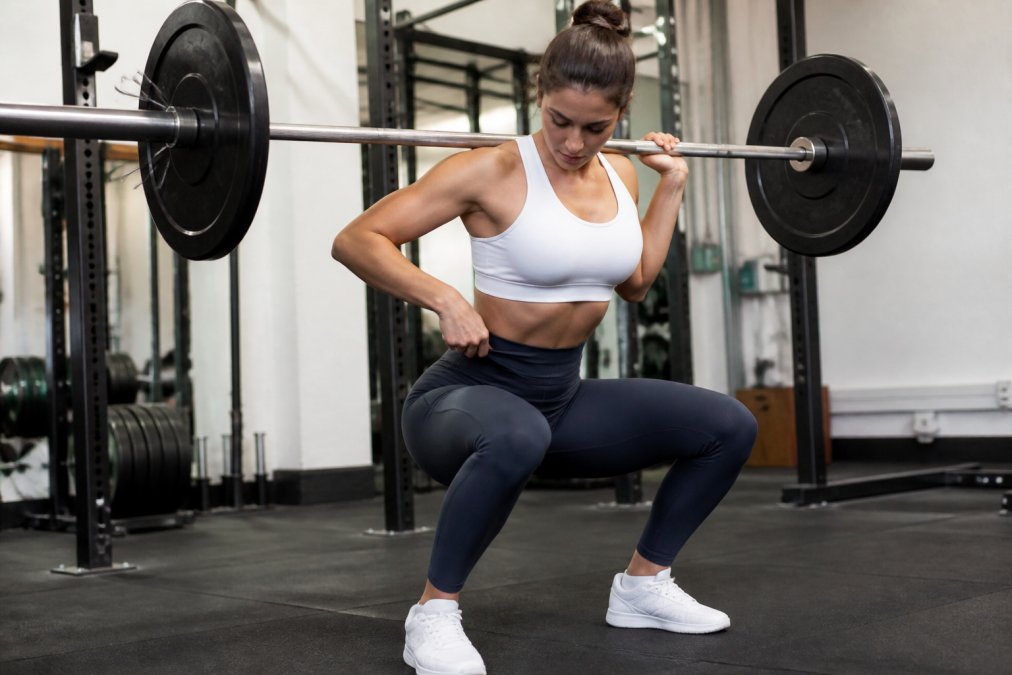
Your torso is not a perfect cylinder. It curves inward at the waist and widens slightly at the ribs and hips. A high waistband that extends past your natural waist can grip this wider area, creating a natural anchor point. Mid-rise bands, sitting at the narrowest part of your waist, have less structural resistance to downward movement.
However, high waisted leggings do fail, and the cause is usually one of three issues:
- Insufficient elastane content: Fabrics with less than 15% elastane lose their recovery power quickly, leading to sagging and crinkling (peer-reviewed research).
- Poor waistband construction: A band that lacks internal structure or uses flimsy elastic will fold over during movement.
- Incorrect sizing: A waistband that is too large cannot grip effectively, while one that is too small will roll down as the fabric fights your body's natural expansion during breathing.
The fix is to look for leggings with a dedicated supportive waistband design, not just a taller cut. The GrantB Flare Leggings feature a supportive waistband engineered to stay securely in place during movement.

How to Stop Leggings Rolling Down During Heavy Lifts
Leggings rolling down during squats and deadlifts ranks as the most common complaint among gym-goers, and the solution starts before you even pull the leggings on. The problem is rarely the leggings alone; it is usually a mismatch between the waistband design and your lifting mechanics.
During heavy compound lifts, your intra-abdominal pressure rises significantly as you brace your core (PubMed). This pressure expands your waist circumference momentarily. A waistband without sufficient elasticity or structural support cannot accommodate this expansion, so it rolls down instead of stretching with you.
To stop leggings rolling down during heavy lifts, follow this process:
- Choose the right rise: Select high waisted leggings that sit above your natural waist, where your torso begins to widen toward the ribs.
- Check the elastane content: Look for at least 20% elastane in the fabric composition for adequate recovery.
- Size for your waist, not your hips: If your waist measurement falls between sizes, size down for a firmer waistband grip, provided the legs still fit comfortably.
- Test with a brace: If you lift with a weight belt, wear it over your leggings during the fitting test to ensure the waistband does not bunch.
- Look for cross-waist or V-waist designs: These constructions distribute tension differently and often hold better during heavy lifts.
A Gym Leggings Fitting Guide for Your Body Type
No single waistband height works perfectly for every body, and the two measurements that matter most are your torso length and your hip-to-waist ratio. Most fitting guides stop at 'know your body shape,' but the real mechanism is simpler to measure than you think.
Start with your torso length
Sit on a hard chair and measure from the top of your hip bone to the bottom of your ribcage. This is your torso window. If that distance is under 18 centimetres, you have a shorter torso. If it is over 22 centimetres, you have a longer torso. This single number predicts how a high waistband will behave on you.
- Short torso (under 18 cm): A waistband that rises 25 to 30 centimetres from the crotch seam will likely reach your ribcage when you sit or hinge forward. Look for a rise between 22 and 25 centimetres, or a style marketed as 'mid-high' rather than 'extra high.' The waistband should sit just above your navel, not crowd your lower ribs.
- Average torso (18-22 cm): Standard high-rise leggings with a 25 to 28 centimetre rise will sit comfortably at or just below your natural waist. You have the most flexibility in style choice.
- Long torso (over 22 cm): A standard high rise will land lower on your abdomen than the label suggests. Look for a rise of 28 centimetres or more, or styles explicitly described as 'extra high rise.' If the waistband ends above your navel but below your natural waist, you will experience more slipping because the band lacks the anchor point of your ribcage flare.
Hip-to-waist ratio changes the grip pattern
Your hip-to-waist ratio determines how much structural resistance the waistband has to downward movement. Measure your waist at its narrowest point and your hips at their widest point, then divide your waist measurement by your hip measurement.
- Ratio below 0.75 (pronounced curve): Your waist is significantly narrower than your hips. A straight-cut waistband will gap at the lower back or dig in at the front. Look for a contoured or curved waistband that follows the natural dip of your waist rather than cutting straight across. The band needs to curve downward slightly at the front and back to match your silhouette.
- Ratio between 0.75 and 0.85 (moderate curve): Most standard high-rise waistbands will work well. The key is ensuring the band fits snugly at your natural waist without being forced to stretch excessively over your hip width when you pull them on.
- Ratio above 0.85 (straighter build): Your waist and hips are closer in measurement, which means there is less natural 'shelf' for the waistband to grip. Firm compression becomes essential here. A waistband with higher elastane content (20% or above) will provide the active grip you need, whereas a softer band may migrate downward during squats or lunges.
The waistband-to-hip test
Before you buy, perform this two-second check. Hold the waistband flat against your lower back and see if it sits flush. Then, without stretching the fabric, wrap it around your natural waist. If the band cannot meet without force, the leggings are too small. If it overlaps by more than two centimetres, they are too large. The correct fit is a band that meets with light tension and no gaping at the lower back.
Why this matters more than body shape labels
Body shape categories like 'hourglass' or 'pear' describe proportions visually, but they do not tell you how a waistband will perform under load. Two women with the same visual body shape can have completely different torso lengths and hip-to-waist ratios, leading to opposite experiences with the same pair of leggings. Measuring your torso window and ratio takes thirty seconds and removes the guesswork from every future purchase.
For most lifters, the practical takeaway is this: if you have a longer torso or a straighter build, prioritise waistband construction and elastane content over rise height alone. If you have a shorter torso or pronounced curve, prioritise rise height and waistband contour. The GrantB Sculpt Set, priced at £119.00, pairs high waisted leggings with a supportive sports bra, allowing you to test both pieces as a coordinated system. The leggings feature a sculpting fit designed to enhance your natural shape.

Best Gym Leggings for Squats: What the Waistband Does
When you search for the best gym leggings for squats, the waistband deserves more attention than any other feature. Squats involve the deepest range of motion of any common gym exercise, which means your leggings face maximum stretch at the hips and maximum compression at the waist simultaneously.
A waistband designed for squatting must do three things: stay anchored through the full descent, return to its original position without sagging, and avoid creating a gap at the lower back when you hinge forward. High waisted leggings excel at all three because the extended band distributes the stress of movement across a larger fabric area.
The fabric's four-way stretch capability determines how well the leggings handle the squat position. Four-way stretch means the fabric stretches both lengthwise and crosswise, allowing it to accommodate the widening of your hips and thighs at the bottom of a squat without losing its shape. Cheaper fabrics with only two-way stretch will strain at the seams and become see-through under tension.
Squat-proof construction also matters. A dense, premium fabric prevents transparency when stretched to its limit. The GrantB Sculpt Leggings are explicitly designed as squat-proof with non-see-through fabric, ensuring confident coverage during squats, lunges, and training sessions. At £69.00, they deliver technical features for lower-body work.
Coverage, Shaping, and the Flattering Factor
The flattering effect of high waisted leggings is not just a marketing claim; it comes from how the extended waistband interacts with your body's proportions. A high rise visually shortens your torso and lengthens your legs, creating the elongated silhouette that most activewear shoppers want.
Shaping technology in quality leggings works through strategic compression zones rather than restrictive squeezing. The fabric holds and smooths the mid-section while allowing your natural curves to show through. This creates a simplified appearance without the discomfort of shapewear.
Coverage is the practical side of the flattering factor. High waisted leggings eliminate the mid-section exposure that happens when you bend, stretch, or reach during workouts. They also provide a smooth base under sheer or cropped tops, giving you more styling options.
The versatility extends beyond the gym. High waisted leggings transition seamlessly to casual wear, coffee runs, and travel because the coverage and shaping work as well with an oversized jumper as they do with a sports bra. The GrantB Studio Flare Set, priced at £98.00, pairs a fitted vest with bootleg flared leggings that elongate the leg while providing a contemporary athleisure look suitable for studio classes or casual styling.
Do High Waisted Leggings Last Longer? The Durability Question
Durability in high waisted leggings comes down to fabric quality and waistband construction, and the answer to whether they last longer than mid-rise styles is nuanced. The taller waistband experiences more stress during wear, which means a poorly constructed high rise may fail faster than a well-made mid-rise. Quality construction reverses that equation.
The waistband is the first place leggings typically fail. After repeated washes, the elastic can lose its snap, causing the band to stretch out and sag. High waisted leggings with a dense elastane content and reinforced waistband stitching resist this degradation far better than cheaper alternatives.
What actually causes waistband sag
Waistband failure is not random wear; it is a materials engineering problem. The elastic fibres inside the waistband are under constant tension whenever you wear the leggings. Every time you bend, squat, or breathe deeply, those fibres stretch and recover. Over hundreds of cycles, the elastane molecules begin to fatigue and lose their ability to return to their original length. This process is called elastic creep, and it is the direct cause of the 'baggy waistband' complaint you see in reviews.
Three construction factors determine how quickly elastic creep sets in:
- Elastane percentage: Fabrics with less than 15% elastane lose their recovery power noticeably faster than those with 20% or more. The higher elastane content provides more molecular 'spring' to resist creep.
- Waistband width: A wider waistband distributes the holding force across more fabric surface area. A narrow 3-centimetre band concentrates all the tension into a small strip, which fatigues faster. A 7 to 10-centimetre band spreads the load and lasts longer.
- Seam construction: Seamless waistbands, knitted in a single continuous loop, have no stitching to fail or pull. Stitched waistbands depend on the thread and seam type; a flatlock or overlock seam will hold better than a basic straight stitch under repeated tension.
Seamless versus stitched: the real trade-off
Seamless waistbands are constructed by knitting the entire garment as one piece, which eliminates the bulky side seams and creates a smooth, uniform compression profile. The advantage for durability is that there are no seams to burst or unravel under stress. The trade-off is that seamless construction typically uses a lighter fabric weight, which can mean less structural support over time if the elastane content is low.
Stitched waistbands, by contrast, allow manufacturers to use a denser, heavier fabric and add an internal elastic band for extra structure. The durability risk shifts to the stitching itself. A well-executed flatlock seam with high-tenacity thread can outlast a seamless band, but a cheap straight stitch will fail within months.
The wash cycle is the real killer
Fabric composition predicts longevity more reliably than any other factor, but how you wash the leggings determines whether that composition survives. Nylon offers exceptional durability and resists pilling, while elastane provides the recovery that keeps the waistband snug. Heat and agitation are the two forces that degrade elastane fastest.
- Wash in cold water (30°C or below) to prevent elastane breakdown from heat.
- Avoid fabric softeners, which coat the elastane fibres and reduce their elasticity.
- Hang dry rather than machine drying, as high heat degrades elastic fibres.
- Wash inside out to protect the outer fabric surface from friction.
| Care Step | Frequency | Impact on Waistband |
|---|---|---|
| Cold water wash | Every wash | Preserves elastane elasticity |
| Hang dry | Every wash | Prevents heat damage to elastic |
| Skip fabric softener | Every wash | Maintains grip and recovery |
| Wash inside out | Every wash | Reduces surface pilling and friction |
How to test waistband recovery in the shop
Before you buy, perform a simple recovery test. Gently stretch the waistband horizontally to about 150% of its resting width, hold for five seconds, then release. A quality waistband should snap back to its original width almost instantly. If it returns slowly or remains slightly stretched, the elastane is already fatigued or the content is too low. This test takes ten seconds and predicts the waistband's behaviour after twenty washes better than any label claim.
A 78% nylon and 22% elastane blend, used across the GrantB range, balances these properties effectively. The high-grade nylon delivers a refined finish with exceptional durability, while the elastane ensures the fabric returns to its original shape after each stretch. The higher elastane content, combined with a wide supportive waistband, helps these leggings maintain their grip through repeated training cycles.
Which High Waisted Style Should You Pick?
The right high waisted style depends on your training mix and how you plan to wear the leggings beyond the gym. Straight-leg high waisted leggings offer maximum versatility, working for everything from heavy squats to casual errands. Flared or bootleg styles add a fashion-forward element while providing the same waistband benefits.
For dedicated lifters who train in leggings several times per week, the GrantB Sculpt Leggings at £69.00 deliver the full package: squat-proof coverage, non-see-through fabric, a supportive waistband that stays in place, and a sculpting fit. The four-way stretch fabric provides a smooth, comfortable feel with supportive compression, and the full-length fit ensures complete leg coverage.
Yoga practitioners and studio-goers may prefer the freedom of a coordinated set. The GrantB Sculpt Set at £119.00 combines a supportive sports bra with high waisted leggings featuring functional pockets and moisture-wicking properties. The set approach ensures your top and bottoms work together rather than fighting each other during complex poses.
For those who value a contemporary silhouette, the bootleg cut of the GrantB Flare Leggings elongates the leg while providing a supportive waistband and moisture-wicking properties. The flared style transitions effortlessly from gym sessions to casual styling with trainers and oversized tops.
Price-conscious shoppers can take advantage of GrantB Sportswear's free UK delivery and £10 off orders over £100. The Performance Set at £139.00 offers a complete package with a jacket, leggings, and sports bra designed for layering through workouts and transitioning from studio to street.
Conclusion
High waisted leggings deliver measurable advantages for most training contexts, from the secure waistband that eliminates constant adjusting to the flattering silhouette that works in and out of the gym. The key is choosing a pair with quality construction: sufficient elastane content, a supportive waistband design, and squat-proof fabric coverage.
The difference between a frustrating pair and a reliable pair comes down to these technical details, not the hype. GrantB Sportswear builds high waisted leggings with a 78% nylon and 22% elastane composition, supportive waistbands engineered to stay in place, and sculpting fits designed to enhance your natural shape. Every piece is crafted to move with you through your first rep to your final set.
Get started with GrantB Sportswear and train with confidence in leggings that stay put, support your lifts, and hold their shape wash after wash.
Frequently Asked Questions
What is the point of high-waisted leggings?
High-waisted leggings provide a longer rise that covers the mid-section, offering more support and compression around the core. This design helps the waistband stay anchored during movement, so you are not pulling them up between sets. They also create a smoother silhouette under tops and give extra coverage during bends and squats, which is why many gym-goers prefer them over mid-rise options.
How do you prevent high-waisted leggings from rolling down during a workout?
Rolling down usually means the waistband lacks sufficient elasticity or the fit is wrong. Look for leggings with a wide, structured waistband and a high elastane content, around 20-25%, which keeps the fabric taut. Size up if the band digs in, as a too-tight fit can fold over.
Are high-waisted leggings more flattering for all body types?
High-waisted leggings are generally flattering across body types because they smooth the midsection and define the waist. For straight or athletic builds, they create the illusion of curves. For curvier figures, they provide coverage and support without digging in. The key is matching the compression level to your preference: light compression for comfort, firmer compression for a sculpting effect during training.
What is the difference between high-waisted and mid-rise leggings for gym performance?
The main difference is where the waistband sits and how much core support it offers. High-waisted styles cover the navel and provide a held-in feel that can improve posture awareness during lifts. Mid-rise options sit below the navel and allow more freedom for high kicks or long torsos. For squats and deadlifts, high-waisted leggings reduce the chance of slippage and offer better coverage.
Which is better for squats: high-waisted or flare leggings?
For squats, the best gym leggings for squats are high-waisted styles with four-way stretch and a dense, squat-proof fabric. Flare leggings can work well too, as long as the waistband offers the same support. The flared cut does not affect waistband security, so choose based on aesthetic preference. Prioritise a high elastane content for full range of motion and a waistband that stays anchored.