

Compression vs Encapsulation Sports Bra for Running
Table of Contents
- Compression vs Encapsulation Sports Bra for Running: The Core Difference
- Side-by-Side Comparison: Support, Bounce and Comfort
- How Compression Limits Breast Movement During Running
- How Encapsulation Supports Each Breast Separately
- Choosing a High Impact Sports Bra for Running and HIIT
- What Is the Best Sports Bra for Running at Your Cup Size?
- Sports Bra for Large Breasts Running: When Encapsulation Wins
- How Should a Running Sports Bra Fit? The Two-Finger Test and More
- Hybrid Designs, Materials and Long-Run Comfort
- How to Test Support While Running (And When to Replace Your Bra)
- Frequently Asked Questions
Last Updated: October 19, 2026
Compression vs Encapsulation Sports Bra for Running: The Core Difference
Compression versus encapsulation is the first decision that shapes how a running sports bra performs, and most runners get it wrong by buying on looks rather than mechanics.

Both reduce bounce. They do it in opposite ways, and that changes comfort, fit and how much support you actually get at speed.
Below, we break down how each design works, who it suits, and how to test a bra before you commit to it.
**Compression sports bras reduce movement by pressing breast tissue against the ribcage.
That single distinction drives everything else. A compression bra relies on a tight, stretchy fit to hold tissue close to the body.
Neither is universally better. A compression bra can feel restrictive on a larger bust, while an encapsulation bra can feel bulky on a smaller one.
How Compression Bras Hold Breast Tissue Close to the Body
A compression sports bra works like a firm, elastic band across the chest. The fabric presses the breasts flat against the ribcage, so there is less tissue free to move when you run. Support comes from tension in the fabric, not from shaped cups.
The upside is simplicity and low cost. There are fewer seams to rub, fewer components to fail, and the fit is more forgiving. The trade-off is that compression flattens rather than separates. For smaller busts, that is fine. For larger busts, the fabric has to work much harder to control movement, and the bra can start to feel like a clamp on longer runs.
How Encapsulation Bras Support Each Breast Separately
An encapsulation sports bra gives each breast its own cup, so the breasts are lifted and held individually rather than pressed together. Support comes from the structure of the cup, often reinforced with seams, moulded panels or underwire.
That individual support matters during high-impact exercise. Each breast can move independently, so controlling them separately reduces the total movement you feel. The cost is complexity: more seams, more structure, and a fit that has to be closer to your actual cup size. Get the size wrong and an encapsulation bra will rub, dig in or leave you unsupported.
Side-by-Side Comparison: Support, Bounce and Comfort
Here is how the two designs compare on the factors that matter for running:
| Feature | Compression | Encapsulation |
|---|---|---|
| How it supports | Presses tissue against chest | Holds each breast in a cup |
| Best bust size | Smaller busts, A to C cup | Larger busts, C cup and above |
| Movement control | Limits overall bounce | Controls each breast separately |
| Comfort on long runs | Can feel tight and flattening | Can rub if fit is off |
| Structure | Fewer seams, simpler build | Structured cups, more seams |
| Typical support level | Medium to high | High |
The table hides one nuance. Compression bras often feel more comfortable in the first ten minutes and less comfortable after an hour, because the pressure never lets up. Encapsulation bras can feel fussy at first and then disappear once the fit is right. That is why testing matters more than the label on the box.
How Compression Limits Breast Movement During Running
Compression controls bounce by removing the space for movement. The fabric holds breast tissue flat against the chest, so there is less mass free to travel up and down with each stride. Fewer moving parts means less bounce.
That approach suits running well because running produces repetitive vertical movement. A firm, close-fitting bra can reduce that motion noticeably, especially for smaller busts. The limit is the amount of force the fabric can absorb. Once a bust gets larger, the tissue has more mass and momentum, and a compression bra has to be extremely tight to control it. At that point, the bra starts to restrict breathing and range of motion.
What Is Actually Moving, and Why It Matters at Pace
Breast movement during running is not a single up-and-down bounce. Tissue moves in three planes at once: vertically with each foot strike, side to side as your hips rotate, and front to back as your torso leans. A compression bra mainly targets the vertical component by holding tissue against the chest wall.
That is why some runners find a compression bra feels secure standing still but less controlled at speed. The faster you run, the more force each stride delivers and the more the fabric has to absorb.
The Distance Effect: Why Compression Feels Different at Kilometre Eight
Compression bras often feel best in the first ten minutes. The fabric is at full tension, the band is fresh, and the fit is snug. Over distance, three things change:
- Fabric fatigue. Elastic fibres stretch under repeated load and recover more slowly when damp with sweat. A bra that held firm at kilometre one can feel looser by kilometre eight.
- Band creep. A band that is slightly too loose rides up at the back as you run, shifting load onto the straps and reducing control.
- Pressure build-up. Constant compression does not let up, so the clamped feeling that was tolerable for a 5K becomes distracting over a half marathon.
This is the practical trade-off: compression gives you immediate, simple control, but the control is only as good as the fabric's tension, and tension fades with sweat, distance and wear.
How to Judge Whether Compression Is Controlling Movement
You do not need a laboratory to assess whether a compression bra is doing its job. Use a progressive test that mirrors how the bra will be used:
- Standing check. Bend forward and side to side. Tissue should stay inside the bra without spilling over the top or out of the armhole.
- Run on the spot for 30 seconds. Watch from the side in a mirror, or ask someone to watch. Visible vertical movement means the fabric is not holding tissue close enough.
- Five minutes at your normal pace. Check that the band has not ridden up and that you can still take full breaths.
- Twenty-second stride. Note any lateral shifting, rubbing under the band, or a sudden sense that the bra has loosened.
- Stop and inspect. Red marks that fade within minutes are normal; deep grooves, chafing or numbness are not.
When Compression Is the Right Running Choice
Compression is a strong choice if you have a smaller bust, run shorter or lower-impact sessions, prefer a simple bra with fewer seams, or want a bra that doubles as a everyday training top. It is a weaker choice if you have a larger bust, run long distances regularly, sweat heavily, or notice lateral movement that a flat-pressing bra cannot control. In those cases, the mechanism itself, fabric tension rather than structure, is the limiting factor, and no amount of sizing up or down will change that.
How Encapsulation Supports Each Breast Separately
Encapsulation takes the opposite route. Each breast sits in its own cup, so the bra can lift and hold it individually. When you run, each breast is controlled within its cup rather than pressed against its neighbour.
That separation is why encapsulation bras tend to win for larger busts. The structure carries the load, so the fabric does not have to squeeze as hard. You get movement control without the clamped feeling. The catch is fit precision. An encapsulation bra needs to match your cup size closely, and a poor fit shows up quickly as rubbing under the band or along the seams.
What Is Inside an Encapsulation Cup
An encapsulation bra is a piece of engineering, not just a shaped piece of fabric. The cup usually combines three elements:
- A structured frame. Seams, moulded panels or a shaped underband create a cradle that holds the breast from below and the side.
- Separation at the centre. A centre panel or gore keeps the breasts apart, so each is supported independently rather than pressed together.
- Load transfer to the band. The cup carries the breast, but the band carries the cup. A wide, firm underband is what stops the whole structure from riding up when you run.
Some encapsulation bras use underwire to reinforce the lower cup; others use moulded foam or seam-built cups without wire. Both approaches aim at the same thing: controlling each breast within its own space rather than flattening the chest as a whole.
Why Separate Support Changes the Running Experience
When each breast is held in its own cup, the bra can respond to movement on each side independently. That matters during running because the two breasts do not move identically, gait asymmetry, shoulder drop and hip rotation all create slightly different forces left and right. A compression bra averages those forces across the chest; an encapsulation bra manages them per side.
The practical result is often less perceived bounce at the same level of tightness. Runners who find compression bras restrictive often describe encapsulation bras as feeling supportive without feeling clamped. The trade-off is that the structure has to be correctly sized.
The Fit Penalty: Why Encapsulation Is Less Forgiving
Compression bras are forgiving because fabric tension adapts to a range of shapes. Encapsulation bras are not. The cup has a fixed geometry, so it either matches your breast shape or it does not. Common failure points include:
- Empty space at the top of the cup when the cup is too large, causing the breast to slide down and rub.
- Pressure at the centre gore when the cup is too small, which can dig in during breathing.
- Band ride-up when the underband is too loose to carry the cup's weight, shifting load onto the shoulders.
- Seam friction where structured seams sit against skin that moves with each stride.
This is why encapsulation bras reward a proper fitting more than compression bras do. The payoff is better control over distance, especially for larger busts, but only if the cup, band and centre panel all sit correctly before you start running.
How to Test Encapsulation Support While Running
Use the same progressive test as for compression, with two extra checks specific to structured cups:
- Standing cup check. Bend forward and confirm each breast stays fully inside its cup with no spill at the top or sides.
- Centre gore check. The panel between the cups should sit flat against your chest, not lift away or dig in.
- Run on the spot for 30 seconds. Watch for movement inside the cup, not just movement of the bra as a whole.
- Five minutes at pace. Check that the band stays level and the cups have not shifted sideways.
- Twenty-second stride. Note any rubbing along seams or under the band.
- Stop and inspect. Look for red marks at the gore, under the band and along seam lines.
When Encapsulation Is the Right Running Choice
Encapsulation is a strong choice if you have a larger bust, run regularly at pace or over distance, sweat heavily, or find compression bras restrictive across the chest. It is a weaker choice if you have a smaller bust and do not need cup-level structure, prefer minimal seams, or want a bra that is easy to size without a fitting. For runners in the middle, around a C cup, or training across several intensities, the decision usually comes down to which fit you can get right, because a well-fitted bra of either style outperforms a poorly fitted one of the 'correct' style.
Choosing a High Impact Sports Bra for Running and HIIT
A high impact sports bra is one built to control movement during running, HIIT and other high-impact exercise, and it should be matched to both your bust size and your training intensity.
Our recommendation is to start with the activity, then the bust. Running and HIIT produce the most vertical movement, so they need the highest support level you can wear comfortably. Yoga and strength work need less.
For runners who want one bra that handles gym sessions, HIIT and studio work, the GrantB Core Sports Bra is built around high support, with engineered underwire, adjustable straps and removable pads. At £29.99, it sits in encapsulation-leaning territory while staying flexible enough for mixed training.
What Is the Best Sports Bra for Running at Your Cup Size?
The best sports bra for running depends on cup size more than any other factor. Smaller busts can run comfortably in compression. Larger busts generally get better support and comfort from encapsulation. The crossover sits around a C cup, and it moves with the intensity of your training.
A rough guide:
- A to B cup: compression is usually enough, and often more comfortable.
- C cup: either design can work, so try both and judge on movement.
- D cup and above: encapsulation, or a hybrid, gives better control.
- Any cup, high mileage: prioritise adjustability and a band that stays level.
Cup size is a starting point, not a rule. Two runners in the same cup can need different bras because breast shape and tissue density vary. The only reliable test is movement under load.
Sports Bra for Large Breasts Running: When Encapsulation Wins
For larger busts, encapsulation usually wins. The reason is mechanical: a larger bust carries more mass, and mass in motion is harder to stop with fabric tension alone.
That does not make compression useless at a larger size. A well-made compression bra can work for lower-impact sessions or shorter runs.
On a larger bust, the band carries most of the weight, so a bra that fits well at the cup but rides up at the back will fail. Look for a wide, firm band and adjustable straps before you worry about cup construction.
How Should a Running Sports Bra Fit? The Two-Finger Test and More
A running sports bra should fit snugly around the ribcage, sit level all the way round, and hold the breasts close without pressing them flat or letting them spill. The band does the work, so it should feel firm but not restrictive.
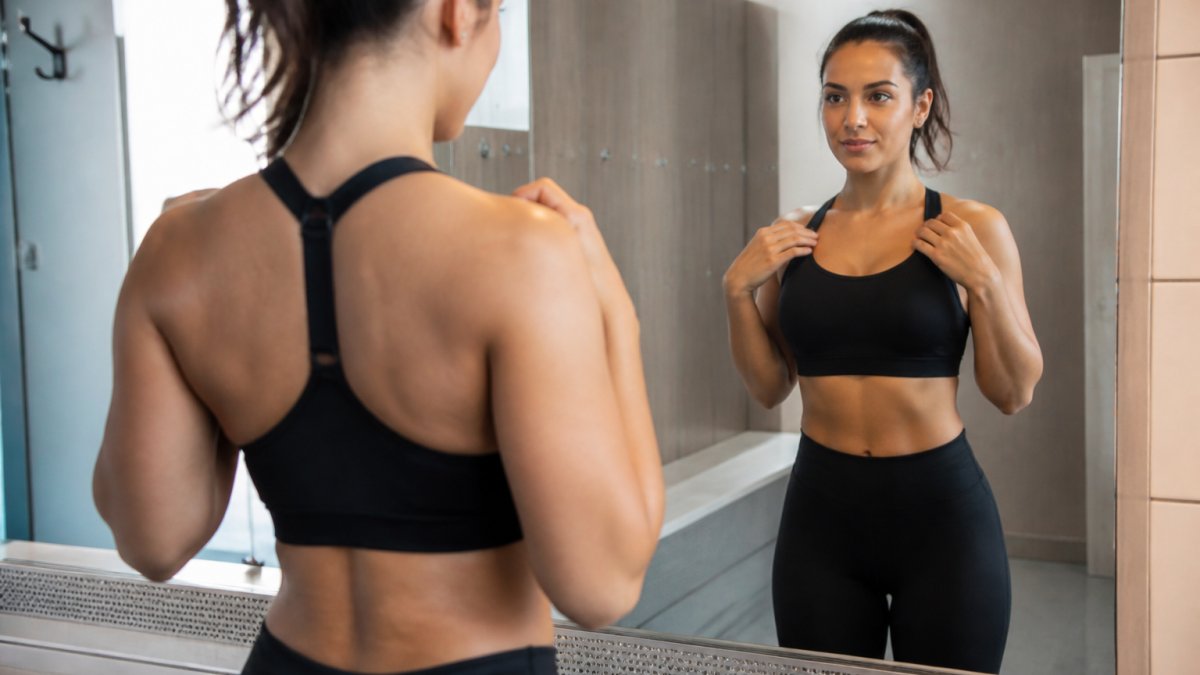
Use these checks before you run in a new bra:
- Two-finger test: you should be able to slide two fingers under the band at the back without forcing it.
- Level band: the band sits horizontal all the way round, not riding up at the back.
- Strap check: straps stay put without digging into your shoulders.
- No spill: breast tissue stays inside the cups when you bend forward.
- Arm test: raise your arms overhead and check the band does not lift away.
- Breath test: take five deep breaths and confirm you can fill your lungs fully.
If any check fails, change the size or the style. A bra that passes all six standing still is ready for the run test.
Hybrid Designs, Materials and Long-Run Comfort
Hybrid bras combine compression fabric with encapsulation cups, and they are now the most common design in high-support running bras. The idea is straightforward: use structure to hold each breast, then add compression fabric to reduce residual movement.
Materials matter just as much over distance. Nylon and elastane blends are common because they stretch in four directions and recover their shape. Moisture-wicking fabric keeps sweat off the skin, which reduces chafing on long runs.
Climate changes the calculation. In warm conditions, breathable, quick-drying fabric matters more than extra structure. In cold weather, a bra that holds its shape when damp keeps you comfortable.
How to Test Support While Running (And When to Replace Your Bra)
Test a new running bra on a short, controlled run before you trust it on a long one. Warm up, then run for five minutes at your normal pace and check three things: bounce, band position and comfort.
A simple test sequence:
- Run on the spot for 30 seconds and watch for vertical movement.
- Run five minutes at pace and check the band has not ridden up.
- Sprint for 20 seconds and note any rubbing or shifting.
- Check for red marks and chafing once you stop.
Replace a bra when the band has stretched, the fabric has lost its recovery, or you notice more bounce than you did when it was new.
The right running bra is the one that passes these tests in your body, at your pace. Start with the design that matches your bust and training, then let the run decide.
Most runners settle for a bra that looks supportive and find out at kilometre eight that it is not. Browse the GrantB Core Sports Bra at £29.99, or pair it with the GrantB Sculpt Set at £59.99 for a coordinated kit that moves with you from the first stride to the final set.

Frequently Asked Questions
What is the difference between compression and encapsulation sports bras?
A compression sports bra presses breast tissue flat against your chest, holding everything close to the body to limit bounce. An encapsulation sports bra uses separate moulded cups, often with underwire, to support each breast individually. Compression suits smaller cup sizes and lower-impact activity; encapsulation gives more structured support and is usually better for larger busts and high-impact exercise such as running. Some modern sports bras combine both methods in one design.
Which type of sports bra is best for running?
For most runners, a high impact sports bra with encapsulation or a hybrid design gives the most reliable bounce control, especially at C cup and above. Compression styles can work well for A and B cups or shorter, lower-impact runs. Whichever style you pick, check that the band sits level and snug, the straps are adjustable, and you can run on the spot without excessive movement before you commit to a long run.
Are encapsulation bras better for larger breasts?
Generally yes. Separate cups hold each breast individually, which limits side-to-side and up-and-down movement more effectively than flattening tissue against the chest. For a sports bra for large breasts running, look for structured cups, adjustable straps and a firm underband. Compression-only bras can feel restrictive and may not control bounce enough at larger cup sizes, so encapsulation or a hybrid design is usually the safer choice.
How should a running sports bra fit?
The band should sit level around your ribcage and feel snug without digging in. You should be able to slide two fingers under the band, which is the two-finger rule. Straps should be adjustable and stay put without cutting into your shoulders. Cups should contain all breast tissue with no spillage or gaping. Test it by running on the spot or doing a few jumps: if you feel significant bounce or chafing, size up, adjust the straps, or try a more structured style.
Do compression sports bras reduce bounce when running?
Compression bras reduce bounce by holding breast tissue close to the body, which limits movement in all directions. The effect is strongest at smaller cup sizes and during lower-impact activity. At larger cup sizes or during high-impact running, compression alone often lets more movement through than an encapsulation or hybrid design. Whichever style you choose, a firm underband and adjustable straps matter as much as the compression itself.