

Alternatives to Compression Bras for Heavy Lifting
Table of Contents
- Why Standard Compression Bras Fall Short Under a Barbell
- Compression vs Encapsulation Sports Bra: How the Two Constructions Differ
- The Encapsulation Sports Bra for Weightlifting: What It Does Better
- Hybrid and Wired Options: The Middle Ground for Fuller Busts
- Sports Bra Fit for Weightlifting: Band, Cup and Strap Checks
- Movement-Specific Testing: Squat, Deadlift, Bench and Overhead Press
- Comfort and Mobility Under a Barbell
- Sports Bra Alternatives for Working Out: Matching Support to Session Type
- GrantB Options Compared: Core Sports Bra and Coordinated Sets
- Durability, Care and Cost Per Wear
- Frequently Asked Questions
Last Updated: October 17, 2026
Why Standard Compression Bras Fall Short Under a Barbell
Standard compression bras flatten the bust against the chest wall to limit movement. That works for steady-state running, but it is the wrong tool for heavy lifting. Under a loaded barbell you need the bust held up and apart, not squashed flat, because compression alone lets tissue shift downward as you brace.
Here is the tension most guides ignore: a bra that feels locked down in a mirror test can still fail the moment you take a deep breath and set your spine. Compression fabric has to stretch to let your ribcage expand. When it stretches, it gives. When it gives, the band rides and the bust drops.
At GrantB Sportswear we design around that trade-off rather than pretending it does not exist. The alternatives worth your money are the ones that separate support from squeeze.
Compression vs Encapsulation Sports Bra: How the Two Constructions Differ
A compression sports bra holds both breasts against the chest as a single mass, while an encapsulation sports bra gives each breast its own shaped cup. Compression controls bounce through fabric tension. Encapsulation controls bounce through structure: seams, moulded cups or an underwire that supports each side independently.

That difference matters more than any marketing label. A compression vs encapsulation sports bra decision comes down to what you are asking the garment to do. For running, compression is efficient and cheap to make. For lifting, encapsulation wins because it holds shape under load without clamping your ribcage.
Combination bras blend both: a compression outer layer over encapsulated cups. They suit fuller busts that want shape and security together. The trade-off is weight and warmth, which you will notice on a long session.
The Encapsulation Sports Bra for Weightlifting: What It Does Better
An encapsulation sports bra for weightlifting keeps each breast supported separately, so the bust stays lifted and stable while your torso expands against a belt. You get lift, separation and shape instead of a uniboob, and the band can sit firm without the cups pulling down.
The practical gains are specific. Straps stay put when you retract your shoulders for a bench press. The underband does not roll when you hinge. And because the cups carry the load, you can breathe into your belly without fighting the fabric.
Our GrantB Core Sports Bra sits in this camp. It uses an engineered underwire with adjustable straps and a structured cup for lift, in a 78% nylon, 22% elastane blend rated for high support. Removable pads let you tune the shape, and the moisture-wicking finish keeps the fabric from getting heavy mid-session. At £29.99 it is the cheapest way to test whether encapsulation suits you before committing to a full set.
Hybrid and Wired Options: The Middle Ground for Fuller Busts
Hybrid and wired sports bras combine a compression panel with shaped cups or an underwire, which makes them the strongest option for fuller busts and small bands. They deliver the bounce control of encapsulation with the security of compression across the top of the chest.
For large breasts on a small band, this is usually where the search ends. A pure compression crop in a 30GG cannot generate enough tension without cutting in, and a soft encapsulation bra can feel flimsy at the top edge. A wired or hybrid construction spreads load across the band and the cups at once.
The mechanics are worth understanding before you buy. A wired bra uses a curved underwire sewn into the underband to define the root of each breast and transfer load down into the band. A hybrid bra usually replaces the wire with a firm moulded cup or a reinforced side panel, then adds a compression layer across the upper chest. Both aim to stop the bust dropping when you brace, but they fail differently. Wires can dig in at the centre front when you lie on a bench; hybrid compression panels can flatten the profile and reduce separation.
Use your band-to-cup ratio to narrow the choice:
- Small band, large cup (for example 30-34 band, DD-H cup): prioritise a wired or firm hybrid with a wide underband and fully adjustable straps. The wire carries load the band alone cannot.
- Mid band, mid cup (for example 36-40 band, C-DD cup): a hybrid with a compression outer layer and shaped inner cups gives enough structure without excessive stiffness.
- Large band, smaller cup (for example 40+ band, A-C cup): a soft encapsulation or light hybrid is usually enough; a stiff wire may rub the ribcage during hinging movements.
Fit checks specific to wired and hybrid bras:
- The wire sits flat against your ribcage, not on breast tissue
- The centre front lies flat when you lie on a bench, with no digging
- The compression panel does not flatten the upper bust to the point of losing separation
- Side panels stay flat when you hinge, with no rolling or bunching
- Straps remain adjustable enough to shorten for overhead pressing
The honest limitation: underwires add structure, and structure adds stiffness. If you spend most of your session on a bench or a mat rather than under a bar, a softer hybrid will feel better than a fully wired bra. If you press overhead regularly, check that the wire does not rise into the sternum at lockout. A common pattern is that lifters love a wired bra for squats and deadlifts but switch to a softer hybrid for bench days.
Sports Bra Fit for Weightlifting: Band, Cup and Strap Checks
Sports bra fit for weightlifting starts with the band, not the cup. Roughly 80% of support should come from a band that sits level and firm around your ribcage, with the cups holding shape and the straps doing trim work only. If you can slide two fingers under the band at the back, it is too loose.
Run these checks before you train in a new bra:
- Band sits level front and back, no riding up when you raise your arms
- You can take a full belly breath without the band digging in
- Centre front lies flat against your sternum, no gaping
- Each breast is fully inside its cup, no spill at the top or sides
- Straps stay on your shoulders when you retract and press
- Underband does not roll when you hinge at the hips
- Hook-and-eye closure sits flat and does not press into the spine on a bench
Adjust in this order: band first, then straps, then the cups. Loosening straps to fix a tight band is the classic error, and it puts all the load on your shoulders.
Movement-Specific Testing: Squat, Deadlift, Bench and Overhead Press
Test a bra against the four lifts you actually train, not against a jog on the spot. Each lift loads the bra differently, and a bra that passes one can fail the next.
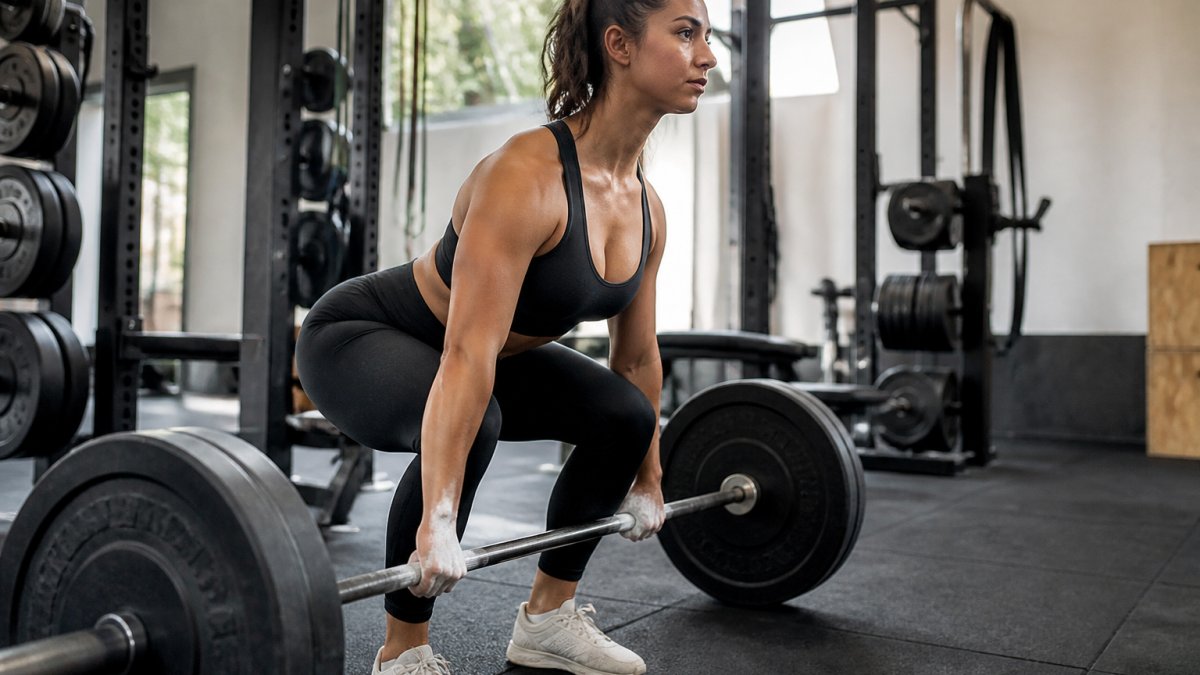
Squat: brace hard, then check the band has not shifted and the cups have not gaped at the top. A bra that rides up here will ride up on every set.
Deadlift: hinge to the bar and look for the underband rolling or the straps sliding outward. This is where wide straps earn their keep.
Bench press: lie flat and press your shoulder blades together. Any hook-and-eye hardware digging into your spine will announce itself immediately.
Overhead press: reach lockout and confirm the band stays down and the straps stay on. If the bra lifts with your arms, the band is too loose.
Comfort and Mobility Under a Barbell
Shoulder mobility decides whether a bra is usable under load. A high-coverage back panel can restrict scapular movement, and if your shoulders cannot retract cleanly, your bench and overhead press suffer before your chest does.
Look for straps that sit clear of the shoulder blade, a racer or strappy back only if you do not press heavy, and flat seams that will not rub under a belt. Breathability matters too: a barbell session is stop-start, and a fabric that traps heat will have you peeling the bra away between sets.
The test we would suggest: wear the bra for a full warm-up and one working set before you judge it. Most fit problems only show up once you are sweating and breathing hard.
Sports Bra Alternatives for Working Out: Matching Support to Session Type
Sports bra alternatives for working out should be chosen by session, not by style. Match the construction to the demand and you stop overbuying support you do not need or underbuying it where it counts.
| Session type | Best construction | Key requirement |
|---|---|---|
| Heavy compound lifting | Encapsulation or wired | Firm level band, shaped cups |
| Cross-training and HIIT | Hybrid or combination | Bounce control plus mobility |
| Running and cardio | Compression or combination | Maximum bounce reduction |
| Yoga and mobility | Light compression | Range of motion, soft seams |
| Gym-to-street days | Encapsulation with clean lines | Shape retention, low profile |
For lifting days, prioritise the band and the cups. For cardio days, prioritise bounce control. For studio days, prioritise freedom of movement. Buying one bra to do all three is how people end up with three bad sessions instead of one good one.
GrantB Options Compared: Core Sports Bra and Coordinated Sets
Our range is small on purpose, and each piece answers a different training pattern. The Core Sports Bra is the support anchor; the sets add coordinated bottoms for people who want one decision instead of two.
| Product | Price | Support | Best for |
|---|---|---|---|
| Core Sports Bra | £29.99 | High, underwire, adjustable straps | Heavy lifting and gym sessions |
| Sculpt Set | £59.99 | High, bra plus leggings | Lifting and studio classes |
| Core Shorts Set | £49.99 | Supportive vest and shorts | Cardio, strength, yoga |
| Studio Shorts Set | £44.99 | Lightweight vest and shorts | Studio and cross-training |
| Performance Set | £69.99 | Jacket and leggings, no bra | Warm-ups and gym-to-street |
The Sculpt Set is the one we would point a lifter toward first: the bra carries the support and the leggings add pockets and a flattering high waist. The Performance Set deliberately excludes a bra, so pair it with the Core Sports Bra if you want full coverage. Delivery is free, and there is £10 off orders over £100 if you are buying a set and a bra together.


Durability, Care and Cost Per Wear
Cost per wear is the number that actually matters, and it exposes cheap bras fast. A £20 bra that loses its elastane in three months costs more per session than a £30 bra that holds shape for a year. Most competitors stop at that observation; the useful part is knowing what degrades, how to spot it, and how to slow it down.
Support loss happens in a predictable order. The band goes first, because elastane in the underband is under constant tension and is the first place to fatigue. Then the straps lose recovery and start to slide. Cups are usually last to fail unless the wire breaks or the moulded foam creases. That order matters because it tells you where to inspect and where to spend.
A simple monthly check:
- Band: fasten on the middle hook. If you can pull the band more than a finger's width away from your ribcage at the back, it has stretched past lifting duty.
- Straps: shorten them fully, then let them retract. If they do not spring back, the elastane has gone.
- Cups: look for creasing at the apex or separation at the top edge. Either means the cup is no longer holding shape under load.
- Wire: run a finger along the casing. A wire that has started to poke or twist will fail during a bench press, not before.
Care decisions that actually extend life:
- Wash cold on a delicate cycle or by hand; heat is the main enemy of elastane.
- Skip fabric softener entirely. It coats the fibres and reduces the fabric's ability to recover.
- Air dry flat or hang; tumble drying breaks down elastane and moulded cup foam.
- Rotate two or three bras rather than wearing one to death. Elastane needs recovery time between wears.
- Fasten hooks before washing to stop them snagging other items and to protect the casing.
Cost per wear in practice: a £29.99 bra worn three times a week for a year works out at roughly 19p per session if it holds shape. A £15 bra that loses band tension in three months costs about 38p per session over the same period, and it will feel worse long before it fails. The calculation only works if you track when the band actually gives, which is why the monthly check is worth more than any upgrade.
When a bra retires from lifting duty, it can still work for yoga, walking or rest days. Demote rather than discard, and replace the lifting bra before the band check fails, not after.
Frequently Asked Questions
What can I wear instead of a compression bra for heavy lifting?
Encapsulation and hybrid sports bras are the most practical swaps. Encapsulation designs hold each breast in its own cup, which limits downward movement without flattening the chest. Hybrids combine a compression outer layer with moulded cups, and wired options add structured lift. For lifting, look for adjustable straps, a firm underband and a hook-and-eye closure so you can tune the fit as you warm up.
Are encapsulation sports bras better than compression bras for lifting?
For heavier lifts they usually are. Compression bras press the bust flat against the ribcage, which controls bounce but reduces separation and can restrict breathing at the bottom of a squat. Encapsulation sports bras support each breast individually, so you get bounce control with less chest compression. That matters when you need a full breath before a heavy set and when you want the band to stay put through a long session.
Do you need a high-impact sports bra for weightlifting?
Not always, but a high-impact rating is a useful signal. Heavy lifting involves less repeated bounce than running, yet the setup, bracing and sudden positional changes still move the bust. A high-impact sports bra with adjustable straps and a wide underband gives you stability during squats, deadlifts and overhead work. For accessory work or yoga-style sessions, a medium-support encapsulation bra is often enough.
How should a sports bra fit for strength training?
The band should sit level and firm on the ribcage, staying put when you raise your arms overhead. You should be able to slide two fingers under the band, no more. Cups should lie flat with no spill at the top or sides, and straps should be tightened enough to hold the cups without digging in. Test it with a few bodyweight squats and an overhead reach before your first heavy set.
How do I stop my sports bra from digging in during a workout?
Digging usually comes from a band that is too loose, forcing the straps to carry the load. Size down in the band rather than up in the cup, and use the hook-and-eye closure to fine-tune. Wide straps spread pressure across the shoulder, which helps during overhead pressing. If the underband rolls or rides up, the bra is too big in the band, not too small in the cup.