

High Impact Sports Bra for Large Busts: The Science
Table of Contents
- Why the Science of Support Matters for a High Impact Sports Bra
- How Breast Movement Happens During Exercise
- What Sports Bra Support and Breast Movement Research Actually Shows
- Encapsulation vs Compression Sports Bra: Which Suits a Large Bust?
- What Qualifies as a High-Impact Sports Bra
- Support Needs for Larger Busts and Full Cup Sizes
- Features That Improve Support and Fit
- How to Measure Sports Bra Size at Home
- Band, Cup and Strap Fit: Getting the Details Right
- Choosing a Sports Bra for Running with Large Breasts
- Matching Support Level to Workout Intensity
- How to Test Bounce Reduction and Movement Control
- Care, Durability and Support Retention
- Common Bad Advice About High Impact Sports Bras
- Conclusion
- Frequently Asked Questions
Last Updated: October 18, 2026
Why the Science of Support Matters for a High Impact Sports Bra
A high impact sports bra for large busts science has transformed is no longer a marketing slogan; it is a measurable engineering problem.

Breast tissue has no muscle of its own. It is held by skin and the Cooper's ligaments, which stretch under repeated loading.
Below, we break down how movement actually happens, what independent testing and biomechanics research suggest, and how to translate it into a bra that fits and performs.
How Breast Movement Happens During Exercise
Breast movement during exercise occurs in three directions at once: vertical bounce, side-to-side sway and forward-back displacement.
The pattern differs by activity. Running produces a high-frequency, high-amplitude cycle. Jumping and HIIT create sharp vertical spikes. Cycling and rowing load the chest more horizontally, so a bra that only stops bounce can still allow sway.
Two further variables matter. That is the entire mechanical case for a properly constructed high impact sports bra.
What Sports Bra Support and Breast Movement Research Actually Shows
Research into sports bra support and breast movement points to a consistent conclusion: the right bra reduces breast displacement substantially compared with no bra, and encapsulation-style designs tend to outperform simple compression for larger cup sizes. But the query asks for science, so it is worth being precise about what that research actually measures, how it is done, and where the evidence stops.
How breast movement is measured
Biomechanics researchers typically track breast displacement using reflective markers placed on the breast surface and captured by motion-capture cameras, sometimes paired with accelerometers or electromagnetic sensors.
Other studies use questionnaires and visual analogue scales to capture perceived support, comfort and pain, and some use pressure sensors at the shoulder straps or underband to quantify load distribution. Each method answers a different question.
What the evidence broadly supports
Across the literature, several findings recur often enough to be treated as reliable:
- Movement is multi-directional. Studies that measure in three axes find vertical and lateral displacement behave differently, and lateral sway is not automatically reduced by a bra that controls vertical bounce.
- Support needs scale with size. Larger busts experience greater absolute displacement and report more exercise-related breast discomfort, so the support requirement rises with cup and band size, not just with activity intensity.
- Encapsulation tends to outperform compression for fuller busts. Separate cups limit independent movement of each breast, whereas a single compressive panel can flatten tissue without stopping sway.
- Band and structure matter more than fabric softness. A firm underband and structured cups drive performance more than a soft, stretchy hand-feel.
What the evidence cannot tell you
Most studies use small samples, often of younger runners, and few cover the full band-and-cup range that fuller-busted wearers actually occupy. Testing conditions vary, so cross-study comparisons are unreliable. No study can tell you which specific bra will suit your body; it can only describe mechanisms and average effects.
For general health context on breast health and exercise, the NHS information on breast health and exercise is a sensible starting point.
Encapsulation vs Compression Sports Bra: Which Suits a Large Bust?
Encapsulation versus compression is the single most consequential choice for a full bust. A compression bra presses the breasts flat against the chest wall.
| Design | How it works | Best for | Trade-off |
|---|---|---|---|
| Compression only | Flattens tissue against the chest | Smaller cups, low-impact activity | Can feel restrictive; less separation |
| Encapsulation only | Separate cups hold each breast | Larger cups, high-impact activity | Bulkier construction; needs precise fit |
| Combined | Cups plus a compressive outer layer | Full bust, running, HIIT | Heavier fabric; higher cost |
For larger cup sizes, encapsulation or a combined design is usually the better answer.
The trade-off is honest: encapsulation adds bulk and usually cost. If you want a single bra that handles running and gym work, a combined design is the pragmatic choice.
What Qualifies as a High-Impact Sports Bra
A high-impact sports bra is one engineered to control breast movement during running, jumping and fast direction changes, using a firm band, structured cups and low-stretch outer fabric. The label alone proves nothing.
Look for these markers:
- A wide, firm underband that sits flat against the ribcage and does not ride up
- Structured or moulded cups rather than a single stretchy panel
- Adjustable straps that can be shortened without digging in
- A back closure that lets you set tension precisely
A high impact sports bra for large busts science has informed should also state its support level honestly. GrantB Sportswear's Core Sports Bra is built as a high-support piece, with engineered underwire, adjustable straps, removable pads and a moisture-wicking nylon-elastane fabric.
Support Needs for Larger Busts and Full Cup Sizes
Larger busts need more support, and they need it distributed differently. The load has to go somewhere: if the band is loose, it transfers to the shoulders, and shoulder straps alone cannot carry a full bust comfortably for long.
Three needs stand out for full cup sizes:
- Band stability. A wide, firm band anchored low on the ribcage stops the bra rotating and riding up.
- Cup containment. Each breast needs its own space so tissue does not spill sideways or over the top during movement.
- Shoulder comfort. Wide straps spread pressure; narrow ones cut in, especially once the band starts to stretch.
What most guides miss is that a full bust often needs a smaller band and a larger cup than expected. Many people size up in the band to get a cup that fits, which destroys band stability.
Features That Improve Support and Fit
Features that improve support are structural, not decorative. The band, the cup construction and the strap system do the work; everything else supports those three elements.
Priority features to check:
- Wide, firm band for load distribution and stability
- Encapsulation cups or a structured centre panel for separation and containment
- Adjustable straps, ideally wider at the shoulder, to tune fit as fabric relaxes
- Back closure so you can set band tension precisely rather than pulling a bra over your head
Fabric composition matters too. A nylon-elastane blend, such as the 78% nylon, 22% elastane used across GrantB Sportswear's range, gives four-way stretch with enough recovery to hold shape. Elastane provides the stretch; nylon provides durability and a smooth finish against skin.
How to Measure Sports Bra Size at Home
To measure sports bra size at home, take two measurements with a soft tape: your underband snug around the ribcage, and your bust at the fullest point. The difference between them gives your cup size.
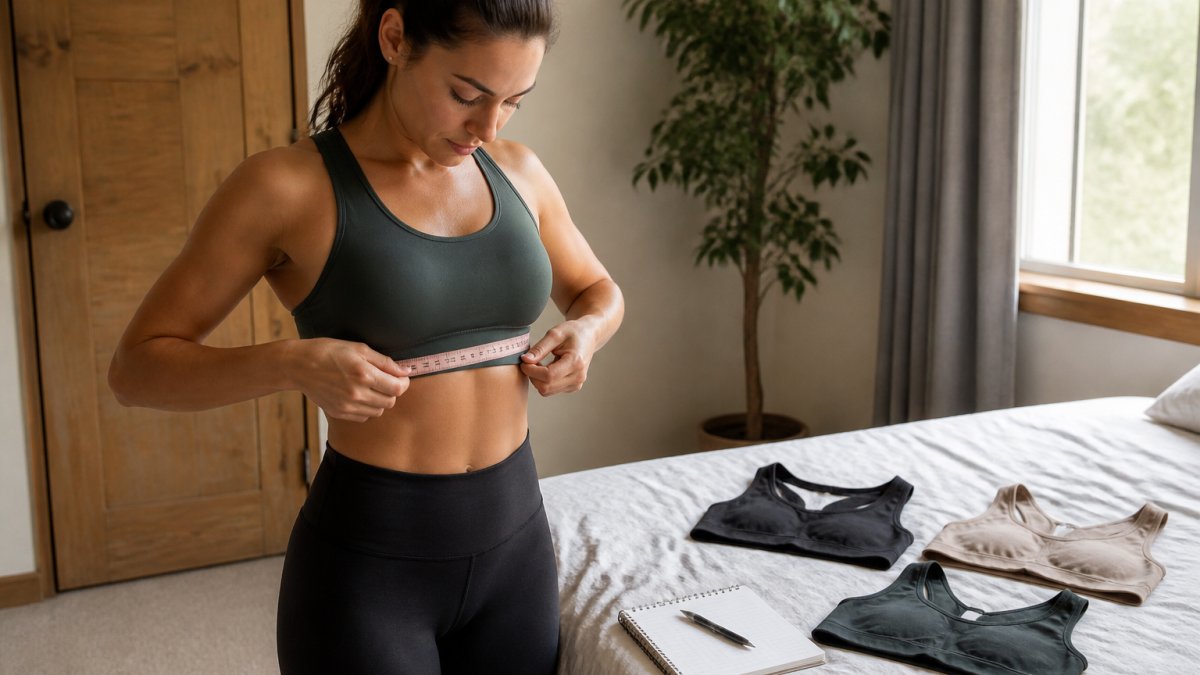
Follow these steps:
- Underband: wrap the tape snugly around your ribcage, directly under the bust, level all the way round. Note the measurement.
- Bust: wrap the tape around the fullest part, usually across the nipple line, keeping it level and not pulling tight.
- Difference: subtract the underband measurement from the bust measurement. Each inch of difference typically corresponds to one cup size.
- Round sensibly: if your underband falls between sizes, round down for a firmer fit, since bands stretch with wear.
- Re-check: measure twice. A half-inch error changes the cup you should buy.
Sports bras often run differently from everyday bras, so check the brand's own size guide before ordering.
Band, Cup and Strap Fit: Getting the Details Right
Band, cup and strap fit is where most support problems begin and end. A bra can have excellent construction and still fail if the band is loose, the cup is wrong or the straps are over-tightened to compensate.
Run this fit check:
- Band: should sit level and firm, not ride up when you raise your arms. It carries most of the weight.
- Cup: should contain all tissue with no spillage at the sides or top, and no wrinkling that suggests it is too large.
- Centre panel: should sit flat against the breastbone. If it lifts away, the cup is likely too small.
- Straps: should feel supportive without digging in. If you need them very tight, the band is too loose.
The centre panel is the detail most shoppers ignore and the one that reveals the most. A gap there means the cups are not containing you, and no amount of strap adjustment will fix it.
Choosing a Sports Bra for Running with Large Breasts
A sports bra for running with large breasts should prioritise multi-directional control and a band that stays put over distance. Running combines high frequency with high amplitude, so the bra has to hold tissue close without restricting your ribcage as you breathe harder.
What to prioritise for running:
- Encapsulation or combined construction to control both bounce and sway
- A firm, wide band that will not shift as you rack up distance
- Wide, adjustable straps that spread load across the shoulder
- Low-stretch outer fabric with breathable panels for heat management
Test before you commit to a long run. GrantB Sportswear's Sculpt Set pairs a supportive bra with moisture-wicking leggings, which suits runners who want a coordinated kit that holds up across sessions.

Matching Support Level to Workout Intensity
Matching support level to workout intensity is straightforward once you separate activity type from effort.
| Activity | Impact level | Support priority |
|---|---|---|
| Yoga, pilates, walking | Low | Comfort, shape retention, breathability |
| Cycling, rowing, weights | Medium | Band stability, containment, shoulder comfort |
| Running, HIIT, plyometrics | High | Multi-directional control, firm band, encapsulation |
The practical rule: own at least one genuinely high-support bra and use it for anything with a jump or a run in it. Medium-support bras handle gym work and cycling well.
If you train across several intensities, a combined encapsulation design covers the widest range.
How to Test Bounce Reduction and Movement Control
Testing bounce reduction and movement control yourself is simple and does not require a lab, but it does require a repeatable protocol. The aim is to reproduce the movements your activity demands, observe whether the bra holds position and contains tissue, and compare bras on the same terms rather than relying on a label's claim of "high impact".
A transparent home protocol
Run the same sequence for each bra you are assessing, in the same order, on the same day where possible:
- Fit baseline. Fasten on the loosest hook, adjust straps so they sit flat without digging, and note the starting position of the underband at the centre front and sides.
- Vertical test. Ten small jumps in place. Watch for vertical bounce and check whether the underband has shifted upward or the cups have spilled.
- Lateral test. Thirty seconds of side steps or a short grapevine. Look for side-to-side sway and whether tissue moves independently of the cup.
- Arm-raise test. Raise both arms overhead and lower them. The band should stay level and the cups should stay in place.
- Jog test. Sixty seconds of jogging on the spot. Check whether the straps need tightening or the band has ridden up.
- Breath test. Five deep breaths. If you cannot breathe fully, the band is too tight regardless of how well it controls movement.
Score each bra pass or fail on each test, and note where it failed. A bra that passes vertical but fails lateral is controlling only one axis, which is not enough for running or plyometrics.
Making it more measurable
You can add simple measurement without specialist equipment. Use a soft tape to record underband position before and after each test, and note strap tension by counting how many fingers fit under the strap at the shoulder. For a more objective read on vertical movement, film a short clip from the side at chest height and compare the highest and lowest points of a fixed reference point on the bra between frames.
What to compare and what to ignore
Compare bras on the same tests, in the same order, and record failures rather than overall impressions. Ignore claims that cannot be verified: a label saying "high impact" is a marketing category, not a measurement. Pay attention to whether the band stays level, whether the centre panel lifts away from the breastbone, and whether you need to adjust mid-test. Those are the observable signs that a bra is or is not controlling movement in more than one direction.
Re-test over time
Support retention changes as fabric relaxes. Repeat the protocol after a few washes and again after a couple of months of regular wear. When a bra that previously passed the lateral and arm-raise tests starts to fail them, the elastic has lost recovery and it is time to replace it, even if the fabric still looks intact.
Care, Durability and Support Retention
Support retention depends on how you wash and dry a bra as much as on how it was built. Elastane degrades with heat and harsh detergents, and a band that has lost its recovery will no longer carry load, no matter how good the cups are.
Care rules that protect support:
- Wash on a cool, gentle cycle, ideally in a mesh bag, or hand wash
- Use a mild detergent and skip fabric softener, which coats elastic fibres
- Never tumble dry; air dry flat or hung, away from direct heat
- Fasten hooks before washing to prevent snagging
Expect a high-support bra to lose some firmness over time. When the band no longer sits flat on the loosest hook, or the cups start to wrinkle, it is time to replace it.
Common Bad Advice About High Impact Sports Bras
Bad advice about high impact sports bras tends to come from the same handful of myths. They sound reasonable, which is why they persist, and each one costs you support.
- "Size up in the band for comfort." This is the most damaging myth for a full bust. A loose band shifts load to the shoulders and the bra rides up.
- "Compression is always best for large busts." Compression flattens but does not always control independent movement. Encapsulation usually suits larger cups better.
- "Tighter means more support." Over-tightening restricts breathing and circulation and causes chafing. Support comes from structure, not from pressure.
- "Any sports bra works for any workout." A low-support bra for running is a false economy. Match the bra to the impact level.
The thread running through all of these is the same: support is engineered, not squeezed in. Buy for construction and fit, then verify with a simple movement test rather than trusting the label.
Conclusion
The science of support comes down to a simple idea: control movement in every direction, distribute load through a firm band, and fit it precisely enough that you never need to adjust mid-session.
At GrantB Sportswear, we build for that standard. Our Core Sports Bra combines engineered underwire, adjustable straps and moisture-wicking fabric for high-support training, while the Performance Set layers cleanly from studio to street.

Frequently Asked Questions
What makes a sports bra high impact?
A high impact sports bra is built to limit breast movement during activities like running, HIIT and plyometrics. The markers are a firm, wide underband, low-stretch fabric, structured cups or an underwire, and adjustable straps that hold the bust close to the chest. Support level comes from construction, not from how tight the bra feels. A bra that compresses the ribcage but lets the bust move independently is not doing the job, however much it costs.
How should a high impact sports bra fit on a larger bust?
The band should sit level and firm around the ribcage, snug enough that you can slide two fingers underneath but not a whole hand. Every breast should be fully inside the cup with no spill above the edge or at the sides, and the centre panel should sit flat against your sternum. Straps should be wide and adjustable without digging into the shoulders. If you can fit a fist between the band and your back, size down in the band and adjust the cup to match.
Do encapsulation sports bras provide more support than compression bras?
For larger busts, encapsulation styles usually control movement better because each breast is held separately in its own cup rather than flattened against the chest. Compression works by pressing the bust inward, which can feel restrictive and often lets tissue shift sideways. Many high-support designs combine both: shaped cups for containment plus low-stretch fabric for overall stability. The right choice depends on your cup size and the activity, and a hybrid build tends to suit running and heavy training best.
How can I reduce breast movement when running?
Start with the band. Most movement comes from a loose underband allowing the whole bra to shift, so a firm wide band is the single biggest fix. Choose a sports bra for running with large breasts that uses encapsulation cups and low-stretch fabric, then tighten the straps so the bust sits high and close. Layer a compression top over an encapsulation bra for extra control on long runs. Replace the bra once the band stretches, since support fades before the fabric looks worn.
Can the wrong sports bra cause breast pain during exercise?
Yes. A bra that is too loose lets the bust move further than the supporting ligaments comfortably allow, which can cause aching and soreness after training. A bra that is too tight restricts breathing and can rub along the band and straps, leading to chafing. Neither problem is solved by ignoring it. If pain persists, is one-sided, or comes with a lump or skin changes, see a GP rather than assuming it is a fit issue.
How often should you replace a sports bra?
Replace a high impact sports bra when the band stops holding firm, usually after roughly 30 to 40 wears for a bra in heavy rotation, or sooner if you machine wash it warm. Signs to watch for are a band that rides up at the back, straps that need constant retightening, and cups that no longer contain the bust during a bounce test. Rotating two or three bras and washing them cool on a delicate cycle keeps elastic working longer.
Are high impact sports bras suitable for strength training?
They work well for lifting, though the demands differ from running. Strength work involves less vertical bounce and more bracing, so a firm band and structured cups help you breathe and brace without the bust shifting under load. Look for a bra with a back closure you can adjust and straps that sit clear of your shoulder blades during pressing and pulling. A high impact sports bra is a sensible choice for compound lifts, and GrantB's Core Sports Bra uses engineered underwire and adjustable straps for exactly this kind of session.
What features should I look for in a sports bra for a large bust?
Prioritise a wide, firm underband, encapsulation cups or an underwire, wide adjustable straps, a back closure for fine-tuning, and low-stretch fabric that still manages moisture. A centre panel that sits flat adds stability, and removable pads let you adjust coverage. Breathable fabric and moisture management matter for chafing and comfort over long sessions. GrantB's Core Sports Bra, at £29.99, combines engineered underwire, adjustable straps and a 78% nylon, 22% elastane blend for four-way stretch.