

7 Ways Supportive Gear Improves Movement During Workouts
Last Updated: October 24, 2026
Quick Summary
Supportive gear holds your body in a stable position while you train, so your joints track properly through each rep and fabric stays where it belongs during fast movement. It reduces the small adjustments that break your focus mid-set and adds confidence, which changes how hard you push.
- Match the support feature to the movement demand, not the label on the tag.
- Wear the least support that does the job and save the heaviest support for the heaviest lifts.
- Never size down to get more compression, as a too-tight band restricts breathing and rib movement.
- Test fit through the actual range of motion, since a band that feels fine standing can ride up in a deep squat.
- The GrantB Core Sports Bra at £29.99 uses a 78% nylon, 22% elastane blend with engineered underwire and adjustable straps.
Table of Contents
- Why Supportive Gear Changes How You Move
- How to Choose Activewear That Supports Movement
- High-Impact Sports Bras: Support Where It Counts
- Compression Leggings for Exercise: What They Do and Don't Do
- Gym Accessories for Training: Bands, Grips and Portable Equipment
- Matching Support to the Movement: Squats, Runs and Change of Direction
- When Support Helps and When It Restricts Movement
- Accessibility and Adaptive Equipment Selection
- Care, Durability and Replacement Indicators
- Building Your Supportive Gear Kit at GrantB Sportswear
- Frequently Asked Questions
Why Supportive Gear Changes How You Move
Supportive gear is apparel and equipment built to hold your body in a stable position while you train, so your joints track properly through each rep. At GrantB Sportswear, we design our gymwear around one idea: the right support changes how you move, not just how you look.
That matters more than most people think. The American College of Sports Medicine notes in its 2026 trend forecast that exercise professionals can combine training formats to help clients improve posture, mobility and core control, which supports safer movement during strength training (ACSM's 2026 fitness trends forecast). Gear is part of that picture.
A 2025 study led by W. Xiao found evidence that functional training benefits athletes' physical and technical performance (study on functional training and performance). Supportive kit helps you train that way with fewer distractions.
Here is the short version of what good support does:
- It keeps fabric and joints where they belong during fast movement
- It reduces the small adjustments that break your focus mid-set
- It adds confidence, which changes how hard you push
Below, we break down seven ways supportive gear improves movement during workouts, and how to pick the right pieces.
How to Choose Activewear That Supports Movement
Start with the movement, not the colour. The best activewear choice depends on what your body has to do in it: squat, sprint, twist, or hold a pose. A common mistake is buying one outfit for everything and wondering why it fails at half of it.
Work through these questions before you buy:
- What is your main training type each week?
- How much impact does it involve: running, jumping, lifting, or flow?
- Do you need the piece to work outside the gym too?
- How often will you wash it?
For a deeper walkthrough, our guide on how to choose supportive gym bras covers strap types, band fit and support levels in detail.
Fit, Sizing and Safe Use
Fit is the whole game. A band that rides up or a waistband that rolls down means the gear is not supporting you, it is interrupting you. Check these before you train in something new:
- The band sits flat and does not lift when you raise your arms
- The waistband stays put through a test squat
- Straps do not dig in or slide off your shoulders
- Nothing restricts your breathing
Our sports bra sizing guide explains how to measure yourself properly, which removes most of the guesswork.
Watch out: never size down to get more compression. A too-tight band restricts breathing and rib movement, which is the opposite of support.
High-Impact Sports Bras: Support Where It Counts
A high-impact sports bra is the single most important piece of supportive gear for anyone who runs, jumps or does HIIT. It limits breast movement at the source, which changes how freely you can move your shoulders and upper back.
Look for three things:
- Engineered support, such as underwire or a structured cup
- Adjustable straps so you can dial in the fit
- Moisture-wicking fabric that keeps its shape when wet
Our GrantB Core Sports Bra (£29.99) is built with a 78% nylon, 22% elastane blend, engineered underwire, adjustable straps and removable pads. It is rated high support for running, HIIT, gym training and yoga. The four-way stretch means your shoulders can still rotate freely when you press overhead.
If you have been making do with a light support bra for burpees, that is the upgrade worth making first.
Compression Leggings for Exercise: What They Do and Don't Do
Compression leggings for exercise give you a secure, held-in feel and stay in place through movement. What they do not do is magically improve your lifts. Be sceptical of any brand that says otherwise.
What good compression actually delivers:
- Fabric that stays put during squats and lunges
- Reduced fabric shift, so you stop tugging mid-set
- A smooth surface under bars and bands
- Confidence in deep positions
What it does not do:
- Replace warm-ups or mobility work
- Fix poor squat mechanics
- Make you stronger on its own
For lifters who want maximum hold, our roundup of high compression gym leggings compares the options worth considering.
Gym Accessories for Training: Bands, Grips and Portable Equipment
Gym accessories for training fill the gaps your main kit leaves. A resistance band adds tension where dumbbells cannot reach. A gripping aid keeps your hands on the bar when your forearms give out first. Portable equipment means you can train the same movement patterns anywhere.
The accessories that earn their place in most bags:
- Resistance bands for warm-ups, glute work and band pull-aparts
- Grips or straps for pulling movements
- A foam roller for recovery between sessions
- Sliders or a small mat for home workouts
A band pull-apart before pressing does more for shoulder position than most people realise. It wakes up the trap muscles and rear shoulders, which sets your posture for the whole session.
Keep the kit small. Three well-chosen accessories beat a bag of things you never use.
Matching Support to the Movement: Squats, Runs and Change of Direction
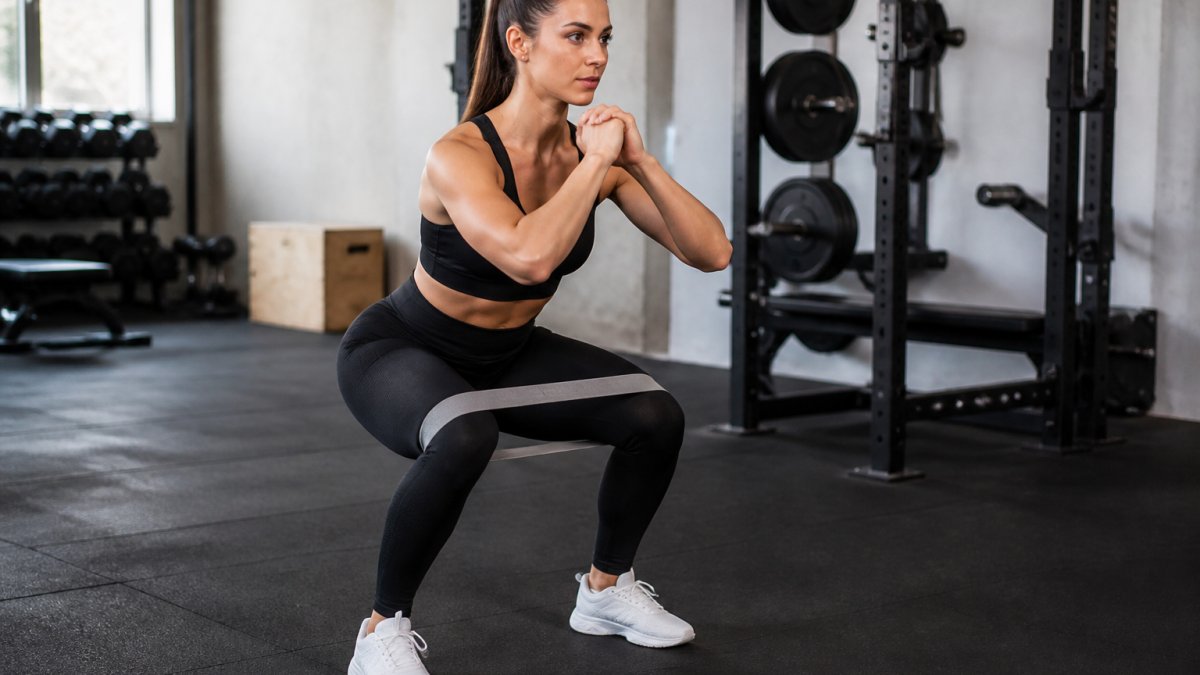
Different sports ask different things of your gear. Matching support to the movement is where most buying decisions go wrong, because people shop by look instead of by demand. The table below maps the main movement demands to the support features that actually matter, then explains how to check fit and use each one safely.
| Movement demand | What your gear must do | Support features to look for | Fit check before you train |
|---|---|---|---|
| Squats and deadlifts | Stay in place through deep hip and knee flexion; resist stretching thin | High-waisted band, squat-proof knit, four-way stretch, flat seams | Do three bodyweight squats: the waistband should not roll or slide, and the fabric should not go sheer at the back |
| Running and jumping | Limit bounce and manage impact without restricting breathing | High-impact bra with structured cup or underwire, adjustable straps, moisture-wicking fabric; cushioned trainers | Jog on the spot for 30 seconds: straps should stay on the shoulders and the band should sit flat against the ribs |
| Change of direction | Move with you with no slipping or bunching | Four-way stretch shorts or leggings, silicone or grippy hem, secure waistband | Do two lateral shuffles each way: hems should not ride up and the waistband should not twist |
| Yoga and mobility | Hold shape while allowing full range | Fitted top with soft support, seamless construction, lightweight stretch fabric | Reach overhead and fold forward: nothing should dig in at the shoulder or hip |
| Pulling and carrying | Protect the hands and keep grip on the bar | Grips or straps, chalk if your gym allows it, a belt only for near-maximal lifts | Hang from a bar for 20 seconds: straps should not pinch the wrist or slip |
Three rules sit behind that table.
First, match the feature to the demand, not the label. A legging marketed as "compression" may still roll down in a squat if the waistband is narrow; a bra marketed as "high impact" may still let the band lift if the underband is too loose. Check the feature, not the word on the tag.
Second, use the smallest amount of support that does the job. A belt or brace worn for every set can stop the trunk muscles doing their own stabilising work, so save the heaviest support for the heaviest lifts and let lighter sessions train your own control. The same logic applies to compression: it is useful for high-impact and fast work, less so for long, low-intensity sessions.
Third, test fit in the movement you will actually do. A band that feels fine standing can ride up in a deep squat; a bra that fits in the mirror can lift when you run. Try the piece through the specific range before you commit to it.
For squats and lifting, our squat proof leggings for training guide covers what to check for coverage and hold. Running shoes matter here too: cushioning and forward motion come from the shoe, not the legging. The Nike Downshifter 14 (£59.95) pairs a breathable mesh upper with a soft foam midsole and rubber outsole for grip.
When Support Helps and When It Restricts Movement
Support helps when it holds a joint or fabric steady without limiting your range. It restricts when it stops your body doing what the movement needs. The line between the two is fit and purpose.
Support tends to help when:
- You are doing high-impact or fast work
- You need fabric to stay put through deep ranges
- You want confidence to push closer to your limit
Support tends to restrict when:
- The band or waistband is too tight to breathe in
- A brace stops a joint moving through its full range
- You wear high-compression kit for long, low-intensity sessions
A 2024 review led by L. K. Skopal looked at how mobility training affects performance in sporting populations, and the takeaway is simple: mobility work and the gear around it should help you move more freely, not less (review of mobility training in sport). If a piece of kit makes you stiffer, it is the wrong piece.
Accessibility and Adaptive Equipment Selection
Adaptive equipment is gear chosen or adapted so a person can train the movement that suits their body. Good selection starts with the person and the movement, not the product. Most guidance stops at "ask for adjustable features"; the framework below is more useful because it turns that advice into a repeatable decision process.
Start with the movement, then the barrier
Write down the movement you want to do and the single thing that currently stops you. Examples:
- "I want to do a seated press, but my grip fails before my shoulders do."
- "I want to row, but my hip range makes the catch position uncomfortable."
- "I want to do floor-based mobility work, but getting down and up is the hard part."
Naming the barrier tells you which support feature to look for. A grip problem points to straps, a wrist wrap or a band instead of a dumbbell. A hip-range problem points to a raised seat, a wedge or a shorter range of motion. A floor-access problem points to a raised mat, a bench or a chair-based variation.
Choose the feature that removes the barrier without adding a new one
| Barrier | Support feature to consider | Trade-off to check |
|---|---|---|
| Limited grip | Wrist straps, lifting hooks, band instead of dumbbell | Straps can mask grip weakness if used for every set; use them for the target movement, not all training |
| Limited hip or ankle range | Wedge, raised heel, elevated seat, shorter range | Raising the heel can shift load to the knee; test the variation before adding load |
| Limited balance or standing tolerance | Seated or bench-supported variations, stable chair, wall support | Seated work reduces whole-body demand; pair it with standing work where possible |
| Limited shoulder range | Band instead of bar, landmine or angled press, shorter range | A shorter range is still training; build range gradually rather than forcing it |
| Limited floor access | Raised mat, bench, chair-based mobility | Raised surfaces change leverage; check the setup is stable before you load it |
Test fit in three positions
Before you train in a new piece, test it seated, standing and mid-movement. A strap that fits seated can dig in when you stand; a band that feels right standing can slip when you sit. Adjust straps, bands and closures before adding more support, and re-check after the first set, gear shifts as you warm up.
Prefer adjustable over fixed
Straps, removable pads, hook-and-loop closures and stretch fabrics adapt far better than fixed designs. Adjustability matters more for adaptive use than for general training, because the same person may need different settings on different days. A piece that cannot be adjusted is a piece that only fits one version of you.
None of this is a compromise; it is good selection. The goal is the same as for any athlete: the least support that lets you train the movement well, with the freedom to progress as your capacity changes.
Care, Durability and Replacement Indicators
Wash your kit properly and it lasts. Elastane breaks down with heat and harsh detergent, which is why expensive pieces sometimes fail early. Follow the care label, use a cool wash and skip the fabric softener.
Signs it is time to replace a piece:
- The waistband no longer stays up during a test squat
- Fabric has gone thin or see-through when stretched
- Straps have lost their stretch or elasticity
- Seams are pulling or pilling heavily
- The band no longer sits flat against your ribs
A sports bra usually needs replacing before leggings do, because the band and straps take the most load. Check yours every few months by raising your arms and doing a few jumps. If it moves more than it used to, it has done its job.
Building Your Supportive Gear Kit at GrantB Sportswear
Build the kit in order of what your training demands most. For most people that means a high-support bra first, then leggings that stay put, then the small accessories that sharpen your movement.
Our own kit is built for exactly this:
- The GrantB Core Sports Bra at £29.99 for high-impact support with adjustable straps
- The GrantB Sculpt Leggings at £34.99 with a squat-proof, non-see-through fabric and a waistband designed to stay in place
- The GrantB Training Shorts at £24.99 with a high-waisted band and four-way stretch
All three use the same 78% nylon, 22% elastane blend, so the fit and feel stay consistent across the set. Delivery is free, and you get £10 off orders over £100.

Frequently Asked Questions
What should I look for in workout clothes for support and mobility?
Look for four-way stretch fabric, a waistband that stays put, and seams that do not dig in. A 78% nylon, 22% elastane blend, like the fabric in GrantB's Sculpt Leggings (£34.99), gives a second-skin feel with enough stretch for squats and lunges. Check that the top offers the right support level for your activity, and try a few movements in front of a mirror before you commit to a full session.
Can workout clothes restrict movement?
Yes. Gear that is too tight, has rigid seams or uses low-stretch fabric can limit your range of motion, particularly in the shoulders and hips. Compression leggings for exercise should feel firm but not restrictive, and you should be able to reach overhead and squat to full depth without the fabric pulling. If you feel pinching or the waistband rolls, size up or switch to a four-way stretch option.
What is the difference between compression clothing and supportive workout gear?
Compression clothing applies firm, consistent pressure to the body, while supportive gear focuses on structure, fit and staying in place during movement. A high-impact sports bra with adjustable straps and engineered underwire, such as the GrantB Core Sports Bra (£29.99), is supportive rather than compressive. Many pieces combine both: the Sculpt Leggings (£34.99) use supportive compression with a high waistband that stays put through squats and cardio.
How can I tell if activewear fits properly?
Do a five-minute movement test: squat, lunge, reach overhead and jog on the spot. The fabric should not go see-through when stretched, the waistband should stay flat, and the straps should not dig into your shoulders. GrantB's Training Shorts (£24.99) are designed with a high-waisted supportive band and four-way stretch, so you can check that the fit holds through squats and lunges before you train for real.
The hardest part is not buying gear. It is knowing which piece your training actually needs first. Start with the movement you do most and build outward from there. Get started with GrantB Sportswear and train with kit that sculpts, supports and moves with you from your first rep to your final set.
