

How to Choose Supportive Gym Bras: Fit Guide 2026
Table of Contents
- Support Levels Explained: Matching Your Bra to Your Training
- High Impact Sports Bra vs Low Impact: What Actually Changes
- How to Measure Sports Bra Size at Home in Four Steps
- Compression vs Encapsulation: Which Build Suits Your Workout
- Signs Your Sports Bra Is Worn Out (and When to Replace It)
- The Fit Test: Checking Underband, Straps and Cups Before You Buy
- Choosing Supportive Gym Bras by Activity: Running, Lifting, Yoga and HIIT
- Sizing Across International Standards and Post-Surgery Support
- Frequently Asked Questions
Last Updated: September 26, 2026
Support Levels Explained: Matching Your Bra to Your Training
Choosing supportive gym bras starts with one question most shoppers never ask: how much movement does your training actually create? Support level is not a marketing label; it is a measure of how much bounce a bra is engineered to control, and matching it to your activity is the single biggest factor in whether you finish a session comfortable or constantly adjusting.
Low support suits walking, gentle yoga and pilates, where the chest moves minimally and breathability matters more than restraint. Medium support covers steady-state cardio, cycling and light weights. High support is built for running, HIIT and plyometrics, where vertical and lateral movement is constant.
Low, Medium and High: What Each Level Holds Up To
The practical test is simple. Jump in front of a mirror. If your chest moves more than you'd like, the support level is wrong for that activity.
| Support Level | Best For | Key Construction | Typical Fit Feel |
|---|---|---|---|
| Low | Yoga, walking, pilates | Light fabric, minimal structure | Relaxed, breathable |
| Medium | Cycling, weights, dance | Wider underband, moulded cups | Secure, flexible |
| High | Running, HIIT, plyometrics | Encapsulation, adjustable straps | Firm, locked-in |
Most women need at least two bras in rotation rather than one compromise garment.
High Impact Sports Bra vs Low Impact: What Actually Changes
The difference between a high impact sports bra and a low impact one comes down to construction, not fabric thickness. High-impact designs add structure: wider underbands, reinforced side panels, adjustable straps and often a wire-free encapsulation system that holds each breast separately rather than pressing them flat.

Low-impact bras prioritise breathability and flexibility. They use lighter fabrics, thinner straps and simpler cup construction. That is the right call for yoga, where you need your ribcage to expand freely through deep breathing.
Here is what most guides miss: a high-impact bra is not automatically "better". Worn for a slow vinyasa class, it restricts the diaphragm and feels stiff. Worn for a 10K run, a low-impact bra allows bounce that stretches the Cooper's ligaments over time. Match the bra to the movement, not to a vague idea of quality.
How to Measure Sports Bra Size at Home in Four Steps
Learning how to measure sports bra size at home takes about five minutes and a soft tape measure. You need two numbers: your underband measurement and your bust measurement. The difference between them determines your cup size.
- Measure your underband. Wrap the tape snugly around your ribcage, directly under your bust, keeping it level. Round to the nearest whole number.
- Measure your bust. Wrap the tape around the fullest part of your chest, usually across the nipple line, without compressing the tissue.
- Calculate your cup size. Subtract the underband measurement from the bust measurement. A 2.5cm difference is typically an A cup, 5cm a B, 7.5cm a C, 10cm a D.
- Convert to alpha sizing. Many sports bras use S/M/L rather than band-and-cup. Check the brand's own size chart, because alpha sizing varies significantly between manufacturers.
Reading the Tape: What Your Numbers Mean
A snug underband is the foundation of all support. If your band rides up at the back, it is too loose, and no amount of strap tightening will fix the bounce. If you can fit more than two fingers under the band, size down.
Cup fit matters just as much. If you are spilling over the top or the sides, the cup is too small, even if the band feels right. Sizing up in the band to compensate for a small cup is the most common mistake we see.
Compression vs Encapsulation: Which Build Suits Your Workout
Compression and encapsulation are the two structural approaches to bounce control, and they suit different bodies and activities. Compression bras press the breasts against the chest wall, limiting movement through firm, elastic fabric. Encapsulation bras give each breast its own moulded cup, supporting it individually.
Compression works well for smaller cup sizes and lower-impact training. It is simple, lightweight and effective when the volume being controlled is modest.
Encapsulation suits larger cup sizes and high-impact work. Separating the breasts reduces the skin-on-skin contact that causes chafing, and the individual cups control movement in multiple directions rather than just pressing downward. Many high-support designs combine both: encapsulation cups inside a compressive outer layer.
Signs Your Sports Bra Is Worn Out (and When to Replace It)
Elastane breaks down with every wash, and a sports bra that has lost its elasticity cannot deliver the support it was designed for. The signs are easy to spot once you know what to check.
- The underband no longer sits flat against your ribcage
- Straps stay stretched after you take the bra off
- The fabric has gone shiny or thin in high-stretch areas
- You are tightening the straps more than you did when it was new
- The cups have lost their shape or the padding has creased permanently
A common approach is to replace training bras every six to twelve months if you wear them several times a week, sooner if you machine wash them warm. Wash on a cool cycle and air dry to extend the life of the elastane.
The Fit Test: Checking Underband, Straps and Cups Before You Buy
Run this three-point check before you commit to any bra, whether in a fitting room or at home with a returns window open. Each check targets a specific failure mode, and each has a physical reason behind it.
The Underband: Your Foundation
The underband should sit level all the way around, snug enough that you can slide two fingers underneath but no more. If it lifts when you raise your arms, it is too loose. If it digs in and leaves red marks that last more than a few minutes, it is too tight.
Why it matters: The underband carries roughly 80% of a bra's support. When it is loose, the straps have to take over, which is why tightening straps never fixes a bouncing bra. The band also anchors the cups; if it shifts, the cups shift with it.
Red flag: A band that rides up at the back is the clearest sign it is too big. The back of the band should sit level with the front, not higher.
The Straps: Load Sharers, Not Load Bearers
Adjust the straps so they sit flat without digging in. They should carry a small share of the load, not all of it. If you need them cranked tight to feel supported, the band is too big.
Why it matters: Straps that are overtightened compress the shoulders and can cause numbness or headaches over time. They also pull the band up at the back, which undermines the foundation. A properly fitted strap sits flush against the skin without leaving deep grooves.
Red flag: If the straps leave deep indentations after 20 minutes, or if you find yourself adjusting them mid-workout, the band is not doing its job.
The Cups: Smooth, No Spillage, No Gaping
The cups should sit smooth against your chest with no spillage over the top or sides, and no gaping when you move. Bend forward, then reach overhead. If tissue shifts out of the cup in either position, the size is wrong.
Why it matters: Spillage means the cup is too small, which forces the underband to stretch and lose support. Gaping usually means the cup is too large or the shape is wrong for your breast tissue. Both cause chafing and movement.
Red flag: If you can pinch fabric at the top of the cup when standing straight, the cup is too big. If you see any tissue bulging over the edge, it is too small.
The Movement Test
A bra that passes the mirror test but fails the movement test is not the right fit. Jump, jog on the spot, and swing your arms. If you feel bounce you cannot control, or if you have to hold the bra in place, it is not supportive enough for high-impact work.
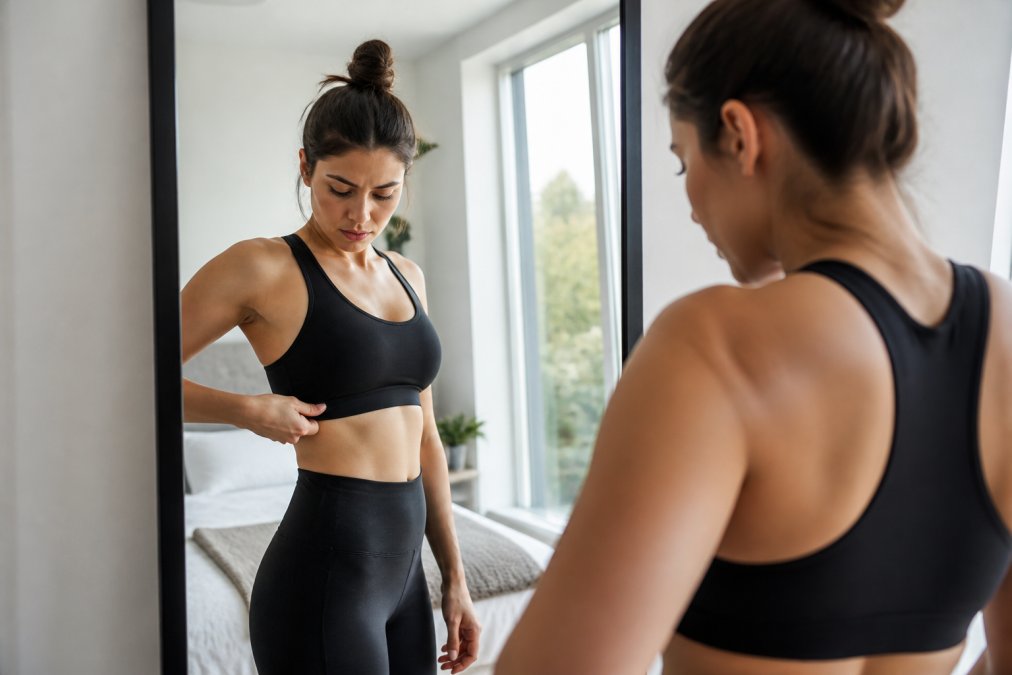
Choosing Supportive Gym Bras by Activity: Running, Lifting, Yoga and HIIT
Activity dictates construction. Running and HIIT demand high support with encapsulation, adjustable straps and a firm underband to control repetitive vertical impact. Weightlifting sits in the middle: you need a secure, snug fit that does not restrict shoulder movement during overhead presses, so look for a racerback or a bra with flexible straps.
Yoga and pilates call for medium to low support with high breathability. A wire-free, long-line design gives gentle coverage without compressing the ribcage during deep breathing.
For a single bra that covers most training, high support with adjustable straps is the safest choice. The GrantB Core Sports Bra is built exactly for this: high-impact support with engineered underwire, adjustable straps, removable pads and moisture-wicking fabric in a 78% nylon, 22% elastane blend that stretches four ways without losing shape. At £29.99, it works for running, HIIT and studio sessions alike.
If you want a coordinated kit, the GrantB Sculpt Set pairs a supportive bra with moisture-wicking leggings with functional pockets for £59.99. For warmer sessions, the GrantB Core Shorts Set swaps leggings for high-waisted shorts at £49.99.


Sizing Across International Standards and Post-Surgery Support
Sports bra sizing is not universal, and the confusion is worse than most guides admit. A 34C in one system may map to a 75C in European sizing or a 12C in Australian sizing, and alpha sizing (S/M/L) varies so much between brands that a medium in one label can fit like a small in another. This is the single most common reason online bra purchases get returned.
Why the Numbers Do Not Travel
The core problem is that band sizing uses different base measurements. A 34 band in the UK system measures roughly 34 inches around the ribcage. The equivalent European size, 75, measures 75 centimetres. They describe the same body, but the numbers look nothing alike, so converting from memory is unreliable.
Cup sizing adds a second layer of confusion. UK and US cup progression diverges after DD: a UK E is a US DDD, a UK F is a US G, and so on. European cup sizing often uses a different letter sequence again. If you order from a brand that labels in a system you do not normally wear, the letter on the tag may not mean what you expect.
| System | Band Example | Cup Example | Notes |
|---|---|---|---|
| UK | 34 | DD, E, F, FF | Cups progress in double letters after DD |
| US | 34 | DD, DDD, G | DDD replaces UK E |
| EU | 75 | D, E, F | Band in centimetres, cups often single letters |
| AU/NZ | 12 | D, DD, E | Band uses dress-size numbering |
A Practical Conversion Method
Rather than memorising a chart, use this three-step approach:
- Find your UK band and cup first. Measure at home using the method above, or get fitted in person. Your UK size is your anchor.
- Check the brand's own chart, not a generic converter. Brands cut differently, and a chart from the manufacturer reflects how that specific bra is graded.
- When in doubt, size by the underband measurement in centimetres. Most European and Australian brands publish a centimetre band measurement alongside the alpha size. Matching that number is more reliable than converting the cup letter.
If you are between sizes, remember that the underband does most of the work. A band that is slightly too snug will stretch with wear; a band that is too loose will never give you proper support, no matter how you adjust the straps.
Post-Surgery and Medical-Grade Support Needs
Post-surgery support needs a different conversation entirely, and most sports bra guides skip it. After breast surgery, many women need soft, seam-free, wire-free bras with gentle compression and front closures for easier dressing. The priorities shift: comfort and wound care come before bounce control.
Support requirements vary by procedure and stage of recovery. A lumpectomy, a mastectomy, and reconstructive surgery all have different implications for what you can wear and when. Follow your surgeon's or specialist nurse's guidance on when to return to high-impact training and what level of compression is appropriate. A well-fitted, wire-free sports bra is often the practical starting point, but medical advice comes first.
For chronic back pain, the same principle applies: a supportive underband and encapsulation cups can reduce strain, but a bra is not a medical device. If pain persists, speak to a physiotherapist or your GP before assuming a different bra will solve it.
Frequently Asked Questions
What is the 2 finger rule for bra fit?
The 2 finger rule is a quick check for underband tension. Slide two fingers under the band at the back. If they fit comfortably, the band is snug without digging in. If you can pull the band more than about 2.5cm away from your body, it is too loose and will ride up during exercise. If your fingers barely fit and the band leaves red marks, size up. This test works best on a supportive gym bra worn on the loosest hook, so you have room to tighten it as the fabric relaxes.
Should a sports bra be the same size as your regular bra?
Not always. Sports bras often use alpha sizing (S, M, L) rather than the band and cup sizing of everyday bras, so your usual 34C does not translate directly. If a bra uses band and cup sizing, start with your measured size, then check the fit test. A supportive gym bra should feel snug around the underband and fully enclose the breast tissue without spillage. Many women need a smaller band or a different cup than their daily bra because support comes from compression and encapsulation, not just coverage.
How do I know if my gym bra is supportive enough?
Test it with movement, not standing still. Jump, run on the spot or do a few burpees in the fitting room or at home. If your breasts move more than slightly, or you feel pulling in the shoulders, the support level is too low for that activity. High-impact sessions such as running, HIIT and plyometrics need high support, while yoga and walking usually work with low or medium support. A supportive gym bra should hold tissue firmly against the chest wall with no bounce that you notice mid-set.
What is the 3 bra rule for sports bras?
The 3 bra rule is a simple wardrobe guideline: keep at least three sports bras in rotation so each one has time to recover between wears and washes. Elastic fibres in the underband and straps need roughly 24 hours to return to shape after being stretched. Rotating three bras spreads the wear, keeps moisture-wicking fabric fresher and extends the life of each piece. If you train four or more times a week, four or five bras in rotation is a better target.