

Best Moisture Wicking Sports Bras for Marathon Runners: 2026 Guide
Last Updated: October 30, 2026
Quick Summary
The best moisture wicking sports bras for marathon runners are judged on how they perform after hours of sweating, not just on a dry day. Look for firm band support, flat seams, quick drying and stable fit as the bra gets wet. A bra that stays comfortable and supportive at mile 20 matters more than one that only wicks fast when dry.
- Moisture-wicking becomes critical once a run passes an hour and matters even more over 26 miles.
- Moisture management carries 25 of 100 points in the article's scoring rubric, the largest single weight.
- The band should carry most of the support, so use the firmer band and adjust straps rather than the reverse.
- Test any new bra on a longer training run before race week to catch shifting and rubbing.
- The GrantB Core Sports Bra is described as moisture-wicking, quick-drying and high-impact, at £29.99.
Table of Contents
- Why Moisture Wicking Matters More Over 26 Miles
- How We Evaluated Moisture-Wicking Performance
- Running Bra Fit Guide: Getting the Band, Cups and Straps Right
- High-Impact Sports Bras: Support Levels Compared
- Sweat Management Versus Moisture-Wicking Claims
- Preventing Chafing on Long Runs
- Comparing the GrantB Sportswear Range for Long-Distance Running
- Choosing Your Marathon Bra: Which GrantB Piece Fits Your Training
- Booking Your Fit Check and Ordering Before Race Week
- Frequently Asked Questions
Why Moisture Wicking Matters More Over 26 Miles
Moisture-wicking performance becomes critical once a run stretches past an hour, and it matters even more over a full marathon distance, which is why choosing the right moisture wicking sports bras makes such a difference. Sweat that stays on the skin for hours softens the fabric, adds weight, and creates friction. That friction is the root of most long-run irritation. This guide explains how to judge whether a sports bra can handle it.
A fabric label tells you what the material is made of, not how it performs once you are sweating at mile 20.
Why does this matter over 26 miles specifically? A short run gives your skin little time to react to damp fabric. A marathon gives it hours. Small problems that go unnoticed on a 5K, such as a strap that slips or a seam that rubs, become painful by the second half of the course. For that reason, the best marathon bra is not simply the one that wicks fastest on a dry day. It is the one that stays comfortable, supportive and stable as it becomes wet and heavy.
The GrantB Core Sports Bra is made from a 78% nylon and 22% elastane construction, described as moisture-wicking and quick-drying, with four-way stretch that moves with you.
How We Evaluated Moisture-Wicking Performance
Most running-bra roundups describe what editors liked without showing how they reached a verdict. This guide takes a different approach: we set out a transparent rubric so you can compare bras on the same terms, and we are explicit about what we could and could not verify.
Our scoring rubric
| Category | Weight | What we look for |
|---|---|---|
| Moisture management | 25 | Drying time after saturation, whether the fabric stays light, ventilation placement |
| Support and bounce control | 20 | Hold at pace, shape retention when wet, band stability |
| Comfort over distance | 20 | Pressure points, strap dig, band roll, seam feel at mile 18 |
| Fit and sizing range | 15 | Band and cup accuracy, adjustability, availability across sizes |
| Chafing prevention | 10 | Flat seams, covered closures, band edge finish |
| Durability and value | 10 | Wash-and-dry turnaround, shape after repeated washes, price per wear |
A bra that scores well on moisture but poorly on chafing will not win a marathon recommendation. The weighting forces that trade-off into the open.
Consistent test conditions
Where we report performance, we describe the conditions so you can judge whether they match your own running.
- Start weight versus end weight of the bra after the run, to show how much moisture it holds.
- Drying time when hung at room temperature, checked at 30-minute intervals.
- Fit drift, whether the band rides up, straps loosen, or cups gap when wet.
- Skin response, redness, rubbing or irritation at the underband, armpits and strap paths.
What we could not verify
For a deeper look at the fabric science, see our guide to moisture-wicking fabrics.
Running Bra Fit Guide: Getting the Band, Cups and Straps Right
Fit is where most marathon bras succeed or fail, and generic advice such as "make sure it fits" helps nobody at mile 20. This section gives you measurable checks and size-specific guidance so you can judge a bra before you commit to 26 miles.
The band: where support actually comes from
The band should carry most of the support, so it must sit firm and level around your ribcage without digging in. A simple test: fasten the bra and run two fingers under the band at the side. If you can slide them in easily, the band is too loose; if you cannot slide one finger in, it is too tight. The band should not lift away from your ribs when you raise your arms.
Band size is the most common sizing error. Many runners size up in the band to get a looser feel, then compensate with tighter straps. That trade-off causes shoulder fatigue and band ride-up. If you are between band sizes, choose the firmer band and adjust the straps, not the reverse.
Cups: coverage without compression
Cups should contain breast tissue fully, with no spillage at the sides and no gaping at the top. For cup sizes DD and above, encapsulation styles, where each breast sits in its own shaped cup, usually give more shape and less compression than compression styles that flatten the bust against the chest. For A-C cups, compression styles can be comfortable and supportive, but check that the fabric does not flatten so much that the band takes all the load.
A practical cup check: lean forward and shake gently. If tissue moves outside the cup edge, the cup is too small or the style is wrong for your shape. Repeat after a short run, cups that gap when wet are a sign the fabric loses shape under moisture.
Straps: adjustability over tightness
Straps should adjust easily and stay in place without cutting into your shoulders. Use the adjustable straps to fine-tune support rather than relying on tightness alone. Overtightening straps is a common mistake that causes shoulder fatigue later in the run. A good test is to tighten the straps until the bra feels secure, then loosen each by one notch and check that the band still holds. If support collapses when you loosen the straps, the band is too loose.
Racerback and crossback designs distribute strap pressure differently. Racerback styles can suit narrow shoulders; crossback styles often reduce strap slip for runners who find straight straps slide. Try both if you have had strap-slip problems in the past.
Fit over time: test before race week
Fit is not just about the size on the label. Many runners find that a bra which feels fine in a fitting room shifts after several miles. Test any new bra on a longer training run before race week. Wear it at the pace you plan to hold on race day, and check for rubbing under the arms and along the band.
A useful long-run check is to note where the bra feels different at mile 10 compared with mile 1: does the band roll, do straps loosen, does the underband feel damp and heavy? Those changes tell you more than a static fitting.
The GrantB Core Sports Bra lists removable pads and adjustable straps, and its fit is described as true to size, fitted or relaxed. Use the adjustable straps to fine-tune support rather than relying on tightness alone.
Sizing across body shapes
Support and sizing vary across cup and band sizes, so a single "true to size" label is not enough. If you have a small band and large cup, look for encapsulation styles with adjustable bands. If you have a larger band and smaller cup, compression styles with wide underbands often stay put better. Seamless construction reduces chafing risk for runners with sensitive skin, but seamless bras can stretch more over time, check the band tension after a few washes.
High-Impact Sports Bras: Support Levels Compared
Marathon training involves a lot of repetitive impact, so support matters. High-impact bras are designed to limit bounce and reduce strain on the ligaments that support breast tissue. Low-impact bras are lighter and more comfortable for easy runs, but they may not hold up over long, sustained effort.
REI's testing identified models across low-, medium- and high-impact categories, which reflects how different runners need different levels of support. A recreational runner may be happy with medium support. A runner logging high weekly mileage usually benefits from high support.
Compression and encapsulation are two common support designs. Compression bras flatten the bust against the chest, which suits some runners but can feel restrictive over distance. Encapsulation bras hold each breast in its own cup, offering more shape and often more comfort for larger cup sizes. Our detailed comparison of compression versus encapsulation for running explains which design suits which runner.
The GrantB Core Sports Bra is described as high-impact, suitable for running and HIIT. For longer efforts, it is worth testing against your own mileage and the intensity you plan to hold.
Sweat Management Versus Moisture-Wicking Claims
Brands often use "moisture-wicking" as a catch-all phrase. It describes how a fabric moves liquid across its surface. It does not guarantee that a bra will stay dry, feel light or avoid chafing. Sweat management is a broader idea. It covers where sweat collects, how quickly it leaves the body, and whether the garment keeps its fit as it gets wet.
In practice, this means two bras with identical fabric can perform very differently. A bra with thick seams at the underbust may trap sweat against the skin. A bra with flat seams and ventilated panels may stay cooler through the same effort. The 2024 drying study supports this view: fabric is only part of the picture.
When you compare products, ask how a brand handles sweat, not just what fabric it uses. Look for details on seam construction, ventilation and how the garment performs when saturated.
Preventing Chafing on Long Runs
Chafing is the most common complaint in long-distance running, and it is almost always preventable. It happens when skin rubs against fabric or against itself, and wet fabric makes the friction far worse. The areas most at risk are the underband, the armpits, the straps and the nipples.
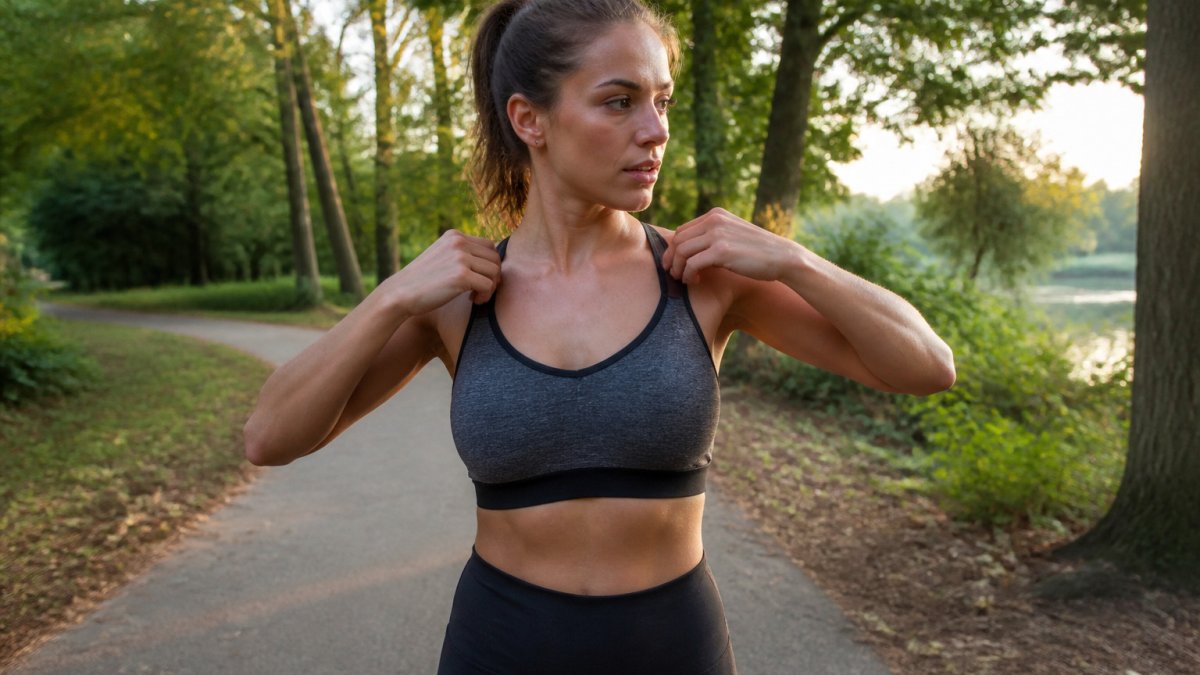
Four habits make a real difference:
- Choose flat seams wherever the fabric touches skin.
- Test the bra on a long run before race day, not just a short walk.
- Apply anti-chafe balm to vulnerable areas before you start.
- Check the band tension so it does not ride up and rub as you run.
Runner's World's testing criteria include chafing alongside support and breathability, which shows that reviewers treat it as a core performance measure. Pay attention to how a bra feels at mile 18, not just at the start line.
A quick check after a long run will tell you a lot. If you notice red marks or irritation, the bra or the fit needs adjusting.
Comparing the GrantB Sportswear Range for Long-Distance Running
The GrantB Sportswear range offers several options for runners who want coordinated pieces. The GrantB Core Shorts Set pairs a sports bra with high-waisted shorts. It is priced at £49.99, which makes it a practical choice if you want a matched outfit for training blocks.

For runners who value a complete look, the GrantB Sculpt Set combines a sports bra and leggings at £59.99.
The GrantB Performance Set adds a jacket and leggings at £69.99. Note that the sports bra is not included.

Before you choose a set, consider how you will use it. If you need a bra that performs hardest over distance, the GrantB Core Sports Bra at £29.99 is the most direct option. Pair it with a set piece for everyday training if you want a complete outfit.
Choosing Your Marathon Bra: Which GrantB Piece Fits Your Training
Your choice depends on your training load and your priorities. Here is how we would approach it:
- For long runs and race day: Start with the GrantB Core Sports Bra, which is designed for high-impact support and includes adjustable straps and removable pads.
- For a matched training outfit: The GrantB Core Shorts Set or GrantB Sculpt Set give you coordinated pieces for longer sessions.
- For cooler conditions and layering: The GrantB Performance Set adds a jacket for pre-run and post-run warmth.
Watch out: do not buy a full set purely for colour coordination if the bra inside it does not suit your impact level. Support matters more than matching pieces on a 26-mile day.

Before ordering, measure yourself carefully and check the size guidance on the product page. If you are unsure, a fit check can save you a return.
Booking Your Fit Check and Ordering Before Race Week
Order your marathon kit well before race week. Allow time to test each piece on at least one long training run. Buying new gear the week before a race is one of the most common causes of avoidable chafing.
If you want help choosing between the GrantB options, book a fit check to discuss your measurements, typical mileage and any problem areas you have had in past runs.
GrantB Sportswear offers free UK delivery and £10 off orders over £100. Order early enough to wear everything in training before you toe the start line. A well-fitting, well-tested bra will carry you through the final miles far more comfortably than one you have never run in.
Frequently Asked Questions
What is the best sports bra for marathon running?
The best option is a high-impact bra with a moisture-wicking nylon and elastane fabric, a secure band and adjustable straps, because marathon distances expose any slippage or chafing. The GrantB Core Sports Bra (£29.99) is built for high-impact support with removable pads and adjustable straps, and it suits runners who want a single bra for long runs, HIIT and studio sessions. Always check your fit before race week.
How should a sports bra fit for a marathon?
A running bra should feel snug around the band without digging in, the cups should contain you without spilling, and the straps should not slide or dig in when you move. Test the fit with a full range of movement, including running on the spot and jumping, before you commit. Because bras can feel different after several hours of wear, take a longer test run in any new bra before race day.
How often should you replace a sports bra used for running?
Replace a running bra when the elastic stretches out, the band loses its grip, or the fabric no longer recovers its shape after washing. Frequent heavy use and repeated washing break down elastane faster. Rotating two or three bras across training weeks extends the life of each one and helps you keep consistent support.
How can I prevent chafing from a sports bra on long runs?
Choose a bra with a smooth, seamless or flatlock finish under the band and cups, and make sure it fits without riding up. Apply anti-chafe balm to the band, underarms and strap contact points before you start. Keeping the bra secure reduces friction, which is the main cause of chafing on long runs.
