

Are Gym Leggings Worth the Money?
Last Updated: October 25, 2026
Quick Summary
Gym leggings are worth the money when the price pays for fabric density, waistband engineering and seam construction rather than branding. A £34.99 pair can outperform a £90 pair if the fabric composition and stitch work are right. Check for 20-22% elastane, a wide flat waistband and flatlock or bonded seams.
- Our leggings use a 78% nylon, 22% elastane composition for opacity and recovery.
- The sweet spot for elastane sits around 20-22%, not higher.
- Size to your hip measurement, not your waist, to avoid sheer fabric.
- Wash inside out at 30°C or lower and never use fabric softener.
- The GrantB Sculpt Leggings cost £34.99 and are high-waisted and squat-proof.
Table of Contents
- What You Should Actually Pay For in Gym Leggings
- How Gym Leggings Fabric and Opacity Decide Performance
- Squat-Proof Gym Leggings: What to Check Before You Buy
- Gym Leggings Sizing and Fit: Getting the Waistband Right
- Matching Leggings to Your Training: Strength, Running and Everyday Movement
- How to Wash Gym Leggings So They Last
- Cost Per Wear: What Value Really Looks Like
- Choosing Your Pair From the GrantB Range
- Frequently Asked Questions
What You Should Actually Pay For in Gym Leggings
A good pair of gym leggings is a piece of equipment, not a fashion accessory. At GrantB Sportswear, we build ours around three things that actually affect how you train: fabric density, waistband engineering, and seam construction. Everything else, from colour to branding, is decoration.
The price you pay should map to those three. A £34.99 pair can outperform a £90 pair if the fabric composition and stitch work are right. The reverse is also true: expensive leggings with thin fabric and a soft, unsupported waistband will let you down on the first heavy squat session.
Here is the honest breakdown of where your money should go:
| What you pay for | Why it matters | What to check |
|---|---|---|
| Fabric composition | Determines opacity, stretch and recovery | Nylon or polyamide with 20%+ elastane |
| Waistband construction | Keeps leggings in place during lifting | Wide, flat, no silicone-free roll |
| Seam type | Prevents chafing and blowouts | Flatlock or bonded, not overlocked |
| Gusset panel | Comfort and hygiene | Present, cotton-lined or seamless |
| Stretch recovery | Shape retention after washing | Four-way stretch, tested stretch-back |
What most guides miss is that a high elastane content is not automatically better. Too much and the leggings feel thin and lose opacity. Too little and they bag at the knee. The sweet spot sits around 20-22% elastane, which is exactly what we use in our range.
How Gym Leggings Fabric and Opacity Decide Performance
Opacity is the single most common complaint about gym leggings, and it comes down to fabric density and colour, not price. A dense knit at a mid-weight will stay opaque when stretched over a squat; a thin knit will not, whatever the label claims.
Two variables decide whether you can bend over with confidence. First, grams per square metre: denser fabrics block light transmission when stretched. Second, the ratio of nylon to elastane: more nylon gives structure and coverage, more elastane gives stretch but thins the fabric under tension.
Research on leggings selected by athleisure consumers in the Journal of Textile Science & Fashion Technology examined the features shoppers want and the performance problems they report, and opacity under movement consistently ranks among the top frustrations. That matches what we hear from customers.
Sweat-wicking and breathability are separate properties again. A moisture-wicking yarn pulls sweat to the surface where it evaporates; a breathable knit lets air move through. You want both, and you can feel the difference within a single session.
Why the Nylon-Elastane Blend Matters
Nylon-elastane is the workhorse blend for performance leggings because it balances three things at once: durability, stretch, and a smooth second-skin finish. Nylon resists abrasion and holds its shape; elastane provides the four-way stretch that lets the fabric move with you rather than against you.
Our leggings use a 78% nylon, 22% elastane composition. The high nylon content delivers the dense, opaque handfeel that survives repeated stretching, while the elastane gives the recovery that stops knees and seats from bagging out.
Cheaper blends often swap nylon for polyester, which is fine for casual wear but pills faster under friction from barbells and mats. If you train hard, the blend is the first thing to check on the label.
Squat-Proof Gym Leggings: What to Check Before You Buy
Squat-proof means the fabric stays opaque when stretched to its limit, and you can test for it before you buy. The simplest check is the stretch test: hold the fabric against a light source and pull it gently in two directions. If you can see your hand through it, it will show under load.
Three things separate genuinely squat-proof gym leggings from pairs that merely claim it:
- Fabric weight. Lighter knits stretch thinner. Ask for the composition and look for a dense handfeel.
- Colour and lining. Darker colours hide more; a double-layer gusset or front panel adds a second barrier.
- Recovery. Fabric that springs back to shape after stretching stays opaque; fabric that stays stretched goes sheer.
A common mistake is judging opacity in the changing room mirror standing still. Squat-proofing is about dynamic stretch, so bend, lunge and twist before you commit. Verywell Fit's testing of 98 pairs of workout leggings found that opacity under movement was one of the clearest differentiators between pairs that performed and pairs that did not.
Our Sculpt Leggings are built with a dense, premium fabric explicitly designed to provide coverage when stretched, with a squat-proof construction for lunges and training.
Gym Leggings Sizing and Fit: Getting the Waistband Right
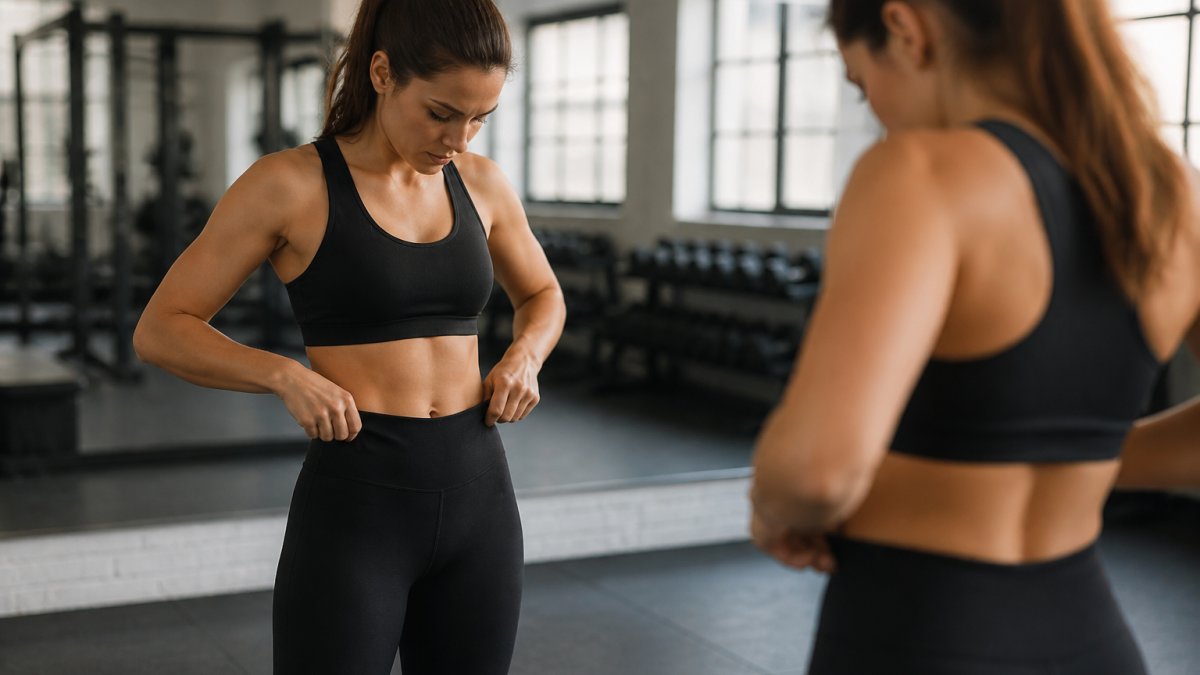
The waistband is where most fit problems begin. A waistband that rolls, digs or slides is usually the wrong width or the wrong tension for your body, not the wrong size. A wide, flat waistband distributes pressure and stays put; a narrow elastic band concentrates it and creeps down. Are high-waisted leggings better explains the benefits of waistband height in more depth.
How to Measure Yourself Properly
Most sizing errors come from measuring over clothing or guessing. Measure against bare skin, keep the tape level and snug but not tight, and write the numbers down rather than trying to remember them.
- Waist: measure at the narrowest point of your torso, usually just above the navel. Keep the tape parallel to the floor.
- Hips: measure at the widest point of your seat, feet together.
- Inseam: measure from the crotch seam of a pair of trousers that fit you well down to the hem. This is more reliable than measuring your leg, because it tells you where a legging hem will actually land.
- Rise: measure from the crotch seam up to where you want the waistband to sit, at the navel for a true high rise, below it for a mid rise.
Size to the larger of your waist and hip measurements. If your hips measure into one size and your waist into the size below, take the hip size: a waistband that is slightly relaxed can be adjusted with the drawcord or folded down, but a hip that is too tight will pull the fabric thin and compromise opacity.
Fit Troubleshooting: What Each Problem Actually Means
| Symptom | Likely cause | What to do |
|---|---|---|
| Waistband rolls down during squats | Band too narrow or too tight for your torso length | Try a wider, flat waistband; size up if the band leaves deep marks |
| Fabric goes sheer at the seat | Hip measurement too small, stretching the knit | Size to your hip measurement, not your waist |
| Leggings bag at the knee | Too little elastane or a poor recovery knit | Check for four-way stretch and 20%+ elastane |
| Hem pools at the ankle | Inseam too long for your height | Choose a cropped or short inseam, or a 7/8 length |
| Waistband digs into the ribs | Rise too high for your torso | Drop to a mid rise or a high rise with a softer front panel |
| Gapping at the back waist | Waistband tension too low for lifting | Look for a contoured or curved back yoke that follows the spine |
A common pattern is shoppers sizing down to get 'compression' and then finding the waistband rolls and the fabric thins under load. True compression comes from the knit and the band construction, not from wearing a smaller size.
Rise, Inseam and Inclusive Fit
Rise and inseam matter as much as the size on the label, and they are the two numbers most product pages leave out. A high rise should sit at or above the navel without compressing the ribs; a mid rise sits just below it. If you are long in the torso, a high rise may sit lower on you than it does on the model, check the stated rise measurement in centimetres rather than relying on the product name.
Inseam is the fix for the most common length complaint. Cropped and 7/8 lengths typically land mid-calf to just above the ankle; full length should reach the ankle without pooling. If you are shorter or taller than average, look for a brand that publishes inseam in centimetres for each cut, and treat 'full length' as a starting point rather than a guarantee.
Fit also has to work across body shapes. A curvy fit with a wider hip and a contoured waistband will stay put better than a straight-cut pair sized up. If you use a prosthetic, a stoma bag or a feeding tube, look for a high waist that sits above the device, flat seams that will not press on it, and a fabric with enough recovery to avoid bunching, and try the pair on with your usual kit before committing.
High-Waisted, Cropped and Full-Length Fits
Fit length changes how leggings perform as much as fabric does. High-waisted cuts support the core and stay put during lifting; cropped lengths suit spin and studio classes where you want airflow; full-length pairs give coverage and warmth for running and outdoor training.
Consider your inseam and where you want the hem to land. A cropped length should finish mid-calf without riding up; a full-length pair should reach the ankle without pooling. Our bootleg and flared cut is a different silhouette again, elongating the leg while keeping the supportive high waist.

Matching Leggings to Your Training: Strength, Running and Everyday Movement
Different training demands different leggings, and buying one pair for everything is where most shoppers go wrong. The useful question is not 'which leggings are best' but 'which construction suits the way I move'. Fabric weight, seam placement, waistband tension and compression all trade off against each other, so a pair built for lifting will feel restrictive on a long run, and a pair built for running will lack the lock-in you want under a barbell.
Strength Training and Lifting
Lifting rewards density and stability. Gym leggings for weight training covers which constructions hold up for strength work. A dense knit resists stretching thin when you squat, and a wide, flat waistband with a contoured back stays put under a belt. Look for flatlock or bonded seams rather than overlocked seams, because overlocked seams create a ridge that chafes where the bar or belt presses in.
- Fabric: denser, heavier knit with 20%+ elastane for recovery
- Waistband: wide, flat, high rise, ideally with a curved back yoke
- Seams: flatlock or bonded, with a gusset panel
- Avoid: soft, narrow waistbands and thin, high-stretch knits that go sheer at the bottom of a squat
Compression here is about support, not restriction. You want the fabric to hold its shape through repeated flexion, not squeeze so hard that the waistband rolls.
Running and Cardio
Running rewards breathability and low friction. You generate more heat and more repetitive movement, so lighter, sweat-wicking fabric with minimal seams reduces chafing and overheating. A secure waistband still matters, but it should be softer and more flexible than a lifting band so it moves with your stride rather than fighting it.
- Fabric: lighter, moisture-wicking knit with good airflow
- Waistband: secure but flexible, with a drawcord if you prefer a locked fit
- Seams: minimal and flat, especially at the inner thigh
- Avoid: heavy dense knits that trap heat, and pockets that bounce
If you run in the dark, look for reflective detailing at the ankle or calf, a small detail that most product pages bury.
Yoga, Pilates and Studio Classes
Studio work rewards stretch and a soft handfeel. Four-way stretch lets the fabric move through deep poses without restriction, and a smooth, seamless construction reduces pressure points when you are on the mat. Opacity still matters for forward folds and inversions, so check the fabric against a light source before you commit.
- Fabric: four-way stretch, soft handfeel, opaque when stretched
- Waistband: high rise that stays flat when you fold forward
- Seams: seamless or bonded, with no bulky side seams
- Avoid: stiff compression bands and thick seams that press into the mat
Everyday Movement and Cross-Training
If you want one pair for the gym, the commute and the school run, prioritise opacity, a flat waistband and a neutral colour. A mid-weight knit with 20-22% elastane is the usual compromise: dense enough to stay opaque, light enough to be comfortable all day. Cross-training, circuits, HIIT, rowing, sits between lifting and running, so favour a secure waistband and a fabric that wicks rather than a heavy compression knit.
| Activity | Fabric priority | Waistband priority | Seam priority |
|---|---|---|---|
| Strength training | Dense, high recovery | Wide, flat, locked-in | Flatlock or bonded |
| Running and cardio | Light, sweat-wicking | Secure but flexible | Minimal, flat |
| Yoga and pilates | Four-way stretch, soft | High rise, flat | Seamless or bonded |
| Cross-training | Mid-weight, wicking | Secure, contoured | Flatlock |
| Everyday | Opaque, mid-weight | Flat, comfortable | Flat, no chafe points |
A pair that works for a 6am spin class and an office afternoon is achievable, but only if the fabric is opaque, the waistband is flat, and the colour is neutral enough to style.
How to Wash Gym Leggings So They Last
Wash gym leggings inside out, in cold water, on a gentle cycle, and skip the fabric softener. Heat and softener are the two things that destroy elastane fastest: heat breaks down the stretch fibres, and softener coats them so they stop recovering. Air-dry flat, never tumble.
A simple routine that protects your investment:
- Turn leggings inside out and close any zips
- Wash at 30°C or lower on a gentle cycle
- Use a small amount of mild detergent, no softener
- Avoid washing with towels or Velcro, which cause pilling
- Air-dry flat or hang, away from direct heat
- Wash after every two to three sessions, not every wear
Watch out: washing leggings with heavy cotton towels is one of the fastest ways to pill the surface and dull the finish. Keep them separate.
Cost Per Wear: What Value Really Looks Like
Cost per wear is the price divided by the number of times you wear a pair, and it is the only honest way to compare gym leggings. A £34.99 pair worn three times a week for two years costs pennies per session; a cheaper pair that loses shape in three months costs far more.
Do the arithmetic before you buy. Divide the price by your realistic number of wears. If a pair survives a full year of regular training without going sheer, bagging or pilling, it has already paid for itself. The pairs that fail early are the expensive ones, whatever the ticket said.
Durability comes down to fabric density, seam quality and care. Wash them properly, rotate between two pairs, and a well-made pair will hold its shape far longer than a cheap one. That is the real value case for buying quality once.
Choosing Your Pair From the GrantB Range
Our range is built around the same fabric specification across every cut, so you can choose by fit and activity rather than compromising on performance. The GrantB Sculpt Leggings at £34.99 are our core pick: high-waisted, four-way stretch, squat-proof and non-see-through, with a supportive waistband designed to stay in place through cardio, strength work and yoga.

If you want a coordinated kit, the GrantB Sculpt Set pairs those leggings with a supportive sports bra for £59.99, and the GrantB Studio Flare Set offers a fitted vest with bootleg flared leggings for £49.99. Every piece uses the same 78% nylon, 22% elastane composition, so the performance is consistent whichever silhouette you choose.

Best for: lifters and gym-goers who want one fabric specification they can trust across cuts. Skip if: you only train occasionally and want the lowest possible upfront price.
Frequently Asked Questions
How can you tell if gym leggings are squat-proof?
Stretch the fabric across your hand and hold it up to a window or lamp. If you can see your skin clearly through it, it will likely go see-through under load. Dense, heavier fabrics hold their opacity better than thin ones. Look for a composition like 78% nylon and 22% elastane, which gives a second-skin finish with enough density for confident coverage during squats and lunges. Always test in the colour you plan to wear, since pale shades show more.
Should gym leggings be tight or loose?
They should feel compressive but not restrictive. A good pair stays in place through a full range of motion without digging into the waist or cutting off circulation. If the waistband rolls down during squats or you need to pull them up mid-set, they are too loose or the wrong shape for you. If you cannot squat comfortably or the seams pull, size up. Supportive compression should feel secure, not squeezed.
What fabric is best for gym leggings?
Nylon and elastane blends work well for most training because they combine durability with four-way stretch. The nylon gives a smooth, dense finish that resists going see-through, while elastane provides the stretch and recovery that keeps the shape after repeated washing. Moisture-wicking, breathable fabrics help during intense training. Avoid thin, high-cotton blends for heavy sessions, as they hold sweat and lose shape faster.
How should you wash gym leggings to help them last?
Wash them inside out on a cool cycle at 30 degrees or lower, and skip fabric softener, which coats the fibres and reduces sweat-wicking performance. Use a mesh laundry bag to protect seams and reduce friction, and air dry rather than tumble drying, since heat breaks down elastane. Wash after every wear to stop sweat and bacteria settling into the fabric, and keep them away from velcro and zips in the machine.
The real test of gym leggings is not how they look in the mirror, it is how they behave in your third set. GrantB Sportswear builds every pair around dense, squat-proof fabric, a supportive high waistband and four-way stretch that moves with you. With free delivery and £10 off orders over £100, you can kit out your training wardrobe without guesswork. Get started with GrantB Sportswear and train with confidence from your first rep to your final set.
