

How to Stop Activewear Smelling After Every Workout
Last Updated: October 27, 2026
Quick Summary
Activewear that does not smell comes down to fabric choice, prompt drying and the right wash routine. Odour forms when bacteria break down sweat in damp fabric, so remove sweat quickly, wash inside out in cool to warm water, skip fabric softener, and dry gear fully before storing it.
- Hang sweaty gear to dry as soon as you get home rather than leaving it in a bag.
- Turn garments inside out before washing so the inner face meets the wash water.
- Wash in a cool to warm cycle, around 30°C by default, and check the care label first.
- Skip fabric softener, since it coats fibres and reduces moisture wicking.
- Antimicrobial treatments slow bacterial growth but do not replace regular washing.
Table of Contents
- Why Activewear Smells in the First Place
- Best Fabric for Workout Clothes That Resist Odour
- Antimicrobial Workout Clothes: What the Treatments Do and Don't Do
- How to Wash Activewear So It Stays Fresh
- How to Get Sweat Smell Out of Workout Clothes That Already Stink
- How Soon to Wash Sweaty Gear and Why Timing Matters
- Matching Activewear to Your Activity, Climate and Sweat Level
- Building an Activewear Wardrobe That Stays Fresh for Longer
- Frequently Asked Questions
Why Activewear Smells in the First Place
Activewear that does not smell starts with understanding where the odour comes from. Sweat itself is largely odourless, which is why activewear that does not smell depends on managing what happens after training. The smell develops when bacteria on the skin break down sweat components, and fabric that holds moisture gives those bacteria a place to multiply. Researchers Y. Chang and colleagues reviewed this process in a 2023 review, concluding that clothing next to the underarm can develop odour, particularly when apocrine sweating is heavy Sweat and odor in sportswear - A review.
This is why a top that smells after one session can feel fine after another. The difference is usually how much you sweated, how long the garment stayed damp, and what the fabric was made from.
How apocrine sweat feeds odour-causing bacteria
Apocrine glands, concentrated in the underarms and groin, release a thicker sweat that bacteria break down into odorous compounds. Most people sweat from these glands during intense training. Left wet in a gym bag, the garment becomes a warm, humid environment where that breakdown speeds up. The fix is less about the sweat and more about how quickly you remove it from the fabric.
Best Fabric for Workout Clothes That Resist Odour
Fabric choice affects how much moisture stays against your skin and how long bacteria have to work. No fabric is completely odour-free, and anyone who tells you otherwise is overselling. Tripulse notes that TENCEL™ Lyocell can naturally resist odour during and after exercise, but it does not claim to eliminate odour altogether Sweaty Workouts: How Activewear Affects Comfort and Odor.
Natural fibres versus synthetic performance fabrics
Our GrantB Sculpt Leggings use a 78% nylon, 22% elastane blend, described as moisture-wicking and quick-drying.
Where merino and bamboo viscose fit in
Merino wool and bamboo viscose are often recommended for odour resistance. Industry analysis suggests bamboo viscose is increasingly highlighted for its thermo-regulating and odour-resistant properties 10 PFAS-Free Apparel Brands For Nontoxic Clothing. They suit low-to-moderate sweat sessions well. For heavy lifting or a hot class, a moisture-wicking synthetic blend often performs better at getting sweat off the skin quickly.
Antimicrobial Workout Clothes: What the Treatments Do and Don't Do
Many activewear brands add antimicrobial treatments to reduce odour. These can help, but they are not a substitute for washing, and the way they work matters when you are deciding what to buy. Broadly, an antimicrobial finish aims to slow the growth of odour-causing bacteria on the fabric. That is different from an odour-masking finish, which covers a smell with a fragrance or a chemical blocker without reducing the bacteria that produce it. A useful question for any brand is which of the two it is selling.
How the main treatment types work
- Silver-based finishes release silver ions that interfere with bacterial cell function. They are among the most established antimicrobial treatments in performance apparel.
- Zinc-based finishes work in a similar way, targeting bacterial growth on the fabric surface.
- Polygiene and HeiQ are brand names for treatment technologies that are applied as a finish during manufacturing. Their effect depends on the specific product and how it is applied, so the brand name alone tells you little about durability.
Jaclyn Tracy's guide points out that treatments such as Polygiene and HeiQ are often undisclosed and not regulated for dermal safety Sweat Clean: The Non-Toxic Activewear Guide. Ask brands which treatment they use and whether it has been tested for skin contact.
Why the effect fades, and what that means for buyers
Antimicrobial finishes sit on or in the fibre, and their effect usually diminishes with repeated washing and abrasion. A finish that performs well in a brand's own testing may behave differently after dozens of domestic washes, because lab tests and real laundry routines are not the same. Treat any antimicrobial claim as a helpful layer rather than a permanent guarantee, and keep washing regularly regardless. If odour control is a priority, ask the brand whether the finish has been tested after multiple wash cycles, not just on new fabric.
Silver and zinc treatments and their trade-offs
Silver and zinc-based treatments target the bacteria that cause odour. Their effect usually fades after repeated washing, and some people with sensitive skin prefer untreated fabric. Treat these as a helpful layer, not a guarantee, and keep washing regularly regardless.
Sensitive skin and treatment disclosure
If you have sensitive skin, eczema or a history of contact reactions, an untreated fabric is the lower-risk starting point. Where a treatment is present, look for a brand that names the technology and publishes care instructions specific to it. Be cautious of vague claims such as "odour-neutral" or "fresh for longer" that do not state a mechanism. A finish that is not disclosed cannot be assessed, and the absence of a disclosure is itself useful information.
How to compare treated and untreated options
When comparing two garments, weigh the treatment against the fabric itself. A moisture-wicking fabric that dries quickly may manage odour well without any finish, while a treated fabric that holds moisture may still smell. Ask three questions: what is the fibre blend, how quickly does it dry, and what finish, if any, has been applied and tested for durability? The answers are more useful than the marketing label.
How to Wash Activewear So It Stays Fresh
Most lingering smell comes from the wash routine rather than the garment itself. A repeatable routine matters more than any single product, because odour-causing bacteria and detergent residue both build up over repeated wears. The routine below is designed to be followed every time, not just when a garment already smells.
A step-by-step routine for every wash
- Deal with it the same day. Hang sweaty gear to dry as soon as you get home. If you cannot wash it immediately, air-drying first stops the damp, warm environment where bacteria multiply fastest.
- Turn garments inside out. Odour-causing bacteria and skin residue sit on the inner face of the fabric, against your skin. Turning the garment inside out exposes that surface to the wash water.
- Check the care label first. Look for the wash temperature and any finish warnings. Heavily treated or wool-blend items often need a cooler, gentler cycle than a plain synthetic blend.
- Use a cool to warm cycle. A 30°C cycle is a sensible default for most activewear; check the label before going warmer. Hot water can set odour compounds into synthetic fibres and can damage elastane over time.
- Dose detergent properly, not generously. Use the amount recommended for your load size and water hardness. More detergent does not mean cleaner gear; it means more residue left in the fibres.
- Skip fabric softener entirely. Softener coats fibres, reduces moisture wicking, and gives bacteria a film to cling to. The same applies to most combined detergent-and-softener products.
- Add an extra rinse if your machine offers one. A second rinse helps flush out detergent residue and loosened soil, particularly on thick or multi-layer garments.
- Dry fully before storage. Air-dry where possible, and make sure the garment is completely dry, including waistbands, seams and gussets, before it goes in a drawer or bag. Damp storage is one of the most common causes of a stale smell that returns within minutes of wearing.
Why detergent residue and fabric softener cause trouble
Fabric softener coats fibres and reduces their ability to wick moisture, which lets bacteria settle in. Residue from heavy detergent does the same. Skip the softener, use less detergent than you think you need, and add a rinse cycle if your machine has one. Dry gear fully before folding it away, since damp storage is a common cause of smell.
Maintenance washing versus deep cleaning
Not every wash needs to be a deep clean. A maintenance wash, the routine above, keeps gear fresh when it is washed promptly. A deep clean is for garments that already smell after a normal wash, or that have been left damp. The next section covers that process. The key distinction is that deep cleaning is a periodic reset, not a substitute for washing gear promptly after training.
What to check on the care label
Care labels vary widely between fabrics and finishes. Look for the maximum wash temperature, whether tumble drying is permitted, and any instruction to avoid biological detergent or fabric conditioner. If a garment carries an antimicrobial finish, the label or brand care page may specify a wash temperature the finish was tested at. When in doubt, wash cooler and air-dry, it is gentler on both the fabric and any treatment.
The routine below is designed to be followed on every wash, and the key settings are summarised here.
| Step | What to do | Time or frequency |
|---|---|---|
| Dry sweaty gear | Hang to dry as soon as you get home | Same day |
| Turn inside out | Expose the inner face to wash water | Every wash |
| Wash temperature | Use a cool to warm cycle | 30°C default, check label |
| Detergent | Use the recommended amount, not extra | Every wash |
| Fabric softener | Skip it entirely | Every wash |
| Extra rinse | Add one if your machine offers it | Every wash |
| Full drying | Dry completely before storage | Before storing |
How to Get Sweat Smell Out of Workout Clothes That Already Stink
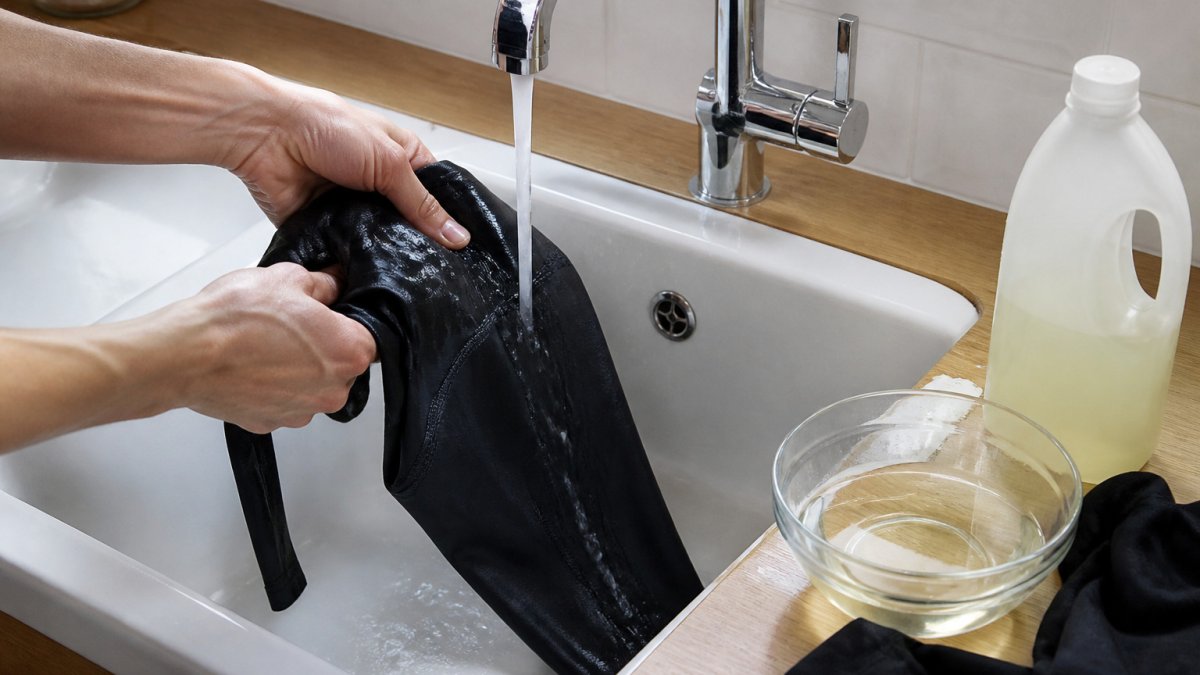
If a garment already smells, a deeper clean can help. Soak it in cool water with a cup of white vinegar for 30 to 60 minutes, then wash it as normal and air dry it. Vinegar helps loosen residue and neutralise some odour compounds. Avoid hot water on synthetic fabrics, which can set smells in.
Check the care label before soaking, and avoid bleach on coloured or treated fabrics.
How Soon to Wash Sweaty Gear and Why Timing Matters
Timing matters more than most people expect. Garments left damp for hours in a gym bag develop smell far faster than those rinsed or washed the same day. If you cannot wash straight after training, at least hang the gear somewhere airy to dry. Never leave it balled up in a bag overnight.
Matching Activewear to Your Activity, Climate and Sweat Level
Your gear should match how much you sweat. Heavy compound lifting or a hot spin class produces far more sweat than a gentle yoga session. For high-sweat sessions, prioritise fabrics that wick moisture fast and dry quickly. For cooler climates or lower-intensity training, natural fibres can be comfortable and perform well.
The Studio Vest is designed for practice and everyday wear, and the Training Shorts are designed for gym and yoga practice with breathable, moisture-wicking fabric. For a more detailed look at technical sportswear, see benefits of technical sportswear for women.
Building an Activewear Wardrobe That Stays Fresh for Longer
Rotate your gear so each piece has time to dry fully between wears. Keep at least two or three sets for regular training. Wash in small, regular loads rather than letting pieces pile up. Replace items that no longer dry properly, since worn-out fabric holds odour more readily.
For care tips in more depth, read how to wash activewear for longevity, and for a fabric-focused look at the GrantB range, see our fabrics. If you are ready to refresh your wardrobe, the GrantB Sculpt Set pairs moisture-wicking fabric with a supportive fit.
Frequently Asked Questions
What fabric is best for activewear that does not smell?
The GrantB Sculpt Leggings use a 78% nylon, 22% elastane blend described as moisture-wicking and quick-drying. The GrantB Studio Vest and Training Shorts also have moisture-wicking fabric.
Why do my gym clothes still smell after washing?
Most persistent smells come from bacteria that survive a wash and from detergent or fabric softener that coats the fibres. Washing in cold or lukewarm water with too much detergent, or drying a damp garment for hours, lets bacteria rebuild quickly. Try a full rinse, reduce the detergent amount, skip fabric softener, and air dry thoroughly. If the smell returns within a wash or two, the garment likely needs a deeper clean rather than another standard cycle.
Are antimicrobial treatments in activewear safe?
Antimicrobial finishes such as silver- or zinc-based treatments are widely used, but disclosure is not always clear and their long-term effect on the skin is not always well documented. If you have sensitive skin, check whether the treatment is listed on the label and ask the retailer for details. Treatments also tend to wash out over time, so they are not a substitute for good care. Where a product does not state its treatment, assume it has none.
