

7 Best Leggings for Weightlifting Under 50 Pounds
Last Updated: October 29, 2026
Quick Summary
The 7 best leggings for weightlifting under 50 pounds are the ones that stay opaque when stretched, hold their waistband through a full range of motion, survive contact with barbells and plates, and cost less than £50. Our GrantB Sculpt Leggings meet that checklist at £34.99, with a dense squat-proof fabric and a supportive high waistband.
- Check opacity by squatting in bright light and repeating the test with a phone torch behind you.
- Choose a waistband at least 8cm deep with a firm elastic core to resist roll-down.
- Moderate compression suits lifting better than high compression, which can restrict squat depth.
- A 78% nylon and 22% elastane blend gives four-way stretch with supportive recovery.
- Order two sizes when returns allow and test both through a squat and hip hinge.
Table of Contents
- Why Most Leggings Fail Under a Barbell
- How to Choose the Best Gym Leggings for Squats
- Squat-Proof Leggings: Testing Opacity Before You Buy
- Gym Leggings That Don't Roll Down: Waistband and Fit Checks
- Compression Leggings for Workouts: How Much Support Do You Need?
- Fabric, Stretch and Breathability for Heavy Lifting
- Durability Under Barbells, Plates and Constant Washing
- Sizing, Fit and Comfort Across Body Shapes
- Try GrantB Sculpt Leggings for Your Next Lifting Session
- Frequently Asked Questions
Why Most Leggings Fail Under a Barbell
Most leggings fail under a barbell because they were never built for one. A brisk walk and a heavy back squat put completely different demands on fabric, and the second exposes every weakness: thin material goes see-through at the bottom of a squat, a soft waistband slides down under load, and a seam that sits in the wrong place chafes against a belt.
The 7 best leggings for weightlifting under 50 pounds are the ones that pass four tests: they stay opaque when stretched, hold their waistband through a full range of motion, survive contact with barbells and plates, and cost less than £50. That last point matters more than most guides admit.
A common pattern in the gym is someone buying a pair built for yoga, wearing them for a deadlift session, and spending the next hour hitching them up between sets. The fabric was never the problem. The design brief was. At GrantB Sportswear, we build gymwear around movement under load, so we look at lifting leggings differently from a general activewear roundup.
Below, we break down exactly what to check before you buy, from opacity testing to waistband construction, so you can spend under £50 and still get a pair that holds up.
How to Choose the Best Gym Leggings for Squats
The best gym leggings for squats combine dense, opaque fabric, a wide high-waisted band that grips without digging, and flat seams that clear a lifting belt. Get those three right and everything else, from breathability to price, becomes a secondary question.
Here is the order we would check them in:
- Fabric density. Hold the fabric up to light and stretch it. If you can see your hand through it, it will not survive a squat.
- Waistband width and structure. A band of at least 8cm with a firm elastic core resists roll-down far better than a thin, soft one.
- Seam placement. Flatlock seams at the gusset and inner thigh reduce rubbing against a barbell or belt.
- Composition. A nylon-elastane blend with a high elastane content gives four-way stretch and recovery, so the fabric springs back rather than bagging out.
- Price per wear. A £34.99 pair worn three times a week for a year costs far less per session than a cheap pair replaced every two months.
Watch out: the biggest mistake is buying for the mirror rather than the movement. A sculpting fit that photographs well can still be too sheer under tension. Always test stretch, not just appearance.
Squat-Proof Leggings: Testing Opacity Before You Buy
Squat-proof leggings are leggings whose fabric stays opaque when stretched to its limit across the hips and knees, so no skin or underwear shows through during a deep squat. Opacity is a fabric property, not a marketing claim, and you can test it yourself before committing.
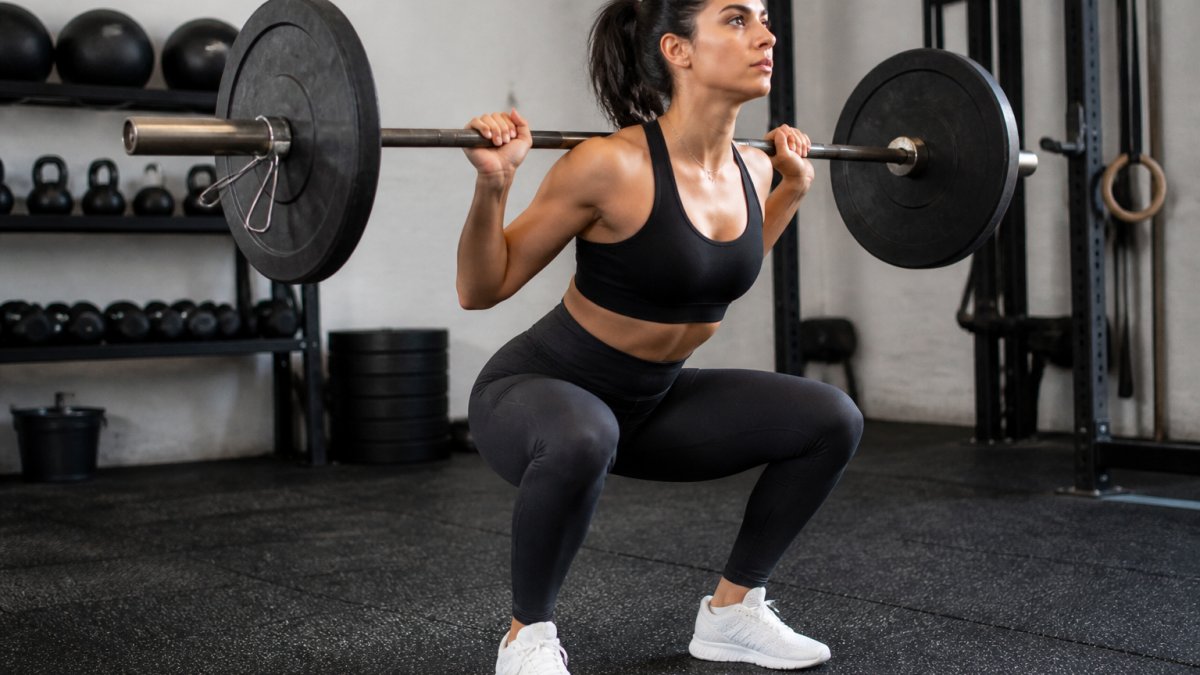
The at-home squat test is simple. Put the leggings on, stand in front of a mirror under bright light, and drop into the deepest squat you can hold. Check three zones: the seat, the inner thigh, and across the knee. Then repeat with a phone torch held behind you. If light passes through the stretched fabric, the pair is not squat-proof.
In practice, this means testing more than one colour. Darker shades hide more than light ones, and a black pair that passes can hide a problem in a pale colourway. If you buy online, read the fabric composition first: a dense knit with a higher elastane content generally holds opacity better than a thin, stretchy one.
A good pair should also pass the same test after a wash, because cheap fabric can thin over time.
Gym Leggings That Don't Roll Down: Waistband and Fit Checks
Gym leggings that don't roll down rely on a wide, structured high waistband that sits above the hip bone and grips the natural waist, rather than a soft band that folds under tension. Roll-down is usually a fit problem, not a fabric failure.
Three checks separate a stable waistband from a flimsy one:
- Band depth. Deeper bands distribute pressure and resist folding. Shallow bands curl.
- Elastic core. A firm internal elastic keeps the band anchored; a band that is only fabric will stretch out.
- Rise. A true high-waisted cut sits at or above the navel, which stops the band riding down during hip hinges.
Fit matters as much as design. A band that is too loose slides; one that is too tight rolls. If you are between sizes, size for the waist rather than the hip, and check the returns policy before ordering.
For a deeper look at the causes and fixes, read our guide on why leggings roll down.
Compression Leggings for Workouts: How Much Support Do You Need?
Compression leggings for workouts provide graduated support, but more compression is not automatically better. For lifting, you want supportive compression that never restricts a deep squat or hip hinge. The practical question is not which pair is tightest, but which pair stays supportive through the bottom of a squat without cutting in.
Think of it in three levels:
- Light support: smooth, second-skin feel. Best for yoga, mobility work and all-day wear.
- Moderate support: firm through the thigh and seat. Best for strength training and compound lifts.
- High compression: tight and technical. Best for recovery and endurance work, but often too stiff for deep squats.
For heavy lifting, moderate support is the sweet spot. You want the fabric to hold its shape under load without cutting into the crease of the hip at the bottom of a squat. A four-way stretch fabric with supportive compression gives you that balance.
A simple test in the fitting room or at home: put the leggings on and perform a bodyweight squat, then a hip hinge with a broomstick or empty bar. Check three things. First, does the fabric bunch or pull behind the knee? Second, does the waistband roll or dig when you hinge? Third, can you take a full breath into your belly without the band feeling restrictive? If any answer is yes, the compression is too high for lifting.
Compression also interacts with fabric composition. A 78% nylon and 22% elastane blend, like the one used in our performance fabric guide, gives a supportive feel without the stiffness of a higher-elastane recovery tight. The elastane content is the number to watch: too little and the fabric sags, too much and it loses structure and can feel restrictive between sets.
The one drawback of higher compression: it can feel restrictive on rest days and in the hours after training. If you want one pair for the gym and the commute, moderate support is the more versatile choice. If you already own a high-compression pair for recovery, keep it for that purpose and choose a moderate pair for lifting sessions.
Fabric, Stretch and Breathability for Heavy Lifting
Fabric decides how a legging performs under load. Nylon-elastane blends dominate lifting leggings because nylon gives durability and a smooth finish while elastane supplies the stretch and recovery that a squat and deadlift demand.
Look for four-way stretch, which means the fabric stretches in both directions rather than only across the body. That matters for lunges and split stances, where a two-way stretch fabric pulls and binds.
Breathability and moisture-wicking come next. Heavy lifting is sweaty work, and a fabric that traps moisture becomes heavy and clammy between sets. A lightweight, quick-drying knit keeps you drier through a long session.
Our own performance fabric guide breaks down how a 78% nylon and 22% elastane composition balances stretch, support and durability. The elastane content is the number to watch: too little and the fabric sags, too much and it loses structure.
Watch out: very soft, brushed fabrics feel lovely but often lack the density to stay opaque under a barbell. Softness and squat-proofing pull in opposite directions.
Durability Under Barbells, Plates and Constant Washing
Durability under barbells comes down to abrasion resistance and stitching quality. A lifting legging rubs against a bar, a belt and gym flooring, then goes through the wash several times a week, and that cycle exposes weak seams and thin fabric fast.
Check these points before you buy:
- Flatlock or reinforced seams at high-stress areas, especially the gusset and inner thigh.
- A gusset panel that reduces friction and strain at the crotch seam.
- Pilling resistance. Rub the fabric between your fingers; if it pills immediately, it will look worn within weeks.
- Colour retention. Wash instructions matter. Cold washes and air drying keep elastane alive far longer than hot cycles.
Cost per wear is the honest measure here. A £34.99 pair that lasts a year of regular training beats three cheap pairs that lose shape in months. For a fuller breakdown of what survives heavy use, see our guide to durable gym wear for heavy lifting.
Sizing, Fit and Comfort Across Body Shapes
Sizing is where most online legging purchases go wrong, because a sculpting fit should follow your shape, not squeeze you into a different one. The right pair feels supportive at the waist and free through the hip, with no digging and no gaping. For lifting specifically, the fit has to survive a deep squat, a hip hinge and a belt without shifting.
Start with your measurements rather than the label. Take a waist measurement at the narrowest point and a hip measurement at the fullest point, then compare both against the retailer's size chart. A common pattern is that lifters with a larger hip-to-waist difference need to size for the hip and rely on a drawcord or structured band for the waist, while lifters with a straighter shape often find the waist is the limiting measurement. If you sit between two sizes, size up for comfort in a compressive fabric, but check that the waistband still grips.
Fit checks once they arrive:
- The waistband stays put when you hinge forward and return to standing.
- The fabric recovers its shape after you stretch it across the knee and seat.
- No seam cuts across the crease of the hip in a deep squat.
- The leg length suits your height without bunching at the ankle.
- The gusset sits flat and does not pull when you take a wide stance.
Inclusive sizing matters too. Check the size range on each product page before you order, so you can confirm it suits your measurements. You can browse our women's plus size gymwear to see the full range of sizes available.
Comfort across body shapes also depends on rise and leg length. A true high-waisted cut sits at or above the navel, which suits most lifters, but if you have a shorter torso you may find a mid-rise more comfortable under a belt.
Try GrantB Sculpt Leggings for Your Next Lifting Session
If you want one pair that covers the checklist above without breaking a £50 budget, our GrantB Sculpt Leggings are built for exactly this job. They cost £34.99 and combine a high-waisted supportive band with a dense, squat-proof fabric designed for confident coverage through squats and lunges.

The 78% nylon and 22% elastane blend gives four-way stretch and a soft, supportive feel, while the moisture-wicking, quick-drying fabric keeps you dry through a long session. The sculpting fit is designed to enhance your natural shape, and the full-length fit is designed to provide full coverage through the leg.
Here is a summary of the key points:
| What to check | Why it matters | GrantB Sculpt Leggings |
|---|---|---|
| Opacity | Stays squat-proof under stretch | Dense, non-see-through fabric |
| Waistband | Prevents roll-down under load | Supportive high waistband |
| Stretch | Full range of motion | Four-way stretch |
| Moisture | Keeps you dry between sets | Moisture-wicking, quick-drying |
| Price | Stays under budget | £34.99 |
Best for: lifters who want squat-proof coverage and a secure waistband under £50. Skip if: you prefer a loose, unstructured fit for rest-day wear.
Frequently Asked Questions
What should I look for in weightlifting leggings?
Prioritise four-way stretch, a wide high waistband and a dense, opaque fabric. Four-way stretch lets you reach full depth in squats and deadlifts without the fabric pulling tight across the hips. The waistband should sit flat and stay put through repeated hinging. Check the fibre mix: a nylon and elastane blend such as 78% nylon and 22% elastane gives a second-skin finish with enough stretch and recovery. Seams should be flat-locked and the gusset should be seamless to avoid chafing under a belt.
How can I tell if leggings are squat-proof?
Do a squat test before you commit. Put the leggings on, stand in bright light and squat as deep as you would in the gym. Look at the fabric across your seat and upper thighs: if you can see skin tone or underwear through the fabric, it is not squat-proof. Repeat in a darker colour and a lighter colour if possible, because opacity varies between colourways. Also stretch the fabric over your hand and hold it up to the light. Dense, heavier fabric passes; thin, shiny fabric usually fails.
Are compression leggings good for lifting weights?
Compression leggings for workouts keep fabric close to the skin so it does not catch on equipment. They are not a substitute for a lifting belt and they will not add strength. Choose moderate compression that lets you breathe and hinge freely. If the waistband digs in or the fabric restricts your squat depth, size up. GrantB Sculpt Leggings use a soft four-way stretch with supportive compression.
How do I stop gym leggings rolling down during squats?
Roll-down usually comes from a waistband that is too narrow, too stretchy or sitting too low. Choose gym leggings that don't roll down by looking for a wide, high-waisted band with a firm elastic core and flat seams. Pull the band up so it sits above your hip bones, not on them. Avoid sizing down to chase compression, because an over-tight band folds over under tension. Wash in cool water and air dry to keep the elastane recovery intact, which helps the band hold its shape.
The real test of a lifting legging is not how it looks in the mirror but how it behaves at the bottom of a heavy squat. GrantB Sportswear designs gymwear around that moment, with a supportive high waistband, squat-proof fabric and four-way stretch that moves with you. Get started with GrantB Sportswear and train with confidence from your first rep to your final set.
