

What Are the Highest Quality Leggings? 2026 Review
Table of Contents
- What Makes the Highest Quality Leggings Worth Buying
- How Can You Tell if Leggings Are Good Quality? Five Checks That Take Two Minutes
- Fabric and Material Composition: What Separates Nylon From Polyester
- Fit, Sizing, Waistband Design and Squat-Proof Coverage
- Comfort, Compression and Shaping: Three Different Things
- Best Leggings for Pilates, Running, HIIT and Everyday Wear
- Recycled Polyester Leggings Durability: What the Fibre Actually Does
- How to Wash Gym Leggings So They Last Longer
- Cost Per Wear: The Value Question Behind Every Pair
- Frequently Asked Questions
Last Updated: October 9, 2026
What Makes the Highest Quality Leggings Worth Buying
The highest quality leggings still fit, cover, and hold their shape after a year of washing, not just in the changing room. This guide from GrantB Sportswear sets out the checks we use, where cheap fabric gives itself away, and what a legging really costs per wear.
Most shoppers judge leggings by feel alone. Fabric weight, stretch recovery, opacity under tension, and seam construction all separate a pair that lasts from one that goes bobbly by month three. The Textile Institute guidance on knitted fabric performance is a useful starting point if you want the technical background.
Below, we'll show you how to test a pair in two minutes, which fabric blends perform best for which activity, and why cost per wear beats price tag every time.
How Can You Tell if Leggings Are Good Quality? Five Checks That Take Two Minutes
You can tell if leggings are good quality by testing stretch recovery, opacity, seams, waistband grip, and fabric weight in about two minutes. None of these checks needs equipment, and two can be done in a shop without anyone noticing.
Pull the fabric apart firmly, hold for five seconds, then release. Good fabric springs back almost immediately; fabric that stays stretched or creeps back slowly has poor recovery and will sag at the knees and seat within weeks.
Then run your thumb along the inside of a seam. Flatlock stitching, where the seam sits flat against the skin, resists chafing and holds up to repeated washing. Overlocked seams with loose threads are a warning sign.
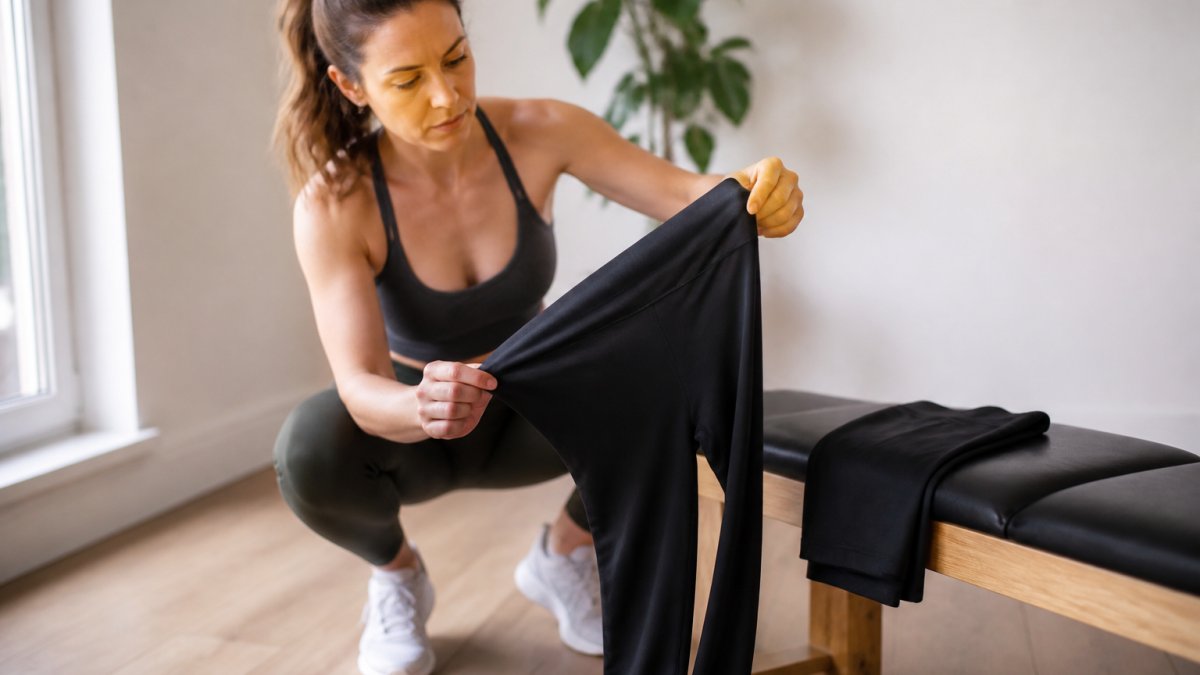
The Stretch and Recovery Test
Stretch recovery is the best predictor of how a legging will look after six months. Pull the fabric across the thigh, hold, release, and watch how fast it returns.
Four-way stretch, which stretches in both directions, gives better range of motion than two-way. Elastane drives recovery, and most performance leggings sit between 18% and 25% elastane; below that, fabric loses its snap quickly.
The Light Test for Squat-Proof Opacity
Hold the leggings to a bright window or phone torch. If you can see your hand clearly through the seat and thigh, the fabric is too thin to be reliably squat-proof.
Opacity comes from fabric density, not thickness. A dense knit blocks light better than a loose, heavier fabric, which is why two pairs can weigh the same and behave differently under a squat.
Fabric and Material Composition: What Separates Nylon From Polyester
Nylon outperforms polyester for stretch leggings in most cases, with higher tensile strength and better elastic recovery at the same weight. Polyester costs less and dries faster, which is why budget leggings lean on it. But the fibre name tells you less than the numbers behind it.
The blend matters more than the headline fibre. Nylon and elastane give a smooth, second-skin finish with strong durability; polyester and elastane feel crisper and dry faster but can pill sooner under friction.
Here's how the common blends compare in practice:
| Fabric blend | Feel | Durability | Best for |
|---|---|---|---|
| Nylon and elastane | Smooth, second-skin | High | Strength training, everyday wear |
| Polyester and elastane | Crisp, lightweight | Medium | Running, HIIT |
| Cotton and elastane | Soft, matte | Low | Lounging, light yoga |
| Recycled polyester and elastane | Similar to virgin polyester | Medium to high | Everyday wear, casual training |
The Four Numbers That Actually Predict Quality
Most shoppers stop at the fibre name. These four specifications predict how a pair behaves after fifty washes, and they are worth checking before you buy.
Elastane percentage. Elastane gives leggings their snap-back. Below roughly 18%, fabric creeps and sags at the knees and seat; 18% to 25% is the working range for performance leggings; above 25%, fabric can feel rubbery and lose its matte finish. A 78% nylon, 22% elastane blend sits mid-band, which is why it is common in pairs built to hold their shape.
Denier. Denier measures yarn density. Higher denier means a thicker, denser yarn that blocks light and resists abrasion longer. A 40-denier nylon knit is noticeably more opaque than a 20-denier one at the same weight, because the yarns are packed more tightly.
Filament count. Multifilament yarns, made from many fine strands twisted together, feel softer and drape better than monofilament yarns of the same denier. They also pill less, because fine filaments spread friction across more surface area.
Knit structure. A tight, dense knit blocks light and resists pilling better than a loose, open knit, even at identical fibre content. Run your thumb across the surface: visible individual loops mean an open knit that will likely go sheer under tension; a smooth, closed surface means the structure is doing its job.
Full-Dull Nylon and Why It Matters for Opacity
Full-dull nylon is worth knowing about if you want maximum coverage. Standard nylon has a slight sheen because light passes through the fibre; full-dull nylon uses a delustring agent that scatters light instead, improving opacity without adding weight. Between two similar pairs, test the full-dull one under a bright window first.
Where Cheap Fabric Gives Itself Away
A few tells separate a well-made knit from a budget one, and they show up before you have worn the leggings once:
- Sheen that looks plasticky. A high-gloss finish often signals a high polyester content with a loose knit, which tends to pill and go sheer.
- A thin, papery hand feel. Fabric that feels flimsy between your fingers usually has low denier and an open knit.
- Visible elastane lines. If you can see faint horizontal lines through the fabric, the elastane is exposed rather than wrapped, which means it will degrade faster with washing.
- Loose surface fibres. Run a fingernail lightly across the fabric. If fibres lift immediately, the yarn is loosely spun and will pill under friction.
Fit, Sizing, Waistband Design and Squat-Proof Coverage
Fit problems in leggings almost always trace back to the waistband, not the leg. A band that rolls, digs, or slides is the number one complaint we hear, and usually means the band is too narrow or the fabric has too little recovery.
High-waisted designs cover more of the torso and distribute pressure better than mid-rise. Look for a wide, contoured waistband with a shaped back panel that follows the curve of the lower back instead of cutting straight across it.
Sizing catches most shoppers out. A pair that feels tight in the shop may relax after a few wears, while a comfortable pair may stretch out and lose support. Between sizes, size down for compression-led training and up for comfort-led everyday wear.
GrantB Sculpt Leggings use a supportive high waistband designed to stay in place during movement, with a sculpting fit that follows your natural shape rather than squeezing it. The full-length cut gives coverage through the leg, and four-way stretch keeps the fabric moving with you rather than against you. At £34.99, they sit well below most premium activewear, and the 78% nylon, 22% elastane blend is the composition we'd choose for a pair built to last.

Comfort, Compression and Shaping: Three Different Things
Comfort, compression, and shaping are not the same thing, and confusing them leads to buying the wrong pair. Comfort is how the fabric feels against your skin and whether it restricts movement. Compression is graduated pressure that supports muscles and improves blood flow. Shaping is a visual effect created by paneling and fabric tension.
A legging can deliver all three, but they pull in different directions. Heavy compression feels supportive during lifting and restrictive during Pilates. Strong shaping can look flattering in a mirror and feel uncomfortable after an hour of wear. Comfort-first leggings move freely but offer less muscle support.
Work out which one you need before you buy. Lifting heavy means compression matters; Pilates or yoga means comfort and freedom matter more; one pair for gym and office means shaping with moderate compression.
Best Leggings for Pilates, Running, HIIT and Everyday Wear
The best leggings for Pilates are high-stretch, low-compression pairs that allow deep ranges without restriction. Running calls for moisture-wicking fabric and a secure waistband. HIIT needs opacity and recovery above all. Everyday wear rewards a sculpting fit that works outside the gym.
| Activity | What matters most | Fabric priority | Waistband priority |
|---|---|---|---|
| Pilates | Stretch and freedom | High elastane, soft hand feel | Low-profile, non-digging |
| Running | Moisture management | Quick-drying, lightweight | Secure, no bounce |
| HIIT | Opacity and recovery | Dense, squat-proof knit | Wide, locked-in band |
| Everyday wear | Shaping and style | Smooth, matte finish | Contoured, high-rise |
For Pilates, choose fabric that moves with you rather than holding you in. For running, moisture-wicking and quick-drying matter more than compression. For HIIT, the priority is a dense fabric that stays opaque deep in a squat.
For everyday wear, the calculus shifts again. A pair that looks good with trainers and an oversized top, and doesn't scream gym, earns its place. GrantB Flare Leggings take the bootleg approach, with a flared silhouette that elongates the leg and works with a jumper or a sports bra. Same fabric composition, different cut, £34.99.

How We Assess Leggings for Each Activity
Recommendations are only useful if the method behind them is repeatable. Here is the framework we use, which you can run yourself before you buy.
Opacity under tension. Stretch the fabric over your hand against a bright window or phone torch, checking the seat and thigh where fabric stretches most under load.
Stretch recovery. Pull the fabric across the thigh, hold five seconds, release, and watch how fast it returns. Immediate spring-back means good elastic memory; slow creep or staying stretched means sagging at the knees and seat within weeks.
Pilling resistance. Rub the fabric against itself or a coarse surface such as a canvas bag strap for thirty seconds, then inspect under good light. Loose surface fibres ball up quickly; a tightly spun multifilament yarn shows little change.
Seam strength. Run your thumb along the inside of a seam. Flatlock stitching sits flat against the skin, resists chafing and holds up to washing; overlocked seams with loose threads are a warning sign.
Waistband grip. Put the leggings on and squat, hinge and twist. A band that rolls, digs or slides is usually too narrow or the fabric has too little recovery.
Wash-and-wear check. The most useful test is the one most guides skip. Wash cold, air dry, and repeat five times, then re-check opacity, recovery and pilling.
Comfort, Compression and Shaping: Which One Do You Actually Need?
Comfort, compression and shaping are not the same thing, and confusing them leads to buying the wrong pair. Comfort is about how the fabric feels against your skin and whether it restricts movement. Compression is graduated pressure that supports muscles and improves blood flow during training. Shaping is a visual effect created by paneling and fabric tension.
A legging can deliver all three, but they pull in different directions. Heavy compression feels supportive during lifting and restrictive during Pilates. Strong shaping can look flattering in a mirror and feel uncomfortable after an hour of wear. Comfort-first leggings move freely but offer less muscle support.
Use this decision guide before you buy:
- If you lift heavy or run long distances, prioritise compression. Look for graduated pressure through the thigh and calf, and a wide waistband that stays locked in.
- If you do Pilates, yoga or barre, prioritise comfort. Look for high elastane, a soft hand feel, and a low-profile waistband that does not dig when you fold forward.
- If you want one pair for the gym and the office, prioritise shaping with moderate compression. Look for contoured paneling and a matte finish that reads as everyday wear.
- If you dislike the feeling of being held in, choose comfort-first fabric and accept that it will offer less muscle support. That is a valid trade-off, not a compromise.
Fit Beyond Size Ranges
Size charts tell you little about how a pair will actually fit, because two people in the same size can have very different waist-to-hip ratios, torso lengths and inseams. The variables that matter most are waistband roll-down, inseam options, and how the fabric performs across body shapes.
Waistband roll-down is the most common fit complaint. It usually means the band is too narrow for the load it carries, or the fabric has too little recovery.
Inseam options matter more than most shoppers realise. A full-length cut that hits the ankle on one person can bunch at the calf on another. For a petite fit, look for an inseam between 63.5 cm and 68.5 cm. For a tall fit, 73.5 cm or more.
Petite and tall fits are not just shorter or longer versions of the same pattern.
Performance across body shapes comes down to four-way rather than two-way stretch. Four-way stretch moves with you through the hip and thigh, reducing the pull that causes sheerness and waistband roll-down.
If you want one purchase that covers gym and casual wear, a coordinated set removes the guesswork. The GrantB Sculpt Set pairs a supportive sports bra with leggings that include functional pockets, at £59.99.
Recycled Polyester Leggings Durability: What the Fibre Actually Does
Recycled polyester leggings can be just as durable as virgin polyester, because the recycled fibre is chemically identical. Durability comes from how the yarn is spun and knitted, not from whether the source was a bottle or a petrochemical.
Most guides get this wrong, treating recycled content as a quality downgrade when it's really a sourcing difference. A well-made recycled polyester blend will outlast a poorly made virgin polyester pair every time.
What affects longevity is the elastane. Recycled polyester handles abrasion well, but elastane degrades first and faster with heat. High-temperature washing and tumble drying are the two fastest ways to kill a pair of leggings, recycled or not.
If sustainability is a factor, recycled content is a reasonable choice as long as the rest of the construction holds up. Check elastane percentage and seam quality before sustainability credentials.
How to Wash Gym Leggings So They Last Longer
Wash gym leggings inside out in cold water on a gentle cycle, skip fabric softener, and air dry. Those three habits do more for longevity than any detergent on the shelf.
Heat is the enemy. Elastane breaks down with hot water and tumble drying, which is why expensive leggings can fall apart in months if washed carelessly. Cold water preserves stretch; air drying preserves shape.
A few practical rules:
- Turn leggings inside out before washing to protect the outer surface from pilling
- Use a mesh laundry bag if you're washing them with anything that has zips or hooks
- Skip fabric softener, which coats the fibres and reduces moisture-wicking performance
- Avoid biological detergents if you have sensitive skin, since residue sits against the skin during workouts
- Wash after every one or two wears, not every wear, to reduce unnecessary fibre stress
- Air dry flat or hang, away from direct heat
Sweat left in fabric breaks down fibres, so don't leave damp leggings in a gym bag overnight. A quick rinse and hang beats a delayed wash.
Cost Per Wear: The Value Question Behind Every Pair
Cost per wear is the price divided by the number of times you actually wear them. A £35 pair worn twice a week for two years costs about 34p per wear; a £15 pair that loses its shape after three months costs far more.
That calculation changes the value conversation. Cheap leggings aren't cheap if you replace them three times a year; expensive leggings aren't expensive if they last four years and still look good.
Here's how to work out your own number:
- Note the price you paid
- Estimate wears per week
- Multiply by 52 for a year, then by the number of years you expect the pair to last
- Divide price by total wears
A pair at £34.99 worn twice a week for two years comes out at roughly 34p per wear. A pair at £15 worn twice a week for three months comes out at roughly 58p per wear, and you'll buy four in the same period.
The other half of the equation is performance while you own them. A pair that stays opaque, holds its waistband, and doesn't pill is worth more per wear than one needing constant adjusting. GrantB Sportswear prices its leggings at £34.99, with free delivery and £10 off orders over £100, which brings the cost-per-wear maths firmly in your favour if you're replacing cheap pairs every few months.
The hard part isn't finding leggings that look good in the mirror. It's finding a pair that still looks good after a year of cold washes, heavy squats, and long days.
Frequently Asked Questions
Which brand of gym leggings is best?
There is no single best brand, only the best match for how you train. Judge any pair on four things: fabric composition, stretch recovery, waistband stability and opacity when stretched. A 78% nylon, 22% elastane blend such as the GrantB Sculpt Leggings (£34.99) gives four-way stretch with a dense, non-see-through finish, which suits lifting, cardio and yoga. If a pair passes the stretch and light checks, the brand label matters far less than the construction.
What are the best leggings for reformer Pilates?
Reformer work involves lying on your back with legs in straps, so you want a smooth, seam-light surface that will not catch or twist, plus a waistband that stays flat when you roll down. A high-waisted, full-length pair with four-way stretch works well, and the GrantB Sculpt Leggings (£34.99) are built with a supportive waistband and a second-skin finish. Avoid heavy compression for Pilates because it restricts the deep hip and spine movement the reformer asks for.
Are recycled polyester leggings durable?
Recycled polyester is chemically the same fibre as virgin polyester, so it resists pilling and holds colour about as well. The catch is stretch: polyester has limited natural give, so it needs a high elastane content to move with you, and that elastane is what wears out first. A recycled pair with 20% or more elastane and a dense knit will outlast a thin one. Wash cool and air dry to slow elastane fatigue.
How should leggings fit for exercise?
They should feel firm but not restrictive at the waist, with no rolling or digging when you bend, squat or hinge. Check that the crotch gusset sits flush, the hem does not ride up your calf, and you can pull the waistband up without it snapping back down. If you are between sizes, size up for strength training and stay true to size for yoga, where a closer fit keeps fabric from bunching during twists.
How do you wash leggings so they last?
Turn them inside out, wash at 30°C on a gentle cycle with a small amount of non-biological detergent, and skip fabric conditioner because it coats the fibres and reduces moisture-wicking. Never tumble dry: heat breaks down elastane faster than anything else. Air dry flat or on a line, away from direct radiators. Done this way, a well-made pair should keep its shape and opacity through a year of regular training.