

High-Support Sports Bras UK: Honest Reviews for Long Workouts
Table of Contents
- High Support Sports Bras UK: What Honest Reviews Actually Reveal
- Quick Comparison: Support, Fabric and Price
- High-Impact Sports Bra Features That Stop Bounce and Friction
- Sports Bra Fitting Guide: Band Size, Cup Size and the Fit Test
- How to Prevent Sports Bra Chafing During Long Workouts
- Sports Bras for Running, Marathon Training and High-Intensity Sessions
- Full-Bust and Heavy Breasts: What Changes at a Larger Cup Size
- Post-Workout Recovery: Treating Skin Irritation Before It Settles In
- How Long Do They Last? Durability Testing and Care
- Frequently Asked Questions
Last Updated: September 10, 2026
High Support Sports Bras UK: What Honest Reviews Actually Reveal
Most reviews of high support sports bras UK shoppers rely on stop at "it fits well and looks nice." That tells you almost nothing about kilometre eight of a long run, when friction and bounce decide whether a bra earns its place in your drawer. Most shoppers complain that the bra felt fine in the changing room, then rubbed a raw line along the ribcage by the halfway point.
This guide takes a different approach. Instead of a generic ranking, it examines the mechanics behind chafing, the construction features that prevent it, and how to match a bra to your body and training. Below, we break down support levels, fitting, anti-chafing pairings, and durability so you can choose with confidence.
The honest answer to whether a high-support bra can stay comfortable over long distances is yes, but only when band tension, seam placement and fabric all work together.
Quick Comparison: Support, Fabric and Price
The table below summarises how GrantB Sportswear's core pieces compare on support, fabric and cost, so you can match a product to your training before reading the detail.
| Product | Support Level | Fabric | Price | Best For |
|---|---|---|---|---|
| GrantB Core Sports Bra | High | 78% nylon, 22% elastane | £59.00 | Running, HIIT, heavy lifting |
| GrantB Sculpt Set | High | 78% nylon, 22% elastane | £119.00 | Gym sessions plus everyday wear |
| GrantB Performance Set | Medium to high | 78% nylon, 22% elastane | £139.00 | Studio to street layering |
| GrantB Core Shorts Set | High | 78% nylon, 22% elastane | £98.00 | Cardio, strength, yoga |
Every piece in the range uses the same four-way stretch composition, which matters more than most shoppers realise. A bra that stretches in only two directions will pull against your ribcage as you breathe, and that constant tension is where chafing starts.

High-Impact Sports Bra Features That Stop Bounce and Friction
Bounce reduction comes down to two things: how the bra holds each breast individually, and how firmly the band anchors to your torso. A high-impact sports bra that only compresses everything flat will still let tissue shift sideways during a run.
Encapsulation vs Compression: Which One Suits Your Workout
Encapsulation means each breast sits in its own shaped cup, so movement is controlled in every direction. Compression presses the breasts against the chest wall to limit vertical bounce. Encapsulation suits running and high-intensity intervals; compression works better for yoga and lower-impact training. Many bras now combine both, using moulded cups inside a compressive outer layer.
Seam-Free, Laser-Cut and Moisture-Wicking Construction
Seams are where friction begins. A seam running across the ribcage or under the arm will rub with every stride, and once sweat softens the skin, irritation follows quickly. Laser-cut edges and bonded construction remove that risk entirely. Look for moisture-wicking fabric too, because dry skin resists friction far better than damp skin.
Sports Bra Fitting Guide: Band Size, Cup Size and the Fit Test
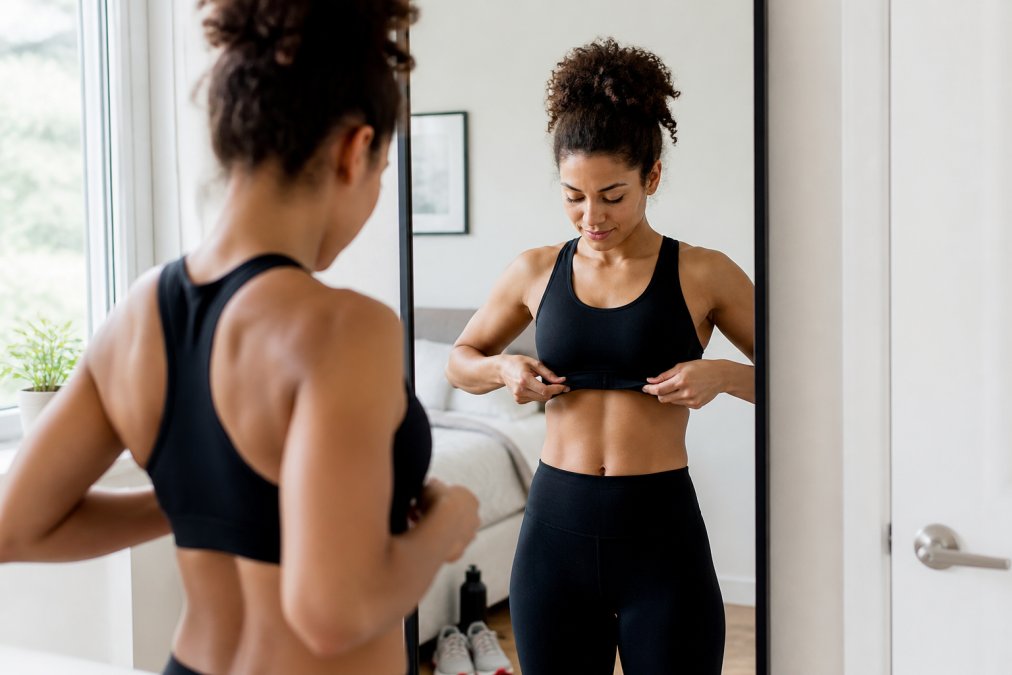
The band does roughly 80% of the support work in any sports bra (peer-reviewed research). If the band is too loose, the straps take over, dig into your shoulders, and the bra rides up during movement. If it's too tight, you'll feel restricted breathing on longer efforts.
Start by measuring your underbust snugly for band size, then measure across the fullest part of your bust for cup size. In practice, many women find they need a smaller band and larger cup than their everyday bra.
- The band sits level all the way around, not riding up at the back
- You can fit two fingers under the band, no more
- Straps stay put without leaving deep grooves
- The centre front sits flat against your sternum
- No gaping at the top of the cup when you lean forward
- You can take a deep breath without the band digging in
Anatomical Fit for Different Body Types
Shallow ribcages suit bras with a wider band and closer-set straps. Broader shoulders often need straps set further apart to avoid cutting into the neck. A short torso can make longline bands feel restrictive, while a longer torso may need a bra with a taller underband to stop it shifting. This is the part most fitting guides skip, and it's usually the reason a bra that works for a friend fails for you.
How to Prevent Sports Bra Chafing During Long Workouts
Chafing is friction plus moisture plus time. Remove any one of those three and the irritation usually stops. That's why anti-chafing strategy is less about buying a special bra and more about how you layer and prepare.
Apply a barrier balm or anti-chafing stick to the ribcage, underarm and shoulder line before you dress. Wear a seam-free bra with laser-cut edges so there's nothing to rub. Keep the fabric dry by choosing moisture-wicking material, and if you're going beyond an hour, consider a thin base layer under the bra band.
Anti-Chafing Product Pairings That Work Together
Pair a balm with a seam-free bra, not with a cotton one. Cotton holds sweat against the skin, which defeats the balm within minutes. If you prefer powder, use it only for shorter sessions, because it clumps once you sweat heavily. For long-distance runners, a light petroleum-free barrier plus a laser-cut bra is the combination that holds up best.
Sports Bras for Running, Marathon Training and High-Intensity Sessions
Marathon training exposes every weakness in a bra. Over hundreds of kilometres, small design flaws become blisters and raw patches. Runners generally need encapsulation cups, adjustable straps and a band that stays level even as you fatigue and your posture shifts.
For high-intensity intervals and heavy compound lifts, the priority shifts slightly. You want a bra that locks movement without restricting your ribcage expansion, because you'll be breathing hard between sets. Adjustable straps matter here, since you can tighten them for lifting and loosen them for warm-ups.
The GrantB Core Sports Bra was built around this exact problem: engineered underwire for individual cup support, adjustable straps, and a 78% nylon, 22% elastane fabric that wicks moisture and dries quickly. It's high support without the rigid feel that puts people off underwired sports bras.

Full-Bust and Heavy Breasts: What Changes at a Larger Cup Size
At a larger cup size, compression alone stops working. Pressing a full bust flat creates skin-on-skin contact underneath, which is a direct route to chafing. Encapsulation becomes essential, and so does a wider band to distribute the load.
Full-bust bras also need more structure in the cup itself. Moulded or seamed cups hold their shape and separate the breasts, while wireless compressive styles tend to let them sit together. If you're above a DD, prioritise encapsulation, a broad underband, and straps that are wide enough not to cut in.
Post-Workout Recovery: Treating Skin Irritation Before It Settles In
Shower as soon as you can after training. Salt and sweat left on irritated skin will keep stinging and slow the healing. Rinse with cool water, pat dry rather than rubbing, and let the area breathe before you dress again.
For mild redness, a fragrance-free barrier cream helps. If the skin has broken, keep it clean and covered, and give it a few days away from the bra that caused it. Most chafing settles within two to four days once the friction stops (the NHS). If irritation persists or looks infected, speak to a pharmacist or GP rather than pushing through.
How Long Do They Last? Durability Testing and Care
Most sports bra reviews are written after a single wear. That tells you how a bra performs on day one, not on wash fifty. Durability is where the honest reviews separate from the marketing copy, because a high-support bra that loses its band tension after three months is not high support at all, it's a medium-support bra with a high-support price tag.
What Actually Fails First
Elastane is the component that gives a sports bra its support, and it's also the first thing to degrade. The order of failure is fairly consistent:
- The underband loses recovery. It stops snapping back to its original length and starts riding up at the back. This is the single biggest cause of a bra being retired.
- The straps stretch out. They need constant re-tightening, and the adjusters start to slip under load.
- The cups crease and gap. Moulded cups lose their shape, and encapsulation stops working because the cup no longer holds the breast individually.
- The seams and bonded edges lift. This is the point where a bra that was seam-free starts to chafe, because a lifted edge becomes a friction point.
How to Test Durability Yourself
You don't need a lab. A simple home protocol gives you a realistic picture:
- The band recovery test. Lay the bra flat, measure the unstretched underband, then stretch it gently and release. A band that doesn't return to within roughly a centimetre of its original length has lost meaningful recovery.
- The wash-count log. Note the date you first wear a bra and roughly how many washes it has had. A well-made high-support bra typically holds its shape for somewhere between 6 and 12 months of regular training, but that range shrinks fast if you wear the same bra every session (peer-reviewed research).
- The bounce check. After a few months, do a short run or a set of star jumps in front of a mirror. If you can see movement you couldn't see when it was new, the support has gone even if the bra still looks fine.
Care That Actually Extends Lifespan
Heat and agitation are what kill elastane. The practical rules:
- Wash on a cool cycle (30°C or lower), hot water accelerates elastane breakdown.
- Use a mesh laundry bag so the bra doesn't tangle with heavier items and get stretched out of shape.
- Never tumble dry. Air dry flat, away from direct heat.
- Skip fabric softener. It coats the fibres and reduces moisture-wicking performance.
- Rotate between at least two or three bras so each has 24-48 hours to recover its shape between wears. Elastic needs time to return to its resting state.
The Honest Replacement Signal
Replace a bra when the band rides up at the back, the straps need constant tightening, or the cups have started to crease and gap. At that point, no amount of adjusting will bring the support back, and continuing to wear it is how chafing starts, a worn band shifts, and a shifting band rubs.
A Note on Sustainability and Disposal
When a bra reaches the end of its useful life, don't just bin it. Many UK councils accept textiles in kerbside recycling, and several high-street retailers run in-store bra recycling schemes that take worn sports bras. If the bra still has some life left but no longer offers enough support for running, demote it to lower-impact use, yoga, walking, or everyday wear, rather than throwing it out.
Frequently Asked Questions
What is the best sports bra for preventing chafing?
Look for seam-free or laser-cut construction, moisture-wicking performance fabric and a band that sits flat against the ribcage without digging in. Chafing comes from friction plus moisture, so a bra that manages sweat and has no raised seams does most of the work. Adjustable straps and a hook-and-eye closure let you fine-tune band tension so nothing rubs during long-distance sessions. The GrantB Core Sports Bra uses this approach with engineered underwire and removable pads.
How do I know if a high support sports bra actually fits properly?
Run a simple fit test: the band should sit level all the way around and stay put when you raise your arms, while the cups lie flat with no gaping or spillage. You should be able to slide two fingers under the band, no more. Jump in place for 30 seconds. If the bra shifts, rides up or the straps dig into your shoulders, the band size is wrong, not the cup. Re-measure before you return it.
Do seamless sports bras actually prevent chafing?
Seam-free construction removes the raised edges that rub against skin, so it reduces one major cause of chafing. It does not eliminate friction entirely. Fabric still moves against skin, especially when wet. Pair a seam-free bra with a sweat-wicking layer and apply an anti-chafing balm to high-friction zones like the underband and shoulder line before long workouts. That combination handles both the seam problem and the moisture problem.
How do I prevent chafing from sports bras during long workouts?
Start with fit: a band that is too loose slides, and a band that is too tight digs in. Both cause friction. Choose moisture-wicking fabric over cotton, apply anti-chafing balm or cream to the underband and strap areas before you start, and reapply on runs longer than 90 minutes. Wash your bra after every session, since dried salt crystals on fabric act like sandpaper. If irritation appears, treat it with a fragrance-free barrier cream before it breaks the skin.